As an Amazon Associate, we earn from qualifying purchases.
At a Glance
- EDITOR'S PICK: Shoulder Pulley Over-Door System
- AMAZON'S CHOICE: Shoulder Pulley System (Amazon’s Choice)
- MOST REVIEWED: Vive Shoulder Pulley for Physical Therapy
- PT CLINIC CLASSIC: Lifeline Deluxe Shoulder Pulley
- BEST UPGRADE: Shoulder Pulley with Fixed Metal Bracket
| Product | Price as of Sep 10, 2026, 7:26 PM UTC | Rating |
|---|---|---|
| Shoulder Pulley Over-Door System | $9.89 | 4.6★ |
| Shoulder Pulley System (Amazon’s Choice) | $9.99 | 4.6★ |
| Vive Shoulder Pulley for Physical Therapy | $14.99 | 4.5★ |
| Lifeline Deluxe Shoulder Pulley | $11.99 | 4.5★ |
| Shoulder Pulley with Fixed Metal Bracket | $26.99 | 4.4★ |
A shoulder pulley is a simple over-the-door system — a nylon rope, two handles, and a door anchor — that uses your good arm to pull your injured arm through its full range of motion. Used in physical therapy clinics for decades, it’s the cheapest tool for restoring shoulder mobility after surgery, treating frozen shoulder (adhesive capsulitis), recovering from rotator cuff injuries, or just undoing the overhead-reach loss that comes from spending 8 hours a day with your arms at keyboard height. Most quality pulleys cost $10–$15. The best-selling option on Amazon is under $10 with 6,600+ reviews.
This guide compares the 5 best shoulder pulleys for 2026 — ranked on door-anchor design, handle quality, rope length, brand authority, and price. Includes the volume leader at $9.89, the iconic Vive pulley with 20,700+ reviews, and a metal-bracket upgrade pick.
Video by Physical Therapy 101 on YouTube — the most-viewed shoulder pulley exercise demo on YouTube (290,000+ views). Watch the original for the full technique walkthrough.
What Does a Shoulder Pulley Do (and Who Needs One)?
A shoulder pulley uses your healthy arm to passively assist the injured arm through ranges it can’t reach actively. You sit or stand under the pulley, hold one handle in each hand, and pull down with the good arm — that movement lifts the injured arm overhead via the rope. The result: you can reach degrees of flexion and abduction that the injured shoulder would refuse to do on its own.
The three highest-leverage use cases:
- Frozen shoulder (adhesive capsulitis): The capsule has tightened to the point where your shoulder won’t lift past a certain angle. Pulley work, 2–3x daily, is the most cited home protocol for breaking through the freezing and frozen stages.
- Post-surgery recovery (rotator cuff, labrum, replacement): Standard PT prescription for early-stage range-of-motion work when the muscles can’t lift the arm yet but the joint needs to move.
- Desk-worker shoulder stiffness: 8 hours a day with elbows below shoulder height progressively shortens the overhead reach. Most desk workers don’t notice until they try to put something on a high shelf and realize their arm won’t go straight up anymore. A 5-minute daily pulley routine reverses this without going to PT.
What to Look for in a Shoulder Pulley
- Door anchor type. Most pulleys use a soft strap that goes over the top of a door — the door closes on it and holds the rope in place. A few premium models use a fixed metal bracket that mounts permanently. Strap is easier; bracket is more stable for daily use.
- Handle quality. Plastic handles are standard and fine. Foam-padded handles cost a few dollars more and matter if you have arthritic hands or grip pain.
- Rope length. Standard rope is ~7 feet. That covers virtually all door heights (most US doors are 80” / 6′8”). Don’t pay extra for “extra long” unless you have specific reason.
- Brand reputation. Vive and Lifeline are the two brands physical therapy clinics actually use. Generic brands are functionally identical but lack the warranty + customer support if you have a quality issue.
Best Shoulder Pulleys at a Glance
- Editor’s Pick / Best Value: Shoulder Pulley (Over-Door) — $9.89, 4.6☆ across 6,600 reviews, 8,000 bought per month (volume leader)
- Amazon’s Choice: Shoulder Pulley System (Amazon’s Choice) — $9.99, 4.6☆ across 1,200 reviews
- Most Reviewed / Trusted Brand: Vive Shoulder Pulley — $14.99, 4.5☆ across 20,700 reviews (the brand PT clinics actually use)
- PT Clinic Classic: Lifeline Deluxe Shoulder Pulley — $11.99, 4.5☆ across 4,100 reviews
- Best Upgrade / Fixed Metal Bracket: Shoulder Pulley with Metal Bracket — $26.59, 4.4☆ rating, permanent door mount
Detailed Reviews
1. Shoulder Pulley Over-Door System
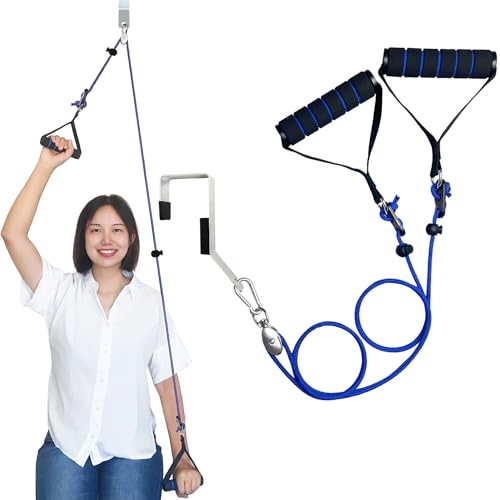
Why it’s #1: For most desk workers and post-injury home users, the difference between a $10 pulley and a $15 pulley is brand recognition, not function. This is the volume leader: 8,000 bought per month tells you the build is durable enough that 8,000 people a month are committing $10 to it without a brand name they recognize. At under $10 with 6,600 reviews, it’s the lowest-risk, lowest-cost entry into shoulder pulley work.
- $9.89 — you can’t get cheaper without giving up review validation
- 8,000 bought per month is the strongest single trust signal in this category — the build holds up
- 6,600 reviews at 4.6☆ matches the Amazon’s Choice pick at $0.10 less
- Standard design works on every interior door
- Plastic handles are functional but rough on arthritic hands (Vive’s padded handles are a real upgrade if you have hand pain)
- No brand support if you ever have a quality issue — generic seller
2. Shoulder Pulley System (Amazon’s Choice)

Why it’s here: Functionally indistinguishable from the Editor’s Pick. The Amazon’s Choice badge is what gets it ranked when buyers search generic terms — some buyers trust that algorithmic blessing over raw review count. It is the closest like-for-like alternative to the Editor’s Pick at the same price.
- Amazon’s Choice badge is what shows up when buyers don’t specify a brand — default trust signal
- 4.6☆ rating matches the Editor’s Pick exactly
- Identical pricing to the volume leader
- 1,200 reviews vs the Editor’s Pick’s 6,600 — less validation despite the badge
- 900 bought per month vs Editor’s Pick’s 8,000 — lower volume signal
3. Vive Shoulder Pulley for Physical Therapy

Why it’s here: If you want the most-trusted brand and don’t mind paying $5 extra, Vive is the right pick. 20,700 reviews is the strongest possible validation of build quality, the foam handles are a real upgrade for post-surgical or arthritic users, and Vive is the brand many PT clinics give patients to take home. Worth the small premium for the warranty alone.
- 20,700 reviews is unmatched social proof — if it had a serious design flaw, it would have surfaced 15,000 reviews ago
- Foam handles genuinely matter for arthritis, post-surgical patients, or anyone with hand sensitivity
- Vive customer support actually responds — useful if you ever need a replacement under warranty
- $5 premium over Editor’s Pick is small in absolute dollars
- $5 more than the generic Editor’s Pick for what is functionally a very similar product
- Rating (4.5☆) is slightly lower than the Editor’s Pick (4.6☆) — volume of reviews drives small drift
4. Lifeline Deluxe Shoulder Pulley
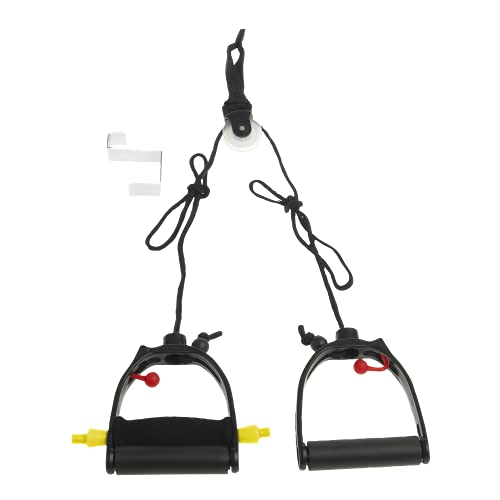
Why it’s here: The pick for users who specifically want a name-brand US-made PT-clinic product and don’t care about foam handles. FSA / HSA eligibility is the practical advantage — if you pay with a health spending account, this is the cheapest of the brand-name picks after pre-tax savings.
- FSA / HSA eligibility brings the effective cost below $10 if you pay with pre-tax dollars
- Lifeline brand has the longest track record in this category — the original PT-clinic pulley
- $11.99 splits the difference between the $10 generic and $15 Vive
- Plain plastic handles — no foam padding like the Vive
- 4,100 reviews is solid but a fifth of the Vive’s 20,700
5. Shoulder Pulley with Fixed Metal Bracket

Why it’s here: Best pick for users committed to long-term daily pulley work who own their home and want a fixed anchor. The metal bracket solves the most common complaint about strap-based pulleys (the strap walks during hard pulls) and the permanent mount saves the 90 seconds of setup every session. Skip this if you rent or only use the pulley occasionally.
- Metal bracket eliminates the #1 complaint with strap pulleys: the strap shifting when you pull hard
- Permanent mount means you don’t set up and break down each session — better for daily use
- Foam handles included at this price tier
- The right pick for users doing multiple daily sessions long-term
- Requires drilling into the door frame — not landlord-friendly
- $26.59 vs $9.89 for the Editor’s Pick — you’re paying for the mount
- Only 75 reviews — less validation than the strap-based picks above
How to Use a Shoulder Pulley (Step-by-Step)
The mechanics are simple but easy to get wrong. The most common mistakes demonstrated by Dr. Dave Candy, PT are pulling too fast, pulling through pain, and shrugging the working shoulder up to the ear.
- Anchor the pulley. Strap models: open the door, drape the strap over the top, close the door so the strap is secured between the door and frame. Test by tugging firmly — the strap should not pull through.
- Sit or stand directly under the pulley. The rope should hang straight down. Both ends should be at chest height. If you’re too far forward or back, the pull won’t track the natural shoulder path.
- Grip both handles, palms facing in. Keep your injured shoulder relaxed. Pull down with your healthy arm to lift the injured arm.
- Stop at the first point of resistance, not pain. The goal is gentle, sustained range work — not breaking through tight tissue with force. Hold for 5–10 seconds at the top, then let down slowly.
- 10–15 reps, 2–3 sets, 2–3 times per day. Frozen shoulder protocols typically prescribe daily sessions for 4–6 weeks before measurable range gains appear.
For desk workers with no specific injury, 10 reps of forward flexion (arm lifts straight in front) and 10 reps of abduction (arm lifts to the side) once a day is enough to maintain shoulder mobility against keyboard posture.
Who Should Skip Shoulder Pulleys
A pulley is cheap and low-risk, but it’s not the right tool for everyone:
- Anyone in the acute, painful phase of an injury or right after surgery without clearance: Passive range work too early can aggravate a healing repair. Follow your surgeon or PT’s timeline first — the pulley belongs in the range-of-motion phase, not the protection phase.
- People whose limitation is strength or rotator-cuff weakness, not stiffness: A pulley restores passive reach; it does almost nothing for strength. If you can already lift your arm overhead but it’s weak or unstable, resistance bands or light dumbbells are the better buy.
- Renters and anyone without a suitable door: Strap models need a standard door that closes; the metal-bracket upgrade needs drilling. If you have only sliding doors, pocket doors, or open archways — or can’t drill — a free-standing pulley frame or wall-anchored PT strap fits your space better.
Honest Limitations of This Guide
A few things we can’t claim with the precision the spec sheets imply:
- The recovery timelines are general, not guaranteed: The “4–6 weeks to noticeable range” figures reflect common physical-therapy protocols, not a controlled trial of these specific products. Frozen shoulder in particular resolves on its own schedule, and a pulley assists that process rather than setting the clock.
- Our ranking leans on Amazon signals, not lab durability testing: Review counts, “bought per month,” and price are strong proxies for build quality in a simple product like this, but we didn’t stress-test the rope, wheel, or strap ourselves over months of use.
- The difference between picks is small and largely non-functional: The $9.89 generic and the $14.99 Vive move your arm the same way. The premium buys foam handles, a warranty, and brand support — real for some users, irrelevant for others — not measurably better rehab.
How We Picked These
We verified each product’s live ASIN, current price, star rating, and review count on Amazon, then compared door-anchor type (strap vs. fixed bracket), handle material (plastic vs. foam), rope length, and brand track record in clinical settings. We weighted proven demand — review volume and monthly sales — heavily, because in a mechanically simple $10–$27 product those signals are the most honest indicator that the build holds up over daily use.
We did not disassemble or long-term stress-test the units ourselves, and we’re upfront that the top pick is a generic seller with no warranty. Where hand comfort, warranty, or FSA/HSA eligibility matters more than saving a few dollars, we said so in the individual picks rather than forcing a single “best for everyone” answer.
Frequently Asked Questions
Are shoulder pulleys good for frozen shoulder?
Yes — they’re one of the most-prescribed home tools for frozen shoulder (adhesive capsulitis). The pulley lets you use your good arm to passively assist the frozen arm through ranges it won’t do actively, which is exactly the stimulus the joint capsule needs to remodel. Most physical therapists prescribe 10–15 reps, 2–3 sets, 2–3 times per day. Expect 4–6 weeks before noticeable range improvements.
How long until a shoulder pulley starts working?
For post-surgery range-of-motion work, most users feel small daily improvements within the first 1–2 weeks. For frozen shoulder, the “freezing” and “frozen” phases can take 6–12 weeks of consistent pulley work to break through. For desk workers doing maintenance, mobility improvements show up in 2–3 weeks of daily use.
Can you do shoulder pulley exercises every day?
Yes — in fact, daily is the standard protocol. Unlike strength training, pulley work is low-load mobility and doesn’t require recovery days. The risk is pulling too aggressively (through pain) rather than too frequently. Stop at the first point of resistance, not pain, and the daily schedule is safe.
Shoulder pulley vs wand exercises — what’s the difference?
A wand (broomstick or dowel) lets the good arm push the bad arm into elevation horizontally and laterally, but can’t reach the same overhead range as a pulley. The pulley specifically targets flexion past 90° (arm overhead) and abduction (arm out to the side and up) — the two ranges desk workers and frozen shoulder patients lose first.
Will a shoulder pulley fit on any door?
Strap-based pulleys (the Editor’s Pick, Amazon’s Choice, Vive, and Lifeline) work on any standard interior door — you drape the strap over the top and the door closes on it. They don’t work on doors that don’t close (open archways), pocket doors, or sliding doors. The metal-bracket model requires drilling into the door frame.
Is the Vive shoulder pulley worth $5 more than the generic?
If you have any hand sensitivity (arthritis, post-surgical wrist work, general grip pain), yes — the foam-padded handles are a real upgrade and the warranty is rare in this category. If you have healthy hands and just want a working pulley, the $9.89 Editor’s Pick is functionally identical.
Does the cheap shoulder pulley really hold up?
The $9.89 Editor’s Pick has 8,000 bought per month and 6,600 reviews at 4.6☆. If 8,000 people per month are buying a $10 product and the average rating is 4.6☆, the build holds up. Some users report needing to re-tie the door strap after 6–12 months of daily use, but the rope and pulley wheel itself last for years.
Final Thoughts
For most desk workers, post-surgery patients, and people managing frozen shoulder, the $9.89 Editor’s Pick is the right call. 8,000 bought per month is the strongest single trust signal in this category — the build has been validated by tens of thousands of daily users at the lowest price in the category.
If you want the most-reviewed brand and foam-padded handles, the Vive Shoulder Pulley at $14.99 with 20,700+ reviews is the small-premium safe pick. If you want a permanent mounted bracket for long-term daily use, the metal-bracket model at $26.59 eliminates the door-strap shifting issue.
Pair the pulley with our steel mace guide for rotational shoulder mobility and our slant board guide for the ankles. Together they’re the top-to-bottom desk-worker mobility stack: pulley restores overhead reach, mace restores rotation, slant board restores the squat and walking gait.
Last updated: July 01, 2026 at 01:09 PM ET. Prices and availability shown are accurate as of this time and are subject to change. As an Amazon Associate, DeskFitPro earns from qualifying purchases.
Ready to Buy?
Prices checked: Sep 10, 2026, 7:26 PM UTC
Product prices and availability are accurate as of the date/time indicated and are subject to change. Any price and availability information displayed on Amazon.com at the time of purchase will apply to the purchase of this product.
Any prices mentioned in the article text are approximate and for comparison only; the figure shown with each product above is the one checked against Amazon at the time stated.
As an Amazon Associate, DeskFitPro earns from qualifying purchases.
Related Products

Chilipad Cube Bed Cooling System - Cooling & Heating Mattress Topper, Set Individual Bed Temperature, Cool Sleep Enhancement, Temp Range of 60-115°F, ME Half Queen Bedsize (30"W x 80"L), Model: CP500
Check Price →
OMI Full Body PEMF Magnetic Field Therapy Mat
Check Price →