As an Amazon Associate, we earn from qualifying purchases.
At a Glance
- BEST OVERALL: TriggerPoint GRID 1.0 Foam Roller (13")
- BEST VALUE: Amazon Basics High-Density Foam Roller (36")
- BEST FOR STUBBORN TISSUE: TriggerPoint CHARGE VIBE Vibrating Foam Roller
| Roller | Surface | Length | Best for |
|---|---|---|---|
| TriggerPoint GRID 1.0 | Multi-density EVA over hollow core | 13" | Targeted work, travel |
| Amazon Basics High-Density | Single firm density | 36" | Thoracic extension, balance work |
| TriggerPoint CHARGE VIBE | Ridged + 3-speed vibration | 7" x 4" | Stubborn tissue, calves and quads |
Foam rollers are the cheapest useful piece of recovery equipment a desk worker can own, and the category is mostly noise: dozens of near-identical cylinders separated by colour and marketing. What actually differs is surface construction, length, and whether the core holds its shape under load.
Three rollers cover almost every real use case, and they are not substitutes for each other — a 13-inch textured roller and a 36-inch smooth cylinder do genuinely different jobs. This guide explains which does what, how to roll without wasting your time, and where the evidence for foam rolling actually stops.
On the claims you’ll see elsewhere: rolling reliably produces short-term range-of-motion gains and reduces how sore you feel afterwards. The popular explanation — that you are “breaking up adhesions” or reshaping fascia — is not well supported; the more likely mechanism is neural, a change in how much stretch your nervous system tolerates. That distinction matters because it tells you rolling is maintenance, not repair.
Construction Guide: What Actually Differs
Density and construction decide how a roller feels under load. Get it wrong in one direction and you feel nothing; wrong in the other and you avoid using it. The three rollers here sit at genuinely different points:
- Single-density moulded foam (Amazon Basics) — a solid firm cylinder with no texture. It does not compress much under body weight, which is what you want for large, dense muscle — quads, glutes, lats — and for lying along lengthways to open the thoracic spine. The simplest thing here and, for most desk workers, sufficient.
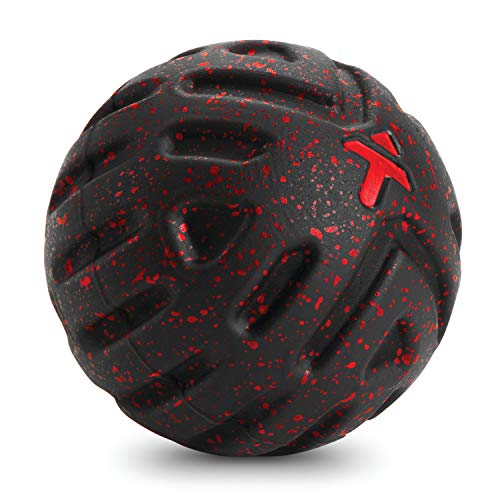
- Foam over a hollow rigid core (TriggerPoint GRID) — EVA foam wrapped around a hollow ABS tube. The core is the point: it keeps the roller firm over time where solid foam gradually packs down. The varied ridge-and-nodule surface means one roller offers several pressure levels depending on which section you use.
- Ridged surface plus vibration (TriggerPoint CHARGE VIBE) — opposing wide and narrow ridges, three vibration frequencies. Vibration makes firm pressure more tolerable, which in practice means you stay on a tight spot longer.
Honest caveat on durability: we have no test data on how long any of these last, and neither does anyone else publishing roller comparisons. Manufacturer warranties are the only verifiable durability signal — TriggerPoint states one year on the CHARGE VIBE. Treat “lasts five years” claims elsewhere, including in our own earlier version of this page, as guesswork.
Detailed Reviews
1. TriggerPoint GRID 1.0 Foam Roller (13")

Why it's here: The GRID is the roller most physical therapists hand you first, and the construction is why: a hollow ABS core wrapped in EVA foam, rather than a solid foam cylinder. That means it stays firm under load instead of compressing flat over a year of use, and the varied ridge-and-nodule surface lets you pick how much pressure you want by changing which part of the roller you sit on. At 13 inches it fits in a carry-on, which is the practical reason most people end up using it rather than the 36-inch one gathering dust.
- Hollow core holds its shape where solid foam rollers compress and go soft
- Multi-density surface lets you dial pressure up or down without buying a second roller
- 13" length fits in luggage and a desk drawer
- The default recommendation in most clinical settings, so technique guidance is easy to find
- 13" is too short to lay along your spine — you'll roll one side at a time
- Firmer than a plain foam roller, which is uncomfortable if you're new to rolling
- Costs more than a plain cylinder that does 80% of the same job
2. Amazon Basics High-Density Foam Roller (36")
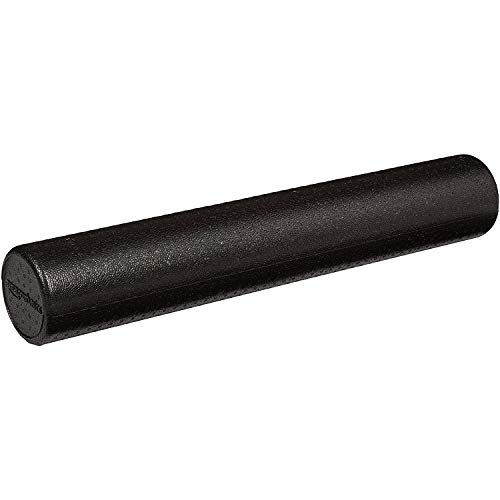
Why it's here: A plain 36 x 6 x 6-inch moulded polypropylene cylinder, and for most desk workers that is genuinely all you need. The full length is the thing the GRID cannot do: lie along it lengthways, spine supported end to end, arms open, and it becomes a thoracic-extension and chest-opening tool rather than just a massage device — which is closer to what eight hours of hunching actually calls for. There is no texture and no gimmick.
- Cheapest way into rolling, and the full 36" length does things shorter rollers can't
- Lengthways spine support makes it a thoracic-mobility tool, not just a massager
- Moulded polypropylene keeps its shape and wipes clean
- Doubles as a balance and core-stability prop
- Single firm density with no textured zones — less targeted than the GRID
- 36 inches is awkward to store and impossible to travel with
3. TriggerPoint CHARGE VIBE Vibrating Foam Roller
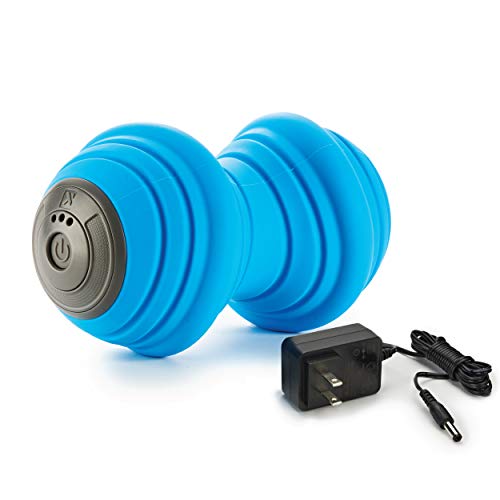
Why it's here: Six times the price of the Amazon Basics, and worth considering only for a specific problem: tissue that does not respond to ordinary rolling. The surface pairs opposing ridge shapes — wide ridges to stretch, narrow ridges to compress — with three vibration frequencies. At 7 x 4 inches and two pounds it is built as a targeted tool for calves, quads, adductors and upper back rather than a general-purpose roller, and it will not do the lie-along-your-spine work the 36-inch cylinder does.
- Three vibration frequencies plus the opposing-ridge surface give real intensity range
- Compact at 7 x 4 inches and 2 lb — the only powered roller here you'd travel with
- Rechargeable, roughly 2 hours per charge, AC charger included
- One-year manufacturer warranty
- About six times the price of a plain high-density roller
- 7 inches is far too short for spine-length work
- Vibration is a comfort and tolerance aid; we have not seen evidence it changes recovery outcomes versus a plain roller
How to Foam Roll Effectively
Most beginners roll back-and-forth quickly across a sore muscle. That doesn’t work. Effective protocol:
- Place roller under target muscle, support body weight on hands/feet.
- Slowly roll until you find the tightest spot — should feel like 7/10 discomfort, not 10/10 pain.
- STOP at the tight spot for 20–30 seconds. Don’t keep rolling. Sustained pressure releases via neuromuscular reflex.
- Breathe deeply — exhale on the pressure point. Holding breath prevents release.
- After release, slowly roll in 1-inch movements around the released area to spread the effect.
- One muscle area: 1–2 minutes total. Don’t camp on one spot for 5+ minutes — diminishing returns and bruising risk.
Daily Foam Roller Routine for Desk Workers
5-minute routine targeting the most desk-induced tight muscles:
- Thoracic spine (1 min) — Roller across upper back, arms crossed. Slowly extend spine over the roller.
- Glutes (1 min) — Sit on roller, lean to one side. Slowly find the tight spot in each glute.
- IT band / outer thigh (1 min per leg) — Side-lying with roller under outer thigh. Roll from hip to knee.
- Quads (1 min per leg) — Face-down with roller under front of thigh. Slow roll from hip to knee.
- Calves (30 sec per leg) — Sit with roller under calf, opposite leg crossed over for pressure.
Skip the lower back. Foam rolling directly over the lumbar spine can compress discs. Use a Chirp Wheel for spine-specific work instead.
Foam Roller vs Chirp Wheel vs Massage Ball
Three categories of self-myofascial release tools:
- Foam roller (this guide) — Cylindrical, broad muscle coverage. Best for: large muscle groups (quads, IT band, lats), full-body warm-up/cooldown.
- Chirp Wheel — Spine-grooved roller. Best for: thoracic spinal decompression specifically. NOT a substitute for foam roller on legs.
- Massage ball — Small ball, precise targeting. Best for: trigger points, hard-to-reach areas (psoas, suboccipital, pec minor).
Most desk workers benefit from owning all three. Total cost: under $80 for a complete release toolkit.
Foam Roller Length Guide
- 12” / short — Travel-friendly. Limited to one muscle at a time. Best for: travelers, small apartments.
- 18” / standard — Most popular size. Covers most use cases. Best for: general fitness.
- 24” / medium — Wider coverage. Good for upper back work where 18” feels short.
- 36” / full — Covers full upper back in one position. Best for: home use without portability needs.
If unsure, get the 36”. Storage is the only downside, and the longer length is more comfortable for spinal/back work.
How We Picked
Every foam roller on this list meets our criteria:
- Live ASIN and price verification — every product here was confirmed via the Amazon Product Advertising API at last update, with the current price recorded rather than estimated
- In stock and buyable — listings with no active offer were dropped rather than left as broken links. Two rollers that appeared in earlier versions of this guide (OPTP PRO-Roller, LuxFit Speckled) were removed for exactly this reason
- Distinct job — one roller per genuinely different use case, not five variations on a cylinder
- Verifiable specs — dimensions, materials, battery life and warranty taken from the manufacturer listing, not inferred
Who Should Skip Foam Rollers
A foam roller is cheap and broadly useful, but it’s the wrong first purchase for a few specific people:
- Anyone whose main complaint is lower-back pain. A cylindrical roller can’t safely address the lumbar spine — rolling directly over the vertebrae compresses discs. If low-back relief is the goal, a back stretcher or spine-grooved Chirp Wheel is the correct tool, not a foam roller.
- People with an acute injury, strain, or swelling. Foam rolling is a maintenance and mobility tool, not a treatment for a fresh injury. Rolling inflamed or torn tissue can set recovery back — wait until you’re cleared and healed.
- People who want targeted trigger-point work more than broad coverage. If your problem is a stubborn knot in the glute, psoas, or under the shoulder blade, a small massage ball reaches it far better than a wide cylinder ever will. Buy the ball first and add the roller later.
Honest Limitations of This Guide
Foam rolling is genuinely useful, but both the evidence and the basis of this guide have limits we’d rather state plainly:
- The research is mixed-but-modest, not dramatic. Studies generally show foam rolling temporarily improves range of motion and reduces delayed-onset muscle soreness by roughly 10–20% — it does not measurably improve strength, sleep, or the recovery markers that actually drive adaptation. It’s a comfort and mobility aid, not a performance intervention.
- Density is partly subjective. “High” versus “medium” density isn’t a standardized spec across brands, and the right firmness depends on your body weight, pain tolerance, and the muscle you’re targeting. Our density ranking is a starting point, not a guarantee that a given roller will feel right to you.
- Durability figures come from user reports, not a multi-year teardown. The “5+ years for high-density EPP, 1–2 years for standard” estimates are drawn from long-run Amazon review patterns, not from us compressing each roller on a rig. Softer rollers do lose firmness over time, and how fast depends heavily on how much you weigh and how often you use it.
Frequently Asked Questions
How often should I foam roll?
Daily 5-minute sessions are ideal. Some users foam roll before workouts (warm-up) and after (recovery). Skip days if persistent soreness develops.
Does foam rolling actually work?
Research is mixed but lean positive. Studies show foam rolling improves range of motion temporarily and reduces delayed-onset muscle soreness (DOMS) by ~10–20%. Doesn’t directly increase strength or recovery markers like sleep does.
Should I foam roll before or after workouts?
Both work. Pre-workout: light pressure to warm up muscles (30 sec per muscle). Post-workout: deeper pressure to reduce DOMS (60–90 sec per muscle).
Why does foam rolling hurt?
Tight muscle tissue with adhesions/trigger points is tender. Pain should be 6–7/10 (intense but tolerable). 8+/10 means too much pressure — use a softer roller or take more weight off.
Can foam rolling cause injury?
Yes if done wrong. Avoid: rolling over the lower spine, kidneys, neck arteries, joints (knees, elbows). Stick to muscle bellies. Don’t exceed 2 minutes on any single spot.
What’s the difference between high-density and standard foam rollers?
A high-density cylinder like the Amazon Basics stays firm under body weight, so more of the pressure reaches dense muscle. Softer standard-density foam gives under load, which is gentler but does less on large muscle groups. Firmer is not better — it is just more intense, and intensity you avoid using is worth nothing.
Should I get a textured (GRID) or smooth foam roller?
Start smooth. The GRID’s ridges concentrate pressure into smaller areas, which is useful once you know where your problem spots are and unpleasant before that. Most desk workers do fine on a smooth cylinder indefinitely.
How long does a foam roller last?
We don’t know, and we’re not going to invent a number. Solid foam compresses gradually with use; a hollow-core roller like the GRID resists that by design. The only durability figure we can point to is TriggerPoint’s one-year warranty on the CHARGE VIBE. Any guide quoting exact lifespans in years is guessing.
Are vibrating foam rollers worth it?
For most people, no. The CHARGE VIBE costs roughly six times the plain cylinder. Vibration appears to make firm pressure more comfortable to tolerate, which can mean you work a tight area for longer — but we have not seen evidence that it improves recovery outcomes compared with a plain roller. Buy it if ordinary rolling isn’t touching a specific stubborn area, not as a default upgrade.
Can I foam roll my lower back?
No. Rolling directly on lumbar vertebrae can compress discs. Use a back stretcher or Chirp Wheel (spine-grooved) for safer lower-back work.
Final Thoughts
If you are buying one roller and want to stop thinking about it, buy the TriggerPoint GRID at about $29. It is firm without being punishing, the hollow core means it won’t go soft, and 13 inches is short enough that it actually gets used rather than stored.
If you mainly want to undo a day of hunching rather than work on specific sore spots, the Amazon Basics 36-inch at $21.02 is the better buy — lying along it lengthways is something no short roller can do. Check stock before you commit; it was down to a single unit at last verification.
The CHARGE VIBE at $122.99 is a targeted purchase, not an upgrade path. Buy it only if plain rolling has failed on a specific area.
Pair a roller with massage balls for trigger points and a Chirp Wheel for spinal work — a roller is the wrong shape for your lower back.
Last updated: July 01, 2026 at 01:06 PM ET. Prices and availability shown are accurate as of this time and are subject to change. As an Amazon Associate, DeskFitPro earns from qualifying purchases.
Ready to Buy?
We may earn a commission if you buy through these links.
Prices checked: Oct 3, 2026, 8:06 PM UTC
Product prices and availability are accurate as of the date/time indicated and are subject to change. Any price and availability information displayed on Amazon.com at the time of purchase will apply to the purchase of this product.
Any prices mentioned in the article text are approximate and for comparison only; the figure shown with each product above is the one checked against Amazon at the time stated.
As an Amazon Associate, DeskFitPro earns from qualifying purchases.