As an Amazon Associate, we earn from qualifying purchases.
At a Glance
- EDITOR'S PICK: Wooden Slant Board (Amazon’s Choice)
- LISTING NEEDS RECHECK: INFIDEZ 25° Slant Board
- MOST REVIEWED: StrongTek Professional Wooden Slant Board
- BEST BUDGET: 5-Angle Slant Board (Under $20)
- BEST MID-TIER: INFIDEZ 25° Slant Board
| Product | Price as of Sep 10, 2026, 7:26 PM UTC | Rating |
|---|---|---|
| Wooden Slant Board (Amazon’s Choice) | $27.99 | 4.6★ |
| INFIDEZ 25° Slant Board | Check price | 4.9★ |
| StrongTek Professional Wooden Slant Board | $58.89 | 4.8★ |
| 5-Angle Slant Board (Under $20) | $17.99 | 4.6★ |
| INFIDEZ 25° Slant Board | $32.39 | 4.8★ |
A slant board is a wedge-shaped platform (typically wood, set at 15–30°) you stand on to load the calves, ankles, and knees through ranges sitting all day actively shortens. Popularized by Ben Patrick (the Knees Over Toes Guy) as the foundation of his ATG knee-rehab system, it’s become the cheapest single tool a desk worker can buy to restore ankle dorsiflexion, fix locked calves, and bulletproof the knees against the damage of an 8-hour-a-day chair. Most users only need a basic adjustable wooden board around $20–$30. The premium options exist for specific use cases (heavy squat loading, ATG-style 25° fixed angles).
This guide compares the 5 best slant boards on Amazon for 2026 — ranked on angle adjustability, weight capacity, build quality, price, and beginner-friendliness. Includes the Amazon’s Choice option (7,000 bought per month), the StrongTek with 6,000+ reviews, and the budget pick under $20.
Video by The Kneesovertoesguy (Ben Patrick) on YouTube — the original source of the slant board / ATG protocol. 349,000+ views.
Why Desk Workers Need a Slant Board (Not Just Lifters)
Sitting for 8+ hours a day locks the ankle joint in a neutral or plantar-flexed position. Over time, you lose the ability to dorsiflex — pulling your toes toward your shin — which is the foundation of every functional movement: walking with a normal gait, squatting to full depth, climbing stairs without knee pain, even just standing for long periods without your calves cramping.
The slant board solves this in 60 seconds a day. Stand on it heels-down (toes up the incline) to actively stretch the calves and Achilles. Flip it (toes down the incline) and you load the tibialis anterior — the shin muscle that virtually no traditional gym movement targets, but which Ben Patrick has shown is the single biggest predictor of knee health. Standing in a wide squat on a slant board (heels-up) drops you into the deep squat positions sitting has stolen.
It’s the cheapest tool in the “undo sitting damage” toolkit and arguably the most leveraged.
What Angle Should You Get?
Adjustable wooden boards typically offer 5 angles — usually 15°, 20°, 25°, 30°, and 35°. Recommended use:
- 15° – 20°: Daily ankle / calf mobility (the use case most desk workers actually need). Comfortable enough to stand on for 5+ minutes during a meeting.
- 25°: The ATG “Knees Over Toes” standard. Used for slant board squats, tibialis raises, and the “patellar tendon protocol” that’s the cornerstone of Ben Patrick’s system.
- 30° – 35°: Advanced. Painful to hold for more than a minute without prior conditioning. Used by lifters for deeper Achilles stretches and heavier squat loading.
If you’re a desk worker buying your first board, an adjustable model in the $20–$30 range covers every use case. The fixed-angle ATG-branded boards exist for users who only ever do 25° work and want a more stable, single-purpose tool.
Best Slant Boards at a Glance
- Editor’s Pick / Amazon’s Choice: Wooden Slant Board (Adjustable) — about $26, 4.6☆ across 1,700 reviews, 7,000 bought per month (highest-volume seller)
- Best Premium / Knees Over Toes: INFIDEZ 25° Slant Board — $46.28, fixed 25° ATG angle
- Best Professional / Most Reviewed: StrongTek Professional Wooden Slant Board — $59.99, 4.8☆ across 6,000+ reviews (most-reviewed in the category)
- Best Budget Under $20: 5-Angle Slant Board — about $17, 4.6☆, 480 lb capacity
- Best Mid-Tier: MUCITAGF Professional Slant Board — $39.99, 4.8☆ across 1,600 reviews
Detailed Reviews
1. Wooden Slant Board (Amazon’s Choice)

Why it’s #1: If you’re a desk worker buying your first slant board in 2026, this is it. $27.99 puts it under the price threshold most people will spend on a single-purpose mobility tool, 7,000 bought per month proves the build holds up to daily use, and the 5-angle adjustability means it grows with you from beginner ankle stretches to ATG-style 25° tibialis work. The cheaper picks save you $10 but lose the volume-validation; the premium picks cost 2–3x more for features most users never use.
- Best price-to-volume ratio in the category — $27.99 with 7,000/month bought tells you durability is real
- Amazon’s Choice badge means Amazon’s algorithm picks this when a buyer doesn’t search by brand
- 5 angles let you progress from gentle daily stretching up to 35° advanced loading
- 1,700 reviews at 4.6☆ — strong enough validation to trust
- 300 lb capacity is the lowest among our picks (StrongTek is 500, KOT is 1,000) — fine for most users but a constraint for heavy lifters
- Side handles are smaller than premium options — carrying it is functional, not graceful
2. INFIDEZ 25° Slant Board

Why it’s here: If you’ve already watched Ben Patrick’s ATG content and you know the 25° squat-and-tibialis protocol is what you’re doing, this is the right tool. Fixed angle means it’s rock-steady for loaded work, the 1,000 lb capacity actually supports barbell squats on the board, and the wider deck means your stance fits. For everyone else, the adjustable Editor’s Pick covers more use cases at less than half the price.
Listing check: Amazon’s catalog reported this listing sold out on September 8, 2026. Check the seller for a later update.
- The 25° fixed angle is the ATG standard — no fiddling with adjustments between sets
- 1,000 lb capacity is built for loaded squat work, not just bodyweight stretching
- Wider deck accommodates a real squat stance (most cheap boards are too narrow)
- 4.9☆ rating reflects build quality justifying the premium
- Fixed angle means you can’t dial it down for daily calf stretches at 15° — locked at the ATG dose
- $65 vs $28 for the Editor’s Pick — only worth it if you’re committed to ATG specifically
- Smaller review base (103 vs 1,700+) means less long-term durability validation
3. StrongTek Professional Wooden Slant Board

Why it’s here: If brand recognition and 6,000+ verified reviews matter more to you than saving $30, StrongTek is the safe pick. They make this specific board in three sizes; this is the standard model. The side handles are a small but real quality-of-life upgrade if you’ll move the board between your home office and living room.
- 6,000+ reviews is unmatched social proof — the build has been validated by years of daily use
- Side handles make this the most practical board if you’ll move it between rooms or take it to a gym
- Full-coverage non-slip surface vs partial-coverage on cheaper boards = safer for barefoot work
- StrongTek warranty / support is the strongest in the category
- $60 vs $28 for the Editor’s Pick — you’re paying for brand and review base, not extra features
- 500 lb capacity is plenty for most users but not the 1,000 lb of the KOT board
4. 5-Angle Slant Board (Under $20)

Why it’s here: If you’re testing the slant board for the first time and want to spend as little as possible, this is the lowest-risk way in. At $17.58 with 1,100 reviews at 4.6☆, the build is validated — you’re trading a slightly less premium feel and shorter expected lifespan for $10 in savings vs the Editor’s Pick.
- $17.58 — under $20 entry to the entire slant board category
- 1,100 reviews at 4.6☆ validates the build at this price point
- 5 angles + 480 lb capacity match the more expensive picks on paper
- Worst-case investment is $18 — lowest risk way to test whether slant board work fits your routine
- Foam pad (vs full wood) wears faster — expect to replace in 1–2 years of daily use
- Generic/unknown brand — no warranty or customer support to fall back on if you have an issue
- Side handles less refined than Editor’s Pick or StrongTek
5. INFIDEZ 25° Slant Board
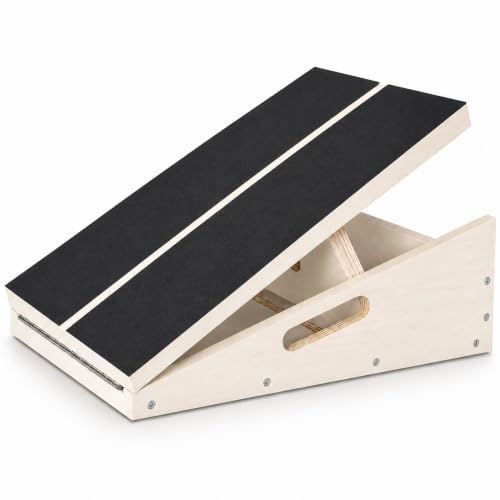
Why it’s here: The sweet spot between the $18 budget pick and the $60 StrongTek. If you want all-wood construction and high review validation (1,600 at 4.8☆) without paying for StrongTek’s brand premium, this is the pick. Most users who own this report 3+ years of daily use without degradation.
- 4.8☆ with 1,600 reviews puts it in the same quality tier as StrongTek at $20 less
- All-wood construction lasts longer than foam-topped budget boards
- Metal locking mechanism is more secure than the wood-on-wood notches on cheaper boards
- Best build quality per dollar in the under-$50 tier
- Less-known brand than StrongTek — smaller support presence
- No carry handles — less portable than the StrongTek
Best Slant Board Exercises for Desk Workers
Choose movements that suit your ability and the board’s instructions. This guide does not establish a universal exercise prescription or how much of a desk worker’s exercise needs a board covers.
- Toes-up calf stretch (15–20°). Stand with heels at the low edge, toes up the incline. Hold 30–60 seconds. Stretches calves and Achilles. Do this twice a day — it’s the single most direct counter to ankle stiffness from sitting.
- Tibialis exercises: A slant board is not required for every lower-leg exercise. Ask a qualified professional for appropriate technique if you are using one for rehabilitation; we cannot claim one muscle predicts knee health.
- Slant board squat (25°, heels-up). Stand on the board with your heels up the incline, feet hip-width apart. Squat to whatever depth you can with the heels glued to the board. Hold 30 seconds at the bottom. This unloads the squat for tight ankles — the slant board lets you reach depth your floor squat doesn’t allow.
Total time commitment: 5 minutes a day. Most users notice meaningful ankle mobility improvements within 2–3 weeks.
Who Should Skip a Slant Board
A slant board is cheap and high-leverage for most desk workers, but it’s the wrong purchase for a few people:
- Anyone with an acute Achilles or ankle injury. Loading a strained tendon on an incline can set your recovery back. Get the injury assessed and rehabbed by a physical therapist first — the board is a maintenance and mobility tool, not an injury treatment.
- Heavy lifters eyeing loaded barbell squats but reaching for the budget board. The Amazon’s Choice and under-$20 picks top out at 300-to-480 lb capacity — fine for bodyweight work, not for you plus a loaded bar. If barbell slant-board squats are the goal, the 1,000 lb Premium Knees Over Toes board is the only pick built for it.
- People who won’t do the daily five minutes. The board only works if you actually stand on it. If a piece of gear in the corner tends to become decoration, a phone reminder and a guided mobility routine will move the needle more than another object you don’t use.
Honest Limitations of This Guide
The recommendations are solid, but a few caveats keep this honest:
- The knee-health and tibialis claims are a framework plus mechanism, not a slant-board RCT. Ben Patrick’s ATG approach and the dorsiflexion-and-tibialis reasoning are compelling and widely echoed, and his channel is full of testimonials — but there’s no peer-reviewed controlled trial on slant boards specifically. That’s an honest gap, and we’re flagging it rather than hiding it.
- Review counts and “bought per month” figures come straight from Amazon listings. They fluctuate and aren’t independently audited. We use them as a durability proxy — a board bought thousands of times a month has been stress-tested by the market — but they’re a signal, not a guarantee.
- Weight-capacity ratings are manufacturer-stated and unverified by us. We didn’t load-test any board to failure, and the foam-versus-wood longevity estimate of one to two years is drawn from owner reviews rather than a controlled abrasion test.
How We Picked These
We verified each ASIN and its current price on Amazon, then compared angle range, weight capacity, review base, and construction material. We prioritized adjustable all-wood boards for the desk-worker default because they cover every use case from a gentle 15-degree calf stretch to 25-degree ATG loading, and reserved the fixed-angle and premium picks for the specific buyers who need them.
We didn’t stress-test capacity claims or run multi-year durability trials, so longevity judgments lean on high-volume review data rather than our own lab. The exercise protocol reflects Ben Patrick’s published ATG guidance, linked directly to his own video rather than paraphrased as if it were ours.
Frequently Asked Questions
What angle slant board for ATG / Knees Over Toes?
The ATG standard is 25°. This is the angle Ben Patrick uses for tibialis raises and slant board squats. If you’re buying specifically to follow his protocol, get a board that includes 25° in its adjustable range (every pick on this list does), or go with the fixed 25° Premium KOT board if you want a dedicated single-purpose tool.
Are wooden slant boards better than foam?
For long-term use, yes. Foam-topped boards (typical in the under-$20 range) wear out in 1–2 years of daily use. All-wood construction lasts indefinitely if kept dry. For testing the discipline, foam is fine; for committing long-term, pay the extra $10–$20 for solid wood.
Can you do squats on a slant board?
Yes, and it’s one of the best uses. Standing heels-up on a 25° slant board lets tight-ankled desk workers reach squat depths their flat-floor squat won’t allow. Start with bodyweight; loaded barbell squats on a slant board are an advanced movement that requires the 1,000 lb capacity of the Premium KOT board.
How long should you stand on a slant board?
Per Ben Patrick’s ATG protocol: 5 minutes per day total across multiple short bouts (1–2 minutes each). Static calf stretches at 15–20° can be done for 30–60 seconds at a time. Active tibialis raises are 3 sets of 25 reps. Slant board squats are 30-second holds at the bottom. You don’t need more than 10 minutes a day to see results.
Is the cheap slant board on Amazon worth it?
Yes, if you’re testing the discipline. The budget pick, at about $17, has 1,100 reviews at 4.6☆ — the same rating as the Editor’s Pick at a $10 discount. The foam top wears faster than wood, but for 1–2 years of casual use it’s perfectly fine. If you know you’ll use it daily for years, pay the extra $10–$20 for solid wood construction.
Slant board vs squat wedges — what’s the difference?
Slant boards have a flat top surface set at an adjustable angle (you stand fully on the incline). Squat wedges are typically smaller fixed-angle blocks that go under your heels only. For desk-worker mobility, the slant board is more versatile — it covers calf stretching, tibialis raises, AND heel-elevated squats. Squat wedges only do the third.
Will using a slant board fix my knee pain?
Often, yes — though the mechanism is indirect. Most desk-worker knee pain stems from ankle stiffness forcing the knee to absorb impact and rotation it wasn’t designed for. Restoring ankle dorsiflexion (calf stretches) and strengthening the tibialis anterior (which decelerates the knee in walking and running) unloads the knee. Ben Patrick’s entire ATG system is built on this insight, and his channel has thousands of before/after testimonials. That said, persistent knee pain warrants a physical therapist evaluation, not just a slant board.
Final Thoughts
For most desk workers in 2026, the Wooden Slant Board (Amazon’s Choice) at about $26 is the right call. The 7,000-bought-per-month volume validates durability, the 5 adjustable angles cover every use case from gentle calf stretches to ATG-style 25° loading, and the price puts it under the threshold most people will spend on a single-purpose mobility tool.
If you want the most-reviewed option with brand support, StrongTek at $59.99 has 6,000+ verified reviews. If you’re specifically following Ben Patrick’s ATG protocol and want a dedicated 25° board built for loaded squats, the INFIDEZ 25° Slant Board at $46.28 is the right tool.
Watch Ben Patrick’s full ATG Foot, Ankle, Achilles & Shin Guide for the actual protocol, then pair the slant board with our best steel mace bells guide for a complete top-to-bottom desk-worker mobility stack — mace and horse stance for shoulders and hips, slant board for ankles and knees.
Last updated: July 01, 2026 at 01:09 PM ET. Prices and availability shown are accurate as of this time and are subject to change. As an Amazon Associate, DeskFitPro earns from qualifying purchases.
Ready to Buy?
Prices checked: Sep 10, 2026, 7:26 PM UTC
Product prices and availability are accurate as of the date/time indicated and are subject to change. Any price and availability information displayed on Amazon.com at the time of purchase will apply to the purchase of this product.
Any prices mentioned in the article text are approximate and for comparison only; the figure shown with each product above is the one checked against Amazon at the time stated.
As an Amazon Associate, DeskFitPro earns from qualifying purchases.


