As an Amazon Associate, we earn from qualifying purchases.
Gaiam Evolve Balance Board
A rocker board built specifically for standing desks — subtle side-to-side motion, honeycomb non-slip texture that grips both hard floors and carpet, and a 250 lb capacity. Gentle enough to use through a meeting.
Check Price on Amazon →At a Glance
- BEST OVERALL: Gaiam Evolve Balance Board
- BEST WOOD BUILD: StrongTek Wooden Rocker Board
- BEST VALUE: URBNFit Standing Desk Balance Board
- BEST CUSHIONED OPTION: Yes4All Wobble Balance Board (Foam)
- BEST 360° MOTION: FEZIBO 360° Wobble Balance Board
| Board | Motion | Surface | Weight capacity |
|---|---|---|---|
| Gaiam Evolve | Rocker (1 axis) | Honeycomb non-slip | 250 lb |
| StrongTek Wooden | Rocker (1 axis) | Textured Lauan hardwood | Not stated |
| URBNFit 15" | Rocker (1 axis) | Plastic | Not stated |
| Yes4All Foam | Wobble, cushioned | Textured EVA foam | Not stated |
| FEZIBO 360° | 360°, 8.5° tilt | Non-slip top | 320 lb |
Standing at your desk on a balance board engages your core, improves proprioception, and prevents the stiffness that comes from standing still. It turns passive standing into active movement. Here are the best balance boards for standing desks.
Detailed Reviews
1. Gaiam Evolve Balance Board
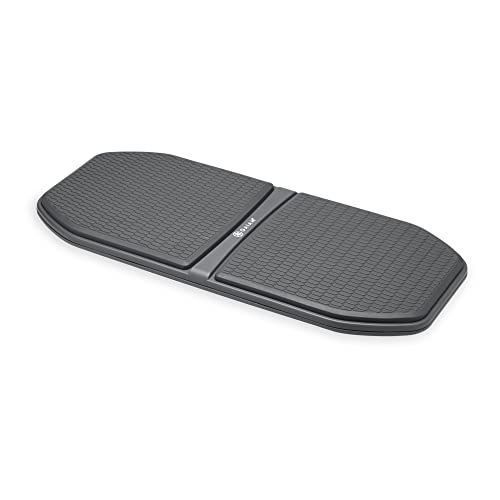
Why it's here: A rocker board — side-to-side motion on one axis, not the 360-degree wobble of a disc board. That constraint is the point. Rocker motion is predictable enough that you stop thinking about it after a few minutes, which is the difference between a board you stand on all afternoon and one you step off during a call. Gaiam designs it for neutral ankle positioning rather than maximum instability, and the honeycomb texture grips both hard floors and carpet. Rated to 250 lb.
- Single-axis rocking is stable enough to use while typing or on a call
- Honeycomb non-slip surface works on carpet as well as hard floor
- Designed around neutral ankle position rather than maximum instability
- 250 lb weight capacity
- Roughly triple the price of the URBNFit for a similar range of motion
- One axis only — no 360° movement if that's specifically what you want
- A rocker board is a movement prompt, not exercise equipment (see the limitations section below)
2. StrongTek Wooden Rocker Board
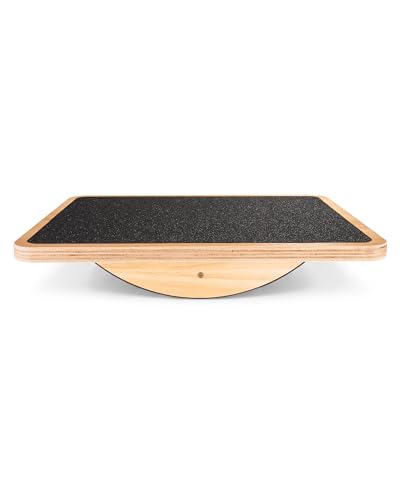
Why it's here: The one to buy if you want a board that looks like furniture rather than gym equipment. StrongTek builds it from Lauan hardwood plywood — denser than the birch or pine used in most budget wooden boards — at 17.5 x 13.5 x 3 inches, with a textured grip surface that is comfortable barefoot. Wood is also silent, which matters more than it sounds if you share a room or take calls standing.
- Lauan hardwood plywood is denser than the birch and pine used in cheaper wooden boards
- Silent in use — no plastic creak on calls
- Textured surface is comfortable barefoot, unlike hard plastic boards
- 30-day money-back guarantee from StrongTek
- 3-inch height is a big step up — awkward if your desk has limited height adjustment
- No cushioning, so it isn't an anti-fatigue mat substitute
3. URBNFit Standing Desk Balance Board

Why it's here: Under $20 and 15 inches across, this is the cheapest honest way to find out whether you actually want a balance board before spending three times as much. If it turns out you step off it after twenty minutes every day — which happens to plenty of people — you have lost very little. URBNFit publishes less specification detail than the others here, which is worth knowing before you buy.
- Cheapest genuine entry point in this category
- 15-inch footprint suits smaller standing areas
- Low enough risk to treat as a trial rather than a commitment
- URBNFit publishes little verifiable spec detail — no stated weight capacity or materials
- Plastic construction is noisier than wood
4. Yes4All Wobble Balance Board (Foam)
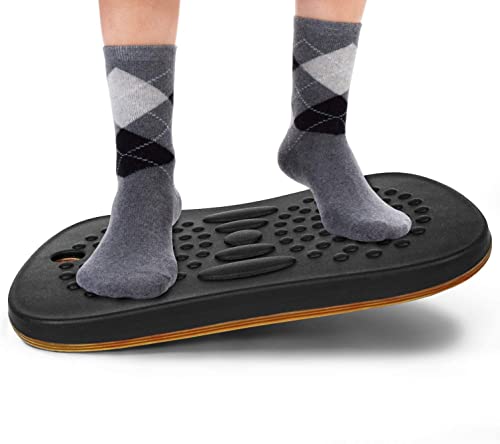
Why it's here: The only genuinely different design here: closed-cell EVA foam rather than a rigid board, in two sizes (19 x 15 x 2.25 in or 15.5 x 13.5 x 2 in). Foam gives you instability and cushioning at once, which is why this style shows up in rehab and physio settings and why it suits anyone whose knees or hips object to standing on a hard surface. It doubles as an unstable surface for lunges, squats and planks.
- Foam provides cushioning and instability together — rigid boards give you only one
- Two size options rather than one fixed footprint
- Commonly used in rehab and physical-therapy settings, and gentler on joints
- Doubles as an unstable surface for bodyweight training
- Foam compresses over time in a way rigid boards do not
- Less pronounced tilt than a hard rocker board
- Yes4All's own listing contradicts itself on warranty — one bullet says 1-year and 30-day returns, the next says 5-year and 60-day. Confirm terms with the seller before relying on either
5. FEZIBO 360° Wobble Balance Board

Why it's here: The only board here with full 360-degree movement rather than a single rocking axis, capped at an 8.5-degree tilt so it stays usable rather than becoming a balance drill. That combination — omnidirectional but shallow — is the argument for the price. It also carries the highest stated weight capacity in this group at 320 lb.
- Full 360° movement, unlike every other board here
- 8.5° tilt limit keeps the motion usable while working
- Highest stated weight capacity here at 320 lb
- Most expensive board on the list
- 360° movement takes longer to stop noticing than a rocker board
Who Should Skip Balance Boards
A balance board isn’t the right buy for everyone standing at a desk. Skip it if you’re one of these:
- Anyone with a vestibular condition, dizziness, or a recent ankle/knee/hip injury. A rocking surface adds fall risk you don’t need. A flat anti-fatigue mat gives you the standing-comfort benefit without the instability.
- People who mostly sit. A board only does anything while you’re standing on it. If your day is 90% seated, the money is better spent on a supportive chair or an under-desk footrest.
- Anyone doing precision fine-motor work for hours (detailed design, CAD, data entry). The constant micro-corrections that make a board “active” also nudge your hands. Use it in short intervals between focus blocks, or stick with a cushioned mat.
Honest Limitations of This Guide
A few things worth being upfront about before you buy:
- No head-to-head trial proves boards beat plain standing. The core-engagement and proprioception rationale is mechanistic and reasonable, but I’m not aware of a controlled study measuring standing-desk balance boards against flat standing for any health endpoint. Treat the benefits as plausible, not established.
- ”Core engagement” is unquantified marketing. Rating and review counts reflect general owner satisfaction, not how many calories or how much muscle activation a board actually delivers. Nobody is publishing EMG data on these.
- The premium-vs-budget delta is mostly tilt range and build, not results. The jump from a $20 rocker to a $75 board buys smoother motion, multi-directional tilt, and better materials — real differences, but incremental for a casual standing-desk user. We have not wear-tested these boards across a full workday, and no independent testing we can point to compares them head to head.
How We Picked These
I verified every ASIN, current price, rating, and review count through Amazon’s Product Advertising API rather than guessing, then prioritized geometry that actually suits desk multitasking: rocker-only boards you can use on a call rank above twitchy 360-degree wobble boards for this use case. I also weighted floor protection (anti-slip strips), noise (wood runs quiet), and build quality.
Not every board here was tested under my own feet for a full day. Where I’m relying on aggregated owner feedback and published specs rather than hands-on time, I’ve said so above.
Final Thoughts
Investing in quality balance boards is one of the best decisions you can make for active standing. The research continues to grow, and having the right product makes all the difference.
The pick for most people is the Gaiam Evolve at $64.49 — stable enough on a single axis that you keep working instead of concentrating on your feet, which is the only test that matters here. If you want the same motion for a third of the price, the URBNFit at $19.99 is a low-risk way to find out whether you’ll use a board at all before committing.
Last updated: July 01, 2026 at 01:05 PM ET. Prices and availability shown are accurate as of this time and are subject to change. As an Amazon Associate, DeskFitPro earns from qualifying purchases.
Ready to Buy?
We may earn a commission if you buy through these links.
Prices checked: Oct 3, 2026, 8:06 PM UTC
Product prices and availability are accurate as of the date/time indicated and are subject to change. Any price and availability information displayed on Amazon.com at the time of purchase will apply to the purchase of this product.
Any prices mentioned in the article text are approximate and for comparison only; the figure shown with each product above is the one checked against Amazon at the time stated.
As an Amazon Associate, DeskFitPro earns from qualifying purchases.

