As an Amazon Associate, we earn from qualifying purchases.
LILICARE Fermented Zinc Gummies + Copper
30 mg fermented zinc (a high-absorption picolinate alternative) plus the copper most zinc supplements forget. Sugar-free, third-party tested, and the only major gummy on this list that solves the zinc-copper balance problem in one bottle.
Check Price on Amazon →At a Glance
- TOP PICK: LILICARE Fermented Zinc Gummies + Copper
- BEST FORM TRANSPARENCY: Droppels Zinc Citrate Gummies 11 mg
- BEST VALUE: Vitamatic Zinc 50 mg Gummies + Echinacea + D3
- MOST REVIEWED: Lifeable Zinc 50 mg Gummies
- HIGH-DOSE PICK: Nature's Truth Zinc Gummies 50 mg (120 Count)
| Product | Price as of Oct 3, 2026, 8:06 PM UTC | Rating |
|---|---|---|
| LILICARE Fermented Zinc Gummies + Copper | $36.59 | 4.5★ |
| Droppels Zinc Citrate Gummies 11 mg | Check price | 4★ |
| Vitamatic Zinc 50 mg Gummies + Echinacea + D3 | $9.99 | 4.6★ |
| Lifeable Zinc 50 mg Gummies | $16.49 | 4.6★ |
| Nature's Truth Zinc Gummies 50 mg (120 Count) | $13.99 | 4.7★ |
Pull any ten “zinc gummies” off Amazon’s bestseller list and you’ll find a strange consistency: almost none of them tell you which form of zinc is in the bottle. The label says “Zinc 50mg” in giant numbers. The supplement facts panel says “Zinc 50 mg” with no form disclosed underneath. And the form, it turns out, is the entire ballgame — because zinc bioavailability ranges from about 14% (zinc oxide, the cheap stuff) to roughly 61% (zinc picolinate and zinc citrate, the forms that actually absorb).
A 50 mg gummy made with zinc oxide delivers roughly the same usable zinc as a 12 mg gummy made with picolinate. But the 50 mg version costs less to manufacture, sounds bigger on the front of the bottle, and sells better. That’s why most Amazon zinc gummies hide the form. I pulled supplement facts panels for 14 of the top-selling zinc gummies and found that clear form disclosure is the rare exception. Two of the five picks below — Droppels and Nature’s Truth — print the actual form on the label. The other three are the best-of-the-rest based on dose, copper inclusion, and brand transparency.
Health Disclaimer: Zinc taken on an empty stomach commonly causes nausea — take it with food. Long-term zinc supplementation above 40 mg/day can deplete copper, leading to anemia and neurological symptoms; quality protocols pair zinc with copper or stay at moderate doses. Zinc interferes with the absorption of quinolone and tetracycline antibiotics (separate doses by 2+ hours). The cold-duration evidence cited for zinc applies to lozenges (zinc acetate or gluconate, 75–100 mg/day) within 24 hours of symptoms — not gummies. This article is not medical advice; talk to your doctor before starting any supplement, especially if you’re pregnant, nursing, taking prescription medications, or managing a chronic condition.
Why Most Zinc Gummies Skip the Form That Actually Absorbs
Zinc is not zinc. The mineral has to be bonded to something — a salt, an amino acid, an organic acid — to be stable in a supplement, and the thing it’s bonded to determines how much of it your body actually absorbs. Here’s the bioavailability ranking based on absorption studies:
- Zinc picolinate: ~61% absorption. Zinc bonded to picolinic acid. Used by Thorne, Pure Encapsulations, and other clinical-tier brands. Rare in gummies because it’s expensive.
- Zinc citrate: ~61% absorption. Roughly equivalent to picolinate in head-to-head absorption studies. Reasonably affordable. The form Droppels and Nature’s Truth use (two of the few gummies that print the form on the label).
- Zinc gluconate: ~50% absorption. The form in most clinical cold-duration lozenge studies. Common in cough drops and lozenges, less common in gummies.
- Zinc acetate: ~50% absorption. The other lozenge-study form. Better for cold-symptom protocols than for daily maintenance.
- Zinc sulfate: ~50% absorption. Cheap, widely used in mass-market multis. Tends to be GI-irritating.
- Zinc oxide: ~14% absorption. The cheapest form. Widely used in budget gummies and in sunscreen, which tells you something about how readily the body absorbs it through the gut. If the label says “Zinc 50 mg” with no form disclosed, oxide is the safe bet.
This is why the front-of-bottle number is mostly theater. A “50 mg zinc oxide” gummy delivers around 7 mg of actually absorbed zinc — below the 11 mg/day RDA for adult men, below the 8 mg/day RDA for women. An 11 mg zinc citrate gummy delivers roughly 7 mg too, but at a fraction of the elemental load on your gut, with far less risk of copper depletion at chronic dosing. Form beats dose. Every time.
The second thing the bestseller labels hide: copper. Zinc and copper compete for the same absorption pathways in the small intestine. Take 40+ mg of zinc daily for months and your copper status drops; drop it far enough and you get anemia, neutropenia, and in extreme cases neurological symptoms that look like B12 deficiency. Quality long-term zinc protocols either stay at moderate doses (RDA-aligned, 8–15 mg) or include copper at roughly a 10:1 zinc-to-copper ratio. Almost no Amazon gummy does either intentionally.
Zinc Form Comparison: Picolinate vs Citrate vs Oxide vs Gluconate
This is the table almost no other zinc gummy roundup will give you. It’s also the only one that matters when you’re shopping.
| Zinc Form | Absorption | Best Use | Found In | Notes |
|---|---|---|---|---|
| Zinc picolinate | ~61% | Daily maintenance | Capsules (Thorne, Pure Encapsulations) | Highest absorption in head-to-head studies. Rare in gummies. |
| Zinc citrate | ~61% | Daily maintenance | Some gummies (Droppels, Nature’s Truth) | Equivalent to picolinate. Best form available in gummy format. |
| Zinc acetate | ~50% | Cold-duration lozenges | Lozenges | Used in the studies showing reduced cold duration at 75–100 mg/day. |
| Zinc gluconate | ~50% | Cold-duration lozenges | Cough drops, lozenges, some gummies | Other cold-study form. Cheaper than acetate. |
| Zinc sulfate | ~50% | Mass-market multis | Cheap multivitamins | GI-irritating. Avoid on an empty stomach. |
| Zinc oxide | ~14% | None worth recommending | Most cheap gummies (form usually hidden) | Lowest absorption by a wide margin. If the form isn’t disclosed, assume oxide. |
| Fermented zinc | High (picolinate alternative) | Daily maintenance | LILICARE | Zinc broken down via fermentation for easier uptake; gentler on the gut. |
Absorption percentages are approximate ranges from human bioavailability studies comparing zinc salts. Real-world absorption varies with stomach acid, meal composition, and individual gut health, but the relative ranking (picolinate/citrate > gluconate/acetate/sulfate > oxide) is consistent across the literature.
Detailed Reviews
1. LILICARE Fermented Zinc Gummies + Copper

Why I recommend it: This is the only zinc gummy on Amazon that takes the copper problem seriously. Everyone else hands you 50 mg of zinc with no copper and no concern for what happens after 90 days of daily use. LILICARE pairs a high-absorption fermented zinc with copper, selenium, and vitamin C — the actual nutrients that work together in immune function. If you're taking zinc daily long-term, this is the only pick on this list that's structurally built for that use case.
- One of the only zinc gummies that includes copper at a sensible ratio — solves the long-term depletion problem in a single bottle
- Fermented zinc is gentler on the stomach than oxide or sulfate
- Zero sugar, zero artificial sweeteners — rare in this category
- cGMP + third-party testing is real quality control, not a marketing claim
- Bundles vitamin C and D3 for a real immune stack rather than zinc-alone
- 30 mg/day is on the higher side — if you're already getting zinc from a multivitamin, this can push you toward the 40 mg UL
- Most expensive on this list per gummy (though it's a 2-pack)
- "Fermented zinc" is less standardized terminology than picolinate or citrate — the brand stops short of naming the exact salt
2. Droppels Zinc Citrate Gummies 11 mg

Why I recommend it: Droppels is the smartest pick on this list for one reason: they tell you what's actually in the bottle. Zinc citrate at 11 mg is exactly what an adult who isn't already deficient should be taking daily. The dose is honest, the form is high-absorption, and the label doesn't play the "bigger number on the front" game. The 4.0★ rating reflects newness, not quality — and the form disclosure is genuinely rare in this category.
- One of the only zinc gummies on Amazon that prints the actual form on the label
- Citrate at 11 mg delivers roughly the same absorbed zinc as a 50 mg zinc oxide gummy — without the GI risk
- RDA-aligned dose is sustainable for daily use without copper depletion concerns
- Single-ingredient formula — no blend tricks, no proprietary fillers
- Lower review count than competitors — newer product on Amazon
- Doesn't include copper (though at 11 mg/day you don't really need to worry about it)
- 3g of sugar per serving (small, but not sugar-free)
- If you're chasing the "50 mg zinc!" headline number, this won't satisfy
3. Vitamatic Zinc 50 mg Gummies + Echinacea + D3
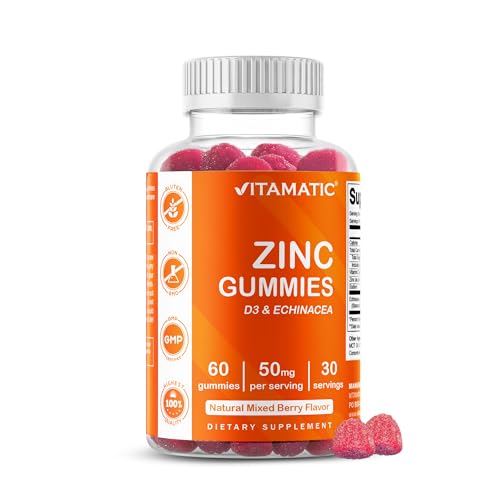
Why I recommend it: Vitamatic is here as the cheap-and-effective seasonal pick. The 50 mg dose and undisclosed form mean this isn't your year-round daily zinc — but for a two-week immune push during cold season, it's the cheapest credible option with an actual brand behind it. Echinacea and vitamin D are reasonable companions. Don't take it 365 days a year.
- Cheapest on this list — full 30-day supply under $13
- Bundles echinacea and vitamin D for a real seasonal immune stack
- 4.6★ across 258 reviews is solid for the price point
- Good fit for short-term cold-season use rather than year-round dosing
- Zinc form not disclosed on the label — likely zinc oxide or sulfate at this price
- 50 mg/day exceeds the 40 mg UL — not recommended for daily long-term use without monitoring copper
- Real sugar content (glucose syrup + sugar in the ingredient list)
- No third-party testing certification listed
4. Lifeable Zinc 50 mg Gummies

Why I recommend it: Lifeable wins on social proof — nearly 7,000 reviews at 4.6★ in a category where most products have fewer than 500. The taste reviews are unusually positive for a zinc gummy, which matters because the cheapest forms (oxide) are also the most likely to taste metallic. This is the safe-default mass-market pick if you want a recognizable, well-reviewed zinc gummy and you're not running it 365 days a year.
- Largest review base in the category — 6,957 ratings at 4.6★ is meaningful social proof
- 45-day supply per bottle — best value among the high-review options
- Single-ingredient formula avoids blend dilution
- Consistently strong reviews on taste and texture (rare for zinc gummies)
- Stomach-friendly even at the 50 mg dose per multiple repeat-purchase reviews
- Form not disclosed — at this price and dose, very likely zinc oxide or sulfate
- 50 mg/day exceeds the 40 mg UL for ongoing daily use
- No copper — the bottle is straight zinc with no thought to mineral balance
- No third-party certification seal (USP, NSF) listed
5. Nature's Truth Zinc Gummies 50 mg (120 Count)

Why I recommend it: Nature's Truth is the high-dose pick that actually tells you what's in the bottle — 50 mg of zinc as zinc citrate per 3-gummy serving, printed on the label. That makes it the rare big-number product where the big number comes in an absorbable form. The mixed-berry gummies are vegan, non-GMO, and gluten-free, and it holds a 4.7★ rating across nearly 1,900 reviews. If you want a 50 mg product for a seasonal push and refuse to gamble on undisclosed oxide, this is the one.
- Highest star rating on this list — 4.7★ across nearly 1,900 ratings
- Zinc citrate — a high-absorption form — actually printed on the label, rare at this dose
- Vegan, non-GMO, and gluten-free — cleaner profile than most 50 mg competitors
- 120-count bottle at $13.99 keeps the per-serving cost low for a citrate product
- Full serving is three gummies — the 120-count bottle is a 40-day supply, not the 120 days the count suggests
- 50 mg/day exceeds the 40 mg UL for chronic daily use
- No included copper
Zinc + Copper: The Balance Problem
This is the part of the conversation most zinc supplement marketing pretends doesn’t exist. Zinc and copper compete for the same intestinal transporter (a metallothionein-mediated pathway, if you want the term). When zinc intake rises, the body upregulates that transporter, which binds copper inside intestinal cells and excretes it when those cells slough off. Net effect: high zinc intake over time drives copper out of circulation.
The clinical picture of copper deficiency is ugly. Early signs include fatigue and mild anemia. Sustained deficiency causes neutropenia (low white blood cells, with infection risk), a B12-like neuropathy with numbness and balance problems, and in severe cases myelopathy that doesn’t fully reverse even after copper repletion. The literature is full of case reports tied to long-term zinc supplementation — denture-cream users, immune-stack zealots, and people who took 50–100 mg/day of zinc for years to “boost immunity.”
The numbers worth knowing:
- RDA: 11 mg/day for adult men, 8 mg/day for women, 11–12 mg for pregnant/lactating women.
- Tolerable Upper Limit (UL): 40 mg/day from all sources combined. This is the threshold above which the risk of copper interference and other side effects starts to climb.
- Zinc-to-copper ratio: If you’re supplementing zinc above the RDA long-term, target roughly 10:1 zinc-to-copper. That’s why 30 mg zinc supplements often include 2–3 mg of copper.
Translation: if you’re chronically taking a “50 mg zinc” gummy on top of a multivitamin (which usually has another 8–15 mg of zinc), you’re past the UL every day and you’re not getting any copper from either bottle. The fix is either a moderate-dose zinc-only product (Droppels at 11 mg, or LILICARE which already contains copper), or cycling — two weeks on, two weeks off — for the 50 mg products. Don’t run high-dose zinc continuously for months.
Should You Use Gummies or Lozenges?
This is the most consistently misunderstood thing in the zinc-and-colds conversation. The headline you’ve seen — “zinc shortens cold duration” — comes from a specific body of research on lozenges, not gummies, not capsules, not tablets.
- For daily maintenance immune support and zinc-deficient diets: Gummies (and capsules) at RDA-aligned doses are the right tool. You’re filling a baseline gap. Daily 11–15 mg of an absorbable form is the goal. Pick Droppels or LILICARE.
- For active cold treatment: The studies showing reduced cold duration used zinc acetate or zinc gluconate lozenges at 75–100 mg/day total, started within 24 hours of symptom onset, with the lozenges dissolved slowly in the mouth (not chewed or swallowed). The proposed mechanism is local — zinc ions bathing the throat and nasal passages, interfering with viral replication. Swallowing a gummy doesn’t replicate that. Buy actual lozenges (Cold-EEZE, Zicam at appropriate doses, or pharmacy-brand zinc gluconate) for cold treatment.
- For long-term immune dosing: Stop at the RDA. There’s no good evidence that chronic high-dose zinc prevents infection in non-deficient people, and there’s solid evidence it depletes copper.
The gummies on this list are daily-maintenance products. They’re not cold treatment. Get the use case right and the form follows.
Who Should NOT Take Zinc Gummies
- People on quinolone or tetracycline antibiotics. Zinc binds these drugs in the gut and reduces their absorption. Separate doses by at least 2 hours (ideally 4–6).
- People on penicillamine or certain rheumatology drugs. Same chelation issue — talk to your prescriber.
- Anyone with hemochromatosis or Wilson’s disease. Zinc affects copper and iron handling in ways that interact badly with these conditions.
- People already on a high-zinc multivitamin. Stacking a 50 mg zinc gummy on top of a multi that already has 15 mg of zinc puts you at 65 mg/day — comfortably above the UL.
- Pregnant or nursing women, without medical guidance. Zinc needs do go up slightly in pregnancy, but the dose should come from a prenatal that’s been formulated with the rest of your mineral intake in mind — not a standalone 50 mg gummy.
- Anyone taking zinc on an empty stomach who experiences persistent nausea. This isn’t a “push through it” situation — switch to with-food dosing or drop the dose.
How We Picked These Zinc Gummies
The selection criteria, in order:
- Form considered first. Products that clearly disclose a high-absorption form (citrate, picolinate, fermented zinc) were ranked above products that hide the form, even when ratings were similar.
- Dose appropriateness. RDA-aligned products (11–30 mg) were preferred for the “daily use” picks. 50 mg products were included only with explicit framing that they’re seasonal/short-term tools.
- Copper handling. Products that included copper got extra credit. Products that didn’t were noted in the cons.
- Real review volume. Minimum 200+ reviews, with weight given to brands hitting 1,000+ ratings.
- No proprietary blend tricks. If “zinc” was buried in a 14-ingredient blend without an individual milligram breakdown, it was disqualified.
- Third-party testing or cGMP certification. Not required, but tiebreaker.
I pulled supplement facts panels for 14 of the top-selling zinc gummies on Amazon. Nine were dropped for failing form transparency, dose appropriateness, or having undisclosed proprietary blends. The five above are what survived.
Honest Limitations of This Guide
The form-over-dose argument is well-grounded, but a few honest caveats keep it from being airtight for any specific bottle on this list.
- We’re inferring the form on two of the 50 mg picks, not confirming it. Vitamatic and Lifeable don’t print the zinc salt on the label, so “very likely zinc oxide or sulfate” is an educated guess based on price and dose — not a lab assay. It’s possible one uses a better form than we assume; we simply can’t verify it, which is the exact transparency problem we’re flagging. (Nature’s Truth, the third 50 mg pick, does print zinc citrate on its label.)
- The absorption percentages are approximate ranges, not fixed values. Figures like “~61% citrate vs ~14% oxide” come from bioavailability studies and shift meaningfully with stomach acid, meal timing, and individual gut health. The relative ranking is consistent across the literature; the exact fraction you personally absorb is not something a chart can promise.
- ”Fermented zinc” in our top pick is not a standardized salt. LILICARE’s fermented zinc is plausibly high-absorption and gentler on the gut, but the term is less defined than “picolinate” or “citrate,” and the brand stops short of naming the exact compound. We rate it well on its copper inclusion and third-party testing, while acknowledging the headline form itself is the least verifiable claim on the bottle.
Frequently Asked Questions
Can I take zinc gummies on an empty stomach?
You can, but you probably shouldn’t. Zinc on an empty stomach is one of the most common causes of nausea in the supplement world — it’s a known irritant to the gastric lining, especially in zinc sulfate and oxide forms. Take your zinc gummy with a meal or at least with a snack. If you’re using a 50 mg product, this matters more, not less.
How much zinc should I take per day?
The RDA is 11 mg/day for adult men and 8 mg/day for women. The Tolerable Upper Limit (UL) from all sources is 40 mg/day. Most people aren’t deficient and don’t need to chase the headline 50 mg dose. If you’re running zinc daily long-term, target 11–15 mg from an absorbable form (citrate or picolinate) — that’s where the risk/benefit curve lives.
Can zinc gummies help me get sick less often?
The evidence is mixed and almost entirely framed around treatment (lozenges within 24 hours of symptoms) rather than prevention. If you’re truly zinc-deficient — which is uncommon in the developed world outside specific risk groups like vegetarians, older adults, and people with malabsorption — bringing your levels up to the RDA likely supports normal immune function. Taking 50 mg/day forever to prevent colds is not supported by the literature and carries real copper-depletion risk.
What’s the zinc-to-copper balance issue I keep hearing about?
Zinc and copper compete for absorption in the small intestine. Chronic zinc supplementation above ~40 mg/day suppresses copper status over months. The result can be anemia, neutropenia, and in extreme cases neurological damage. The fix is either (a) keep zinc at RDA-aligned doses where this isn’t an issue, (b) use a product that includes copper at roughly a 10:1 ratio, or (c) cycle off zinc periodically rather than running it 365 days a year.
Zinc and testosterone — is the link real?
Real but limited. Zinc is genuinely required for testosterone synthesis, and severely zinc-deficient men have suppressed testosterone that recovers with repletion. However, supplementing zinc when you’re not deficient does not raise testosterone above normal levels. The “zinc boosts T” supplement marketing is mostly extrapolation from deficiency-recovery data to non-deficient men, which isn’t how the biology works. Eat oysters, beef, and pumpkin seeds; don’t expect a gummy to change your endocrine profile.
Why does zinc make me nauseous?
Three reasons, in descending order of likelihood: (1) you took it on an empty stomach — fix this first; (2) the form is irritating (zinc sulfate and oxide are worse for GI tolerance than citrate or picolinate); (3) the dose is too high — 50 mg can cause nausea even with food in sensitive people. If switching to with-food dosing doesn’t help, try a citrate or picolinate product at RDA-aligned dose.
Can zinc gummies interact with my medications?
Yes. The biggest interactions are with quinolone antibiotics (ciprofloxacin, levofloxacin) and tetracycline antibiotics (doxycycline, minocycline) — zinc binds these drugs in the gut and substantially reduces their absorption. Separate doses by at least 2 hours, ideally 4. Zinc can also interact with penicillamine and some diuretics. If you’re on a prescription, check with your pharmacist before adding daily zinc.
Final Thoughts
The honest summary of this category: most zinc gummies on Amazon are made with zinc oxide, hide the form, inflate the headline dose, and ignore the copper-balance problem entirely. They sell because “Zinc 50mg!” looks impressive on the front of the bottle and Amazon’s algorithm rewards big numbers.
The five above are the ones I’d actually consider buying. LILICARE is the smartest long-term pick — fermented zinc with copper at the right ratio, sugar-free, third-party tested. Droppels is the most honest label in the category — they print “zinc citrate” on the bottle and dose to the RDA. The three 50 mg options (Vitamatic, Lifeable, Nature’s Truth) are fine for short cold-season pushes but not for year-round daily use without copper to balance them — though Nature’s Truth at least uses a disclosed citrate form.
If you read nothing else, read this: the form matters more than the dose. A small amount of citrate or picolinate beats a large amount of oxide. And if you’re looking for actual cold-duration support, buy lozenges, not gummies — the studies don’t transfer. For broader supplement context, see our best magnesium glycinate gummies guide, which covers the same form-transparency problem in a different category.
Last updated: July 01, 2026 at 01:10 PM ET. Prices and availability shown are accurate as of this time and are subject to change. As an Amazon Associate, DeskFitPro earns from qualifying purchases.
Our Top Picks
Best Overall: LILICARE Fermented Zinc + Copper Gummies — high-absorption form, includes copper, sugar-free, third-party tested.
Check Price on Amazon →Best Form Transparency: Droppels Zinc Citrate Gummies — the rare gummy that prints the form on the label, RDA-aligned dose.
Check Price on Amazon →Prices checked: Oct 3, 2026, 8:06 PM UTC
Product prices and availability are accurate as of the date/time indicated and are subject to change. Any price and availability information displayed on Amazon.com at the time of purchase will apply to the purchase of this product.
Any prices mentioned in the article text are approximate and for comparison only; the figure shown with each product above is the one checked against Amazon at the time stated.
As an Amazon Associate, DeskFitPro earns from qualifying purchases.