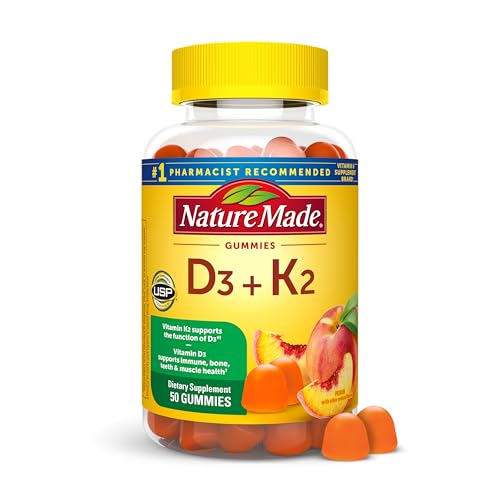
OUR #1 PICK Nature Made Vitamin D3 K2 Gummies 5000 IU 5,000 IU of D3 (cholecalciferol) paired with K2 (MK-7) for calcium routing, USP-verified, from the only major-brand gummy that prints both numbers on the label without a proprietary blend. The dose endocrinologists actually use to correct deficiency — in the format you'll actually take. Check Price →

Best Vitamin D Gummies 2026: Why 1,000 IU Doesn’t Move the Needle (And the 5 That Actually Will)

Open the vitamin D aisle on Amazon and you’ll see hundreds of gummies stamped “1,000 IU” with bone-and-immune marketing copy. Here’s the problem: 1,000 IU is the dose that was calibrated for bone-only outcomes in the 1990s, and it almost never moves a deficient serum 25-hydroxyvitamin D level into the healthy range. According to the most recent NHANES dietary survey, roughly 40% of US adults are deficient (serum vitamin D below 20 ng/mL), and the share is higher for darker-skinned adults, older adults, and anyone living north of about 37° latitude.

I pulled the supplement facts panels for a dozen of the top-selling vitamin D gummies on Amazon and cross-checked dose, form (D3 vs D2), and whether K2 was included for calcium routing. Below are the 5 brands that survived — every pick delivers at least 2,000 IU per serving, all use D3 (cholecalciferol, the form that actually raises serum levels), and the top picks pair it with K2 to keep that incoming calcium going to your bones instead of your arteries.

Health Disclaimer: Vitamin D is fat-soluble and stores in body tissue. Long-term intakes above 10,000 IU/day have been associated with hypercalcemia, kidney stones, and soft-tissue calcification. Vitamin D can interact with thiazide diuretics, calcium channel blockers, digoxin, certain seizure medications, and statins. If you have hyperparathyroidism, sarcoidosis, kidney disease, or a calcium-handling disorder, do not start high-dose vitamin D without your doctor. This article is not medical advice — get a 25-hydroxyvitamin D blood test before going above 2,000 IU/day if you’ve never been tested.

OUR #1 PICK

Nature Made Vitamin D3 K2 Gummies 5000 IU

5,000 IU of D3 (cholecalciferol) paired with K2 (MK-7) for calcium routing, USP-verified, from the only major-brand gummy that prints both numbers on the label without a proprietary blend. The dose endocrinologists actually use to correct deficiency — in the format you’ll actually take.

Check Price on Amazon →

As an Amazon Associate, I earn from qualifying purchases. Learn more.

Why 1,000 IU Vitamin D Won’t Get You to a Healthy Level

The 600–800 IU RDA you see on the back of a Centrum bottle was set decades ago using bone-only endpoints — the dose at which a small, healthy adult population avoided clinical rickets and maintained baseline bone mineralization. It was not the dose that gets a deficient adult to an optimal serum level. It was not calibrated against the immune, mood, or cardiovascular endpoints that more recent research has pulled into the conversation. And it absolutely was not designed for the realities of modern American life: indoor work, sunscreen, northern latitudes, and the average adult getting essentially zero meaningful UVB exposure for half the year.

Here’s what the actual data shows when you read the supplement facts panels and the clinical guidelines side by side:

  • Most US adults are already deficient. NHANES dietary survey data puts roughly 40% of US adults below 20 ng/mL serum 25-hydroxyvitamin D (the lab marker for deficiency), and another 30%+ in the “insufficient” 20–30 ng/mL band. That means most people walking into the supplement aisle don’t need maintenance — they need correction.
  • 1,000 IU doesn’t correct deficiency. The clinical rule of thumb is that 1,000 IU/day will raise serum 25-OH D by roughly 6–10 ng/mL over 8–12 weeks. If you start at 18 ng/mL, that won’t get you to the 30–50 ng/mL range most clinicians actually target. It just barely nudges you into the “still insufficient” zone.
  • What deficiency-treating doctors actually prescribe. The Endocrine Society’s clinical guidelines list 1,500–2,000 IU/day as the general maintenance dose for adults — already 2x to 3x the RDA. For actual deficiency correction, the playbook is 2,000–5,000 IU/day for several months, or pulse dosing at 50,000 IU/week under supervision. The 1,000 IU bottle on the shelf isn’t wrong; it’s just not the dose anyone treating low blood levels reaches for.
  • D3 raises levels roughly twice as effectively as D2. Cholecalciferol (D3, what your skin makes from sunlight) outperforms ergocalciferol (D2, the plant-derived form) at raising and maintaining serum 25-OH D. Every pick on this list is D3. If a gummy doesn’t explicitly say D3 or cholecalciferol, skip it.
  • K2 routes the calcium your D3 is mobilizing. Vitamin D’s main job is helping you absorb calcium from food. Vitamin K2 (specifically the menaquinone-7 or MK-7 form) activates the proteins that decide where that calcium goes — into bone matrix, where you want it, rather than into arterial walls, where you don’t. This is why the better gummies pair D3 with K2.

Translation: if you’re going to take vitamin D, take a dose that actually does something. The five picks below all clear that bar.

At a Glance

The Dose Math: RDA vs Clinical vs What Your Doctor Actually Targets

Three different vitamin D numbers get thrown around. They are not the same thing, and that’s where most consumers get lost:

Number What It Actually Means Who Uses It
600–800 IU (RDA) The dose calibrated for baseline bone health in a healthy population with some sun exposure. Floor, not target. FDA labeling, multivitamin formulas
1,500–2,000 IU (general maintenance) The Endocrine Society’s recommended maintenance dose for adults to keep serum 25-OH D in a healthy range. Most primary care guidance for non-deficient adults
2,000–5,000 IU (clinical correction) The daily dose most clinicians use to bring a deficient patient (serum < 20 ng/mL) up to 30–50 ng/mL over 3–6 months. Endocrinology, integrative/functional medicine, deficiency treatment
50,000 IU/week (pulse correction) Short-course prescription dosing for severe deficiency, typically 8–12 weeks under supervision. Rx only, monitored by labs
10,000 IU (upper tolerable) The IOM-defined upper limit before hypercalcemia risk climbs over long-term use. Hard ceiling for self-supplementation

The honest framing: if you’ve never had a 25-hydroxyvitamin D blood test, start at 2,000 IU/day and get tested in 8–12 weeks. If you know you’re deficient, 5,000 IU/day is the dose that actually moves the needle. The 1,000 IU bottle is a placebo for the 40% of US adults who walk into a CVS already deficient.

Comparison Table

Brand D3 / Serving K2 (MK-7) Form Disclosed 3rd-Party Tested Price
Nature Made D3 K2 5,000 IU (1 gummy) 25 mcg MK-7 Cholecalciferol Yes (USP Verified) $15.99
Nature Made 2000 IU 2,000 IU (2 gummies) Cholecalciferol Yes (USP Verified) $10.99
Amazon Basics 2,000 IU (2 gummies) Cholecalciferol Not specified $8.99
Sports Research Vegan 5,000 IU (1 gummy) 100 mcg MK-7 Lichen-derived D3 IGEN Non-GMO tested $24.95
Nature Made 5000 IU 5,000 IU (1 gummy) Cholecalciferol Yes (USP Verified) $13.99

All five picks use D3 (cholecalciferol) — none use D2. Prices fluctuate on Amazon; confirm current pricing on the product page.

Detailed Reviews

TOP PICK

1. Nature Made Vitamin D3 K2 Gummies 5000 IU

4.6 (2,400 reviews)
$15.99
Nature Made Vitamin D3 K2 Gummies 5000 IU bottle
Key Features:
  • 5,000 IU vitamin D3 (cholecalciferol) per 1-gummy serving
  • 25 mcg vitamin K2 as MK-7 (menaquinone-7) included
  • USP Verified (independent third-party certification)
  • 50 gummies per bottle, 50-day supply at one per day
  • Gluten free, no synthetic dyes, made in USA
Pros:
  • The only major-brand gummy that pairs a clinical-correction D3 dose with MK-7 K2 — and prints both numbers clearly
  • USP verification means what’s on the label is what’s in the bottle (independent assay)
  • One-gummy serving keeps sugar load at ~2 g, lower than most stack gummies
  • Nature Made has Pharmavite-backed QC and a multi-decade regulatory track record
Cons:
  • 25 mcg MK-7 is on the lower end of the K2 dose range — Sports Research delivers 100 mcg
  • 5,000 IU is too high for someone who’s never been tested — start at 2,000 IU if uncertain
  • 50-gummy bottle is a shorter supply than the Amazon Basics 80-day option

Why I recommend it: This is the cleanest stack on Amazon at the dose most clinicians actually use for deficiency correction. You get cholecalciferol (not D2), at 5,000 IU (not 1,000), paired with MK-7 (not the inferior MK-4), and stamped with USP verification — a combination almost no Amazon-native brand can match. If your last 25-OH D test was below 30 ng/mL or you’ve never been tested and you live anywhere with a real winter, this is the bottle.

Check Price on Amazon →
BEST STARTER DOSE

2. Nature Made Vitamin D3 2000 IU Gummies

4.8 (7,200 reviews)
$10.99
Nature Made Vitamin D3 2000 IU Gummies bottle
Key Features:
  • 2,000 IU vitamin D3 per 2-gummy serving (50 mcg cholecalciferol)
  • USP Verified — independent third-party assay
  • 90-gummy bottle, 45-day supply
  • Strawberry, peach, mango fruit-derived flavors, gluten free
  • 4.8★ from 7,200+ reviews — best-rated D3 gummy on Amazon
Pros:
  • Highest review rating in the entire vitamin D gummy category — by a wide margin
  • 2,000 IU matches the Endocrine Society’s general adult maintenance recommendation
  • USP-verified — same QC infrastructure as the 5,000 IU stack
  • Cheapest USP-certified D3 gummy on Amazon at the maintenance dose
Cons:
  • No K2 in the formula — pair with a K2 capsule if you’re stacking
  • 2-gummy serving means twice the sugar load of the 5,000 IU one-gummy option
  • Not the right dose if you already know you’re deficient — step up to the 5,000 IU bottle

Why I recommend it: If you’ve never had your vitamin D tested and you want the safe, defensible starting dose, this is the one. 2,000 IU/day is the dose most primary care doctors recommend without bloodwork because it’s well above the RDA, well below any toxicity threshold, and matches what the Endocrine Society uses as “general maintenance.” Take this for 8–12 weeks, then get a 25-OH D test. If you’re still under 30 ng/mL, upgrade to one of the 5,000 IU picks.

Check Price on Amazon →
BEST VALUE

3. Amazon Basics Vitamin D3 2000 IU Gummies (160 ct)

4.7 (22,100 reviews)
$8.99
Amazon Basics Vitamin D3 2000 IU Gummies 160 count bottle
Key Features:
  • 2,000 IU vitamin D3 per 2-gummy serving (50 mcg cholecalciferol)
  • 160 gummies per bottle — 80-day supply at one serving per day
  • Orange, lemon, and strawberry fruit-flavored gummies
  • Formerly sold under the Solimo brand — same formulation
  • Made in the USA in an FDA-registered facility
Pros:
  • 22,100+ reviews at 4.7★ — second-highest review volume on this list
  • Cheapest cost-per-day of any pick, period — about 11¢ per 2,000 IU serving
  • 80-day supply means fewer reorders and less subscription friction
  • Manufactured by a contract facility Amazon vets for FDA compliance
Cons:
  • No USP/NSF third-party certification — relies on internal QC
  • No K2 in the formula
  • Generic flavoring; some reviewers note the taste is more “candy” than “fruit”

Why I recommend it: When you’re going to take a supplement every day for the next year, cost-per-day matters more than label aesthetics. Amazon Basics delivers the same 2,000 IU D3 dose as Nature Made at roughly half the cost per serving, with 22,000+ reviews at 4.7 stars to back the formulation. The trade-off is the missing USP seal — but the dose, form, and manufacturer transparency are all here. Best pick for anyone supplementing the whole household.

Check Price on Amazon →
BEST VEGAN D3+K2

4. Sports Research Vegan Vitamin D3 + K2 Gummies 5000 IU

4.7 (1,000 reviews)
$24.95
Sports Research Vegan Vitamin D3 K2 Gummies bottle
Key Features:
  • 5,000 IU lichen-derived vegan D3 (125 mcg cholecalciferol) per 1-gummy serving
  • 100 mcg vitamin K2 as MK-7 — 4x the K2 of the Nature Made stack
  • Sugar-free formula (sweetened with monk fruit and stevia)
  • IGEN Non-GMO and vegan certified
  • 60 gummies per bottle, 60-day supply
Pros:
  • Highest K2 dose on this list at 100 mcg MK-7 — closer to the studied range for calcium routing
  • Only truly vegan D3 option in the top-rated gummy tier (lichen-sourced, not lanolin)
  • Zero added sugar — best pick for keto, diabetic, or low-glycemic diets
  • Sports Research is a well-regarded independent supplement brand with consistent QC
Cons:
  • Most expensive per serving on this list — roughly 2x Amazon Basics cost-per-day
  • No USP/NSF seal (IGEN certifies non-GMO status, not assay accuracy)
  • Sugar alcohols and stevia can taste off-puttingly herbal to some users

Why I recommend it: If you want the full D3+K2 stack at clinical-correction doses, and you want vegan D3 (most D3 is derived from sheep lanolin), Sports Research is the pick. The 100 mcg MK-7 is the dose K2 research actually uses for arterial calcium handling — not the token 25 mcg that gets sprinkled into most stack products. Worth the price premium if K2 dosing is the reason you’re buying a stack product in the first place.

Check Price on Amazon →
HIGHEST DOSE

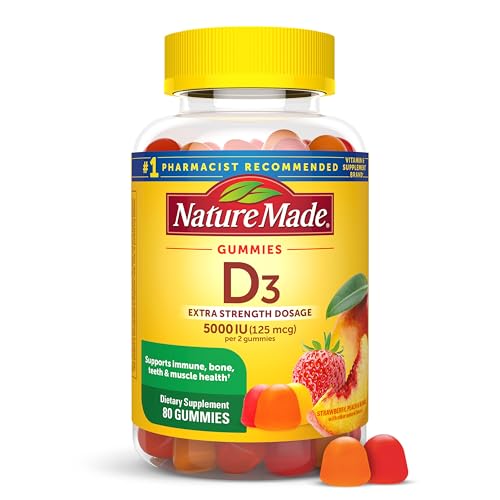
5. Nature Made Vitamin D3 5000 IU Extra Strength

4.7 (11,300 reviews)
$13.99
Nature Made Vitamin D3 5000 IU Extra Strength gummies bottle
Key Features:
  • 5,000 IU vitamin D3 per 1-gummy serving (125 mcg cholecalciferol)
  • USP Verified — same certification as the rest of the Nature Made line
  • 80 gummies per bottle, 80-day supply
  • Strawberry, peach, mango fruit-flavored, gluten free
  • 11,300+ reviews at 4.7★ — most-reviewed 5,000 IU D3 gummy on Amazon
Pros:
  • Pure D3 — no K2, no proprietary blend, no added “complex” ingredients
  • USP-verified at the clinical-correction dose, which is rare in gummy form
  • 80-day bottle delivers the longest supply at a deficiency-correction dose
  • Best pick if you already supplement K2 separately or use a vitamin K-rich diet
Cons:
  • No K2 — if you’re going to take 5,000 IU long-term, K2 pairing is meaningful
  • Sugar content per gummy is the same as the 2,000 IU bottle (~2 g), so per-IU sugar is best in class — but still 2 g of sugar daily
  • Overkill if you’ve never been tested — start at 2,000 IU first

Why I recommend it: If you’ve had bloodwork done, you know you’re deficient, and your doctor or your own research has you running the 5,000 IU/day clinical-correction protocol, this is the cleanest single-ingredient way to do it in gummy form. USP-verified, no stacked ingredients you didn’t ask for, 80-day supply at the dose that actually moves serum 25-OH D. Pair it with a separate K2 capsule if you want the calcium-routing protection.

Check Price on Amazon →

D3 vs D2: Why Form Matters

There are two main forms of supplemental vitamin D, and they are not interchangeable:

  • D3 (cholecalciferol) is the form your skin produces from UVB exposure and the form found in animal foods like egg yolks, fatty fish, and liver. It’s the form that most efficiently raises and maintains serum 25-hydroxyvitamin D levels.
  • D2 (ergocalciferol) is plant-derived (typically from yeast or fungi). It’s cheaper to produce, and it’s what most prescription “vitamin D” capsules historically used in the 50,000 IU pulse-dosing protocols. The problem: head-to-head trials consistently show D2 is roughly half as effective as D3 at raising serum levels, and the effect doesn’t last as long.

The practical implication: if a bottle just says “Vitamin D” without specifying D3 or cholecalciferol, you have to flip to the supplement facts panel and check. Every pick on this list is D3. If you’re vegan and need plant-sourced D3 (not D2), Sports Research uses lichen-derived cholecalciferol — true D3 from a non-animal source.

Why You Should Take K2 With Your D3

This is the part most vitamin D content skips entirely, and it’s the most important practical decision after dose:

Vitamin D’s main biological function is to upregulate calcium absorption from your gut. When you take a meaningful dose of D3, more calcium gets pulled out of food and put into your bloodstream. The question your body has to answer next is: where does that calcium go? The answer depends on vitamin K2.

K2 activates two proteins — osteocalcin and matrix Gla-protein (MGP). Osteocalcin pulls calcium into bone matrix, which is where you want it. MGP actively keeps calcium out of soft tissue, including arterial walls, which is where you do not want it. Without enough K2, the calcium D3 is mobilizing has no traffic cop. Long-term, this is the theoretical concern behind high-dose D3 monotherapy and arterial calcification.

Within K2 itself, there are two relevant subtypes:

  • MK-7 (menaquinone-7) — the form most research uses for cardiovascular and bone outcomes. Long half-life (~3 days), so once-daily dosing maintains stable blood levels. Every K2-containing pick on this list uses MK-7.
  • MK-4 (menaquinone-4) — short half-life (~6 hours), requires multiple daily doses to maintain effect. Used in some Japanese clinical protocols at much higher doses (45 mg/day) but largely irrelevant to consumer supplementation at typical gummy doses.

The honest framing: if you’re taking 2,000 IU/day of D3 for a few months, K2 pairing is nice-to-have. If you’re taking 5,000 IU/day long-term, K2 pairing is meaningful enough that the Nature Made D3 K2 stack or Sports Research vegan D3+K2 is worth the small price premium over a D3-only product.

How to Tell If You’re Deficient (Get the Test)

The only way to actually know your vitamin D status is a blood test — specifically the 25-hydroxyvitamin D test (25-OH D, also written as 25(OH)D). This is the standard lab marker. You can order it through your doctor for usually $30–60 with insurance, or direct-to-consumer through services like Quest, LabCorp, or Empower for around $40–80 cash.

The bands most clinicians use:

  • Below 20 ng/mL: Deficient. This is where the 40% of US adults sit per the NHANES dietary survey. Most clinicians correct with 5,000 IU/day or pulse dosing.
  • 20–30 ng/mL: Insufficient. You’re above clinical deficiency but below the range associated with the broader benefits in the research. 2,000–5,000 IU/day daily maintenance.
  • 30–50 ng/mL: The range most integrative and functional medicine practitioners target. 1,500–2,000 IU/day maintenance typically keeps you here.
  • 50–80 ng/mL: Higher than necessary but not dangerous. Some optimization-focused practitioners target this range; the evidence for benefit above 50 is thin.
  • Above 100 ng/mL: Approaching the range where hypercalcemia risk starts to be discussed. Stop and re-test.

The practical move: get tested before you start supplementing above 2,000 IU/day, and re-test 8–12 weeks after starting. Your serum response to a given oral dose is surprisingly variable — body weight, gut absorption, baseline status, and genetic variation in vitamin D binding all matter. Two adults on the same 5,000 IU bottle can end up at very different blood levels.

Who Should NOT Take High-Dose Vitamin D

Vitamin D is one of the better-tolerated supplements at moderate doses, but it’s not for everyone, and high-dose D3 has real contraindications:

  • Hyperparathyroidism or known hypercalcemia. Vitamin D raises serum calcium, which is exactly the wrong direction if your parathyroid is already over-mobilizing calcium.
  • Sarcoidosis, tuberculosis, or other granulomatous diseases. These conditions can cause uncontrolled activation of vitamin D, leading to hypercalcemia at doses that would be safe for most people.
  • Kidney disease or a history of calcium-oxalate kidney stones. High vitamin D can increase urinary calcium and stone risk. Talk to your nephrologist before exceeding 2,000 IU/day.
  • People on thiazide diuretics, digoxin, or calcium channel blockers. Vitamin D can interact with calcium-handling pathways these drugs depend on. Get medical guidance.
  • Pregnancy. Standard prenatal supplementation usually includes 400–600 IU. Going above that during pregnancy should be doctor-supervised.

The hard ceiling for self-supplementation is generally considered 10,000 IU/day. Above that, long-term, hypercalcemia risk climbs. Almost no one should be hitting that without a blood test and a clinician watching.

How We Picked These Gummies

The selection criteria, in order:

  1. D3, not D2. Cholecalciferol only. Any product using ergocalciferol was disqualified.
  2. At least 2,000 IU per serving. Anything at 1,000 IU was excluded because it doesn’t deliver the maintenance dose the Endocrine Society actually recommends.
  3. Form disclosure. The supplement facts panel must explicitly say “cholecalciferol” or “D3.” If K2 is included, it must specify MK-7 or MK-4.
  4. Manufacturer transparency. Major-brand QC track record (Nature Made, Sports Research, Amazon Basics) or USP/NSF/IGEN third-party verification.
  5. Real review volume. 1,000+ ratings minimum, weighted toward products with 5,000+ reviews.
  6. No proprietary blends hiding the D3 dose. If “Vitamin D3” was buried inside a 12-ingredient blend with no individual mg breakdown, it didn’t make the list.

I pulled supplement facts panels from 14 top-selling vitamin D gummies. Nine were dropped for falling below 2,000 IU, using D2, or hiding dose inside proprietary blends. The remaining 5 are above.

Frequently Asked Questions

How long does it take for vitamin D gummies to work?

If you’re taking 2,000 IU/day, you’ll see serum 25-OH D rise meaningfully over 8–12 weeks. At 5,000 IU/day, you’ll see correction faster — typically 6–10 weeks to move from deficient to sufficient. The subjective effects (energy, mood, immune resilience) lag behind the blood number and depend heavily on how deficient you were to start. Don’t expect to “feel” anything in week one.

Vitamin D from gummies vs sunlight — which is better?

Sunlight is the form your body evolved to use, and 10–20 minutes of midday sun on bare skin in summer can produce 10,000–20,000 IU. The catch is that effective UVB exposure requires the sun above ~50° in the sky, no sunscreen, and skin actually exposed. North of about 37° latitude (roughly San Francisco / Richmond), you produce essentially zero vitamin D from October to March. Most modern adults get nowhere near enough UVB year-round. Supplementation isn’t a replacement for sunlight; it’s a workaround for indoor life and northern latitudes.

Why take D3 + K2 together instead of just D3?

D3 increases calcium absorption from your gut. K2 (specifically MK-7) activates the proteins that direct that calcium into bone instead of into arterial walls. At maintenance D3 doses (2,000 IU), K2 pairing is nice-to-have. At clinical-correction doses (5,000 IU/day for months), pairing K2 is more meaningful because you’re moving more calcium and you want it routed properly. Nature Made D3 K2 and Sports Research Vegan D3+K2 are the cleanest stack picks on this list.

Can vitamin D actually fix winter depression?

The honest answer is “sometimes, partially.” Serum 25-OH D drops in winter for most adults living above ~37° latitude, and low vitamin D status is associated with seasonal affective symptoms in observational data. Randomized trials show modest mood improvement in deficient adults who get corrected, but vitamin D is not a substitute for light therapy, behavioral changes, or actual mental health treatment. If your mood drops every winter, get tested in January or February — your level will probably be lower than expected.

Is 5,000 IU vitamin D safe to take every day?

For most adults, yes — 5,000 IU/day is well below the 10,000 IU upper tolerable limit and is exactly the dose endocrinologists use for deficiency correction. The caveat is that “safe for most adults” isn’t “safe for everyone.” If you have a history of hypercalcemia, kidney stones, hyperparathyroidism, sarcoidosis, or take medications that interact with calcium handling, talk to your doctor first. And if you’re going to stay on 5,000 IU long-term, get a 25-OH D test once a year to make sure you’re not climbing above the range you want.

Does vitamin D need to be taken with food?

Yes — vitamin D is fat-soluble, so absorption improves substantially when taken with a meal that contains some fat. Gummies don’t help with this because the gummy matrix itself contains essentially no fat. Take your gummy with breakfast, lunch, or any meal that includes oil, butter, eggs, dairy, nuts, or meat. Taking it on an empty stomach with water is the worst-case absorption scenario.

Should I stack vitamin D with magnesium?

Practically, yes. Vitamin D activation in the liver and kidney is magnesium-dependent — chronically low magnesium can blunt the effect of vitamin D supplementation. If you’re correcting a deficiency, getting magnesium intake into the 300–400 mg/day range (food plus supplement) is a reasonable adjunct. See our guide to the best magnesium glycinate gummies for the picks that survived the spec check.

Final Thoughts

The honest version of this article is: 1,000 IU vitamin D gummies are the supplement industry’s most successful placebo. They’re priced at the dose people are willing to accept for a daily vitamin, not the dose that actually corrects the deficiency 40% of US adults are walking around with. If you’re going to take vitamin D, take a dose that does something.

If you’ve never been tested and want the safe, defensible starting dose, Nature Made 2,000 IU is the call — USP-verified, the Endocrine Society’s general maintenance dose, the highest-rated D3 gummy on Amazon. If you know you’re deficient or you live anywhere with a real winter, step up to the Nature Made D3 K2 5,000 IU stack — clinical-correction D3 paired with MK-7 K2 to route the calcium properly, USP-verified at the dose your doctor would actually use. If you want the cleanest cost-per-day for the whole household, Amazon Basics 2,000 IU is the best buy in the category, full stop.

And whatever you do — flip the bottle and read the supplement facts panel. If the form isn’t cholecalciferol (D3), the dose isn’t at least 2,000 IU per serving, or the K2 isn’t specified as MK-7, you’re paying for a placebo with a fruit flavor.

Our Top Picks

Best Overall: Nature Made Vitamin D3 K2 Gummies 5000 IU — clinical-correction D3 dose paired with MK-7, USP-verified.

Check Price on Amazon →

Best Value: Amazon Basics Vitamin D3 2000 IU Gummies — 80-day supply, lowest cost-per-day, 22,000+ reviews at 4.7★.

Check Price on Amazon →

Last updated: June 16, 2026. Prices and availability checked at time of publication. Amazon prices fluctuate — confirm current pricing on the product page. As an Amazon Associate, we earn from qualifying purchases at no extra cost to you.