Olly Kids Probiotic + Prebiotic Gummies (BC30 Bacillus coagulans)
Uses Bacillus coagulans GBI-30, 6086 (BC30) — a spore-forming strain that's naturally acid-resistant and actually survives the gummy format. Branded "kids" but the dose is fine for adults too. The strain has the strongest published survival data of any probiotic in chewable form.
Check Price on Amazon →At a Glance
- BEST OVERALL: Olly Kids Probiotic + Prebiotic Gummies — Why it's #1: The closest thing to an honest probiotic gummy on Amazon. BC30 is the most-published spore-forming strain for shelf stability and GI survival, paired here with a real prebiotic. The "kids" branding is the only thing keeping the price down — adult equivalents use the same strain at a 2-3x markup.
- BEST CLINICALLY STUDIED STRAIN: Culturelle Daily Probiotic Gummies — Why it's here: If you're going to take an unprotected Lactobacillus in gummy form, LGG is the strain. It's the workhorse of probiotic research — pediatric diarrhea, antibiotic-associated GI upset, general digestive maintenance. The Bacillus subtilis pairing is a sensible hedge: the spore-former gets through reliably, the LGG that survives does what LGG does.
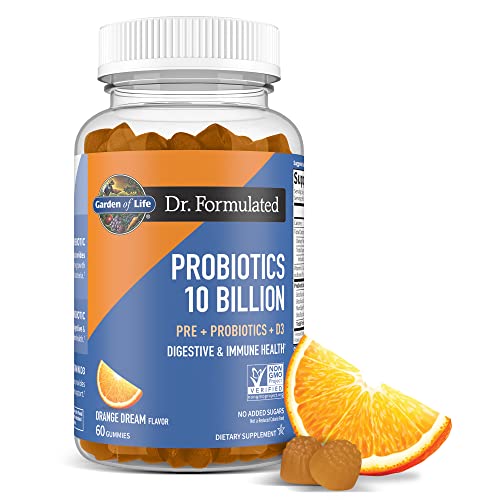
- BEST ADULT DAILY GUMMY: Garden of Life Dr. Formulated Probiotic Gummies — Why it's here: The adult-targeted, sugar-free version of the Olly formula with 20x the CFU and a vitamin D3 stack. Right strain for a gummy, generous dose, no added sugar feeding the wrong microbes on the way in. Pair with our best magnesium glycinate gummies guide for most of the "boring foundational stack" without touching capsules.
- BEST ORGANIC: MaryRuth Organics USDA Organic Probiotic Gummies — Why it's here: The only USDA Organic probiotic gummy that uses the right strain at a credible dose. Cane sugar is the trade-off you accept for an actually-organic gummy — there's no USDA Organic erythritol-sweetened gummy at this price point.
- BEST FOR ANTIBIOTIC RECOVERY: Florastor Daily Probiotic (S. boulardii) — Why it's here (and why it's a capsule): S. boulardii has the cleanest, most-targeted evidence base — antibiotic-associated diarrhea, traveler's diarrhea, post-GI recovery. There's no honest S. boulardii gummy because the yeast doesn't gummify well. If you're going on antibiotics, recovering from a stomach bug, or traveling somewhere with iffy water, this is the probiotic you actually want — leaving it out would be lying by omission.
| Product | Price | Rating |
|---|---|---|
| Olly Kids Probiotic + Prebiotic Gummies | $18.29 | 4.7★ |
| Culturelle Daily Probiotic Gummies | $13.99 | 4.7★ |
| Garden of Life Dr. Formulated Probiotic Gummies | $11.85 | 4.4★ |
| MaryRuth Organics USDA Organic Probiotic Gummies | $26.95 | 4.7★ |
| Florastor Daily Probiotic (S. boulardii) | $26.99 | 4.7★ |
Probiotic gummies are a $2 billion category built on a fragile premise: that the live bacteria on the label survive the trip from mouth, through stomach acid (pH 1.5-3.5), past bile salts, and arrive alive in your colon. For most of them, the math doesn’t work. Independent survival studies on unprotected Lactobacillus and Bifidobacterium strains in gummy form put delivery rates between 1% and 10% — meaning a 10-billion-CFU label can translate to 100 million bacteria actually reaching the gut.
This guide focuses on the few that survive the format honestly: spore-forming Bacillus coagulans, Saccharomyces boulardii (a yeast — immune to stomach acid), or clinically studied strains with published survival data. Our best ACV gummies guide covers the acetic-acid side of the gut-health conversation.
Health Disclaimer: Probiotics aren’t appropriate for everyone. Severely immunocompromised patients, those with central venous catheters or PICC lines, critically ill patients, and people with short bowel syndrome or recovering from major GI surgery should not take probiotics without medical clearance — bloodstream infections (including S. boulardii fungemia) have been documented in these populations. Separate probiotic and antibiotic doses by at least 2 hours so the antibiotic doesn’t kill the probiotic on contact. This article is educational, not medical advice. Talk to your doctor before starting any probiotic, especially if you’re pregnant, nursing, managing IBD or another chronic GI condition, or on prescription medication.
Why Most Probiotic Gummies Die in Your Stomach
CFU on the label tells you what’s in the gummy at the factory, not what reaches your gut. Live bacteria face three serial filters between mouth and colon. First, gastric acid — fasting stomach pH 1.5-3.5. Most Lactobacillus and Bifidobacterium strains, the two genera that dominate probiotic labels, aren’t adapted to it; in-vitro studies show 1- to 2-log reductions (90-99% kill) within 30-90 minutes at pH 2.0. Second, bile salts in the duodenum dissolve cell membranes — another log lost. Third, gummies dissolve in the mouth and stomach, dumping bacteria into the worst possible environment instead of carrying them deeper the way an enteric-coated capsule would.
Gummy-specific problems pile on: manufacturing heat denatures cultures, sugar feeds yeast and Streptococcus mutans rather than gut flora, and you can’t enteric-coat something that’s chewed. The category looks great in marketing and falls apart under a basic survival audit.
The honest exceptions are organisms that don’t need protection. Bacillus coagulans is spore-forming — it travels through the stomach in a dormant, armored spore state, then germinates in the small intestine. Studies on BC30 (GBI-30, 6086) show 90%+ survival through simulated gastric transit, an order of magnitude better than unprotected Lactobacillus. Saccharomyces boulardii is a yeast, not a bacterium — biologically immune to stomach acid and oral antibiotics. It’s the most-studied probiotic for antibiotic-associated diarrhea for a reason.
Strain matters more than CFU. L. rhamnosus GG has the strongest evidence base for general digestive support and pediatric diarrhea. B. lactis BB-12 has been studied for immune markers and bowel regularity. S. boulardii CNCM I-745 is the gold standard for antibiotic-associated diarrhea. A label that says “proprietary blend, 50 billion CFU” without naming strains is marketing.
The Strain Hierarchy: Why Bacillus Coagulans Wins in Gummy Format
Rank strains by how much actually reaches your colon alive in a chewable:
- Saccharomyces boulardii — yeast, biologically immune to stomach acid and antibiotics. ~90-100% GI survival.
- Bacillus coagulans (BC30, Unique IS-2, MTCC 5856) — spore-forming, naturally acid-resistant. 90%+ survival through gastric pH 2.0. Germinates in the small intestine.
- L. rhamnosus GG, B. lactis BB-12 — acid-sensitive but well-studied. Unprotected survival is 1-10%, but the strains are robust enough that what survives still does something.
- Generic “proprietary blend” Lactobacillus/Bifidobacterium — unspecified strains, no published survival data. The label CFU is fiction.
That’s why almost every honest probiotic gummy converges on Bacillus coagulans — not a marketing choice, the only thing that survives the format. A 50-billion-CFU “proprietary blend” with no strain numbers is technically accurate and functionally irrelevant.
Detailed Reviews
1. Olly Kids Probiotic + Prebiotic Gummies
Why it's #1: The closest thing to an honest probiotic gummy on Amazon. BC30 is the most-published spore-forming strain for shelf stability and GI survival, paired here with a real prebiotic. The "kids" branding is the only thing keeping the price down — adult equivalents use the same strain at a 2-3x markup.
- Strain class that actually survives a gummy format
- True synbiotic (probiotic + prebiotic)
- Same strain as adult products at a lower cost
- "Kids" branding — adults may feel weird
- 3g added sugar per serving
- Label CFU looks small next to "50 billion" competitors
2. Culturelle Daily Probiotic Gummies
Why it's here: If you're going to take an unprotected Lactobacillus in gummy form, LGG is the strain. It's the workhorse of probiotic research — pediatric diarrhea, antibiotic-associated GI upset, general digestive maintenance. The Bacillus subtilis pairing is a sensible hedge: the spore-former gets through reliably, the LGG that survives does what LGG does.
- LGG has the strongest evidence base of any single strain
- Bacillus subtilis hedges survival risk
- Specific strain identification (not "proprietary blend")
- LGG is acid-sensitive — expect CFU loss in transit
- Pricier per serving than Olly
- 3-4g added sugar per serving
3. Garden of Life Dr. Formulated Probiotic Gummies
Why it's here: The adult-targeted, sugar-free version of the Olly formula with 20x the CFU and a vitamin D3 stack. Right strain for a gummy, generous dose, no added sugar feeding the wrong microbes on the way in. Pair with our best magnesium glycinate gummies guide for most of the "boring foundational stack" without touching capsules.
- Higher CFU of the right strain — meaningful delivered dose
- No added sugar (rare in this category)
- D3 bundle is genuinely useful
- Most expensive per serving
- Erythritol can cause GI upset at higher doses
- Heat-sensitive — store away from light
4. MaryRuth Organics USDA Organic Probiotic Gummies
Why it's here: The only USDA Organic probiotic gummy that uses the right strain at a credible dose. Cane sugar is the trade-off you accept for an actually-organic gummy — there's no USDA Organic erythritol-sweetened gummy at this price point.
- USDA Organic = meaningful supply-chain oversight
- Correct strain for the format
- Short, clean ingredient list
- Organic cane sugar (2-3g per serving)
- Lower review count than Culturelle or Olly
- Higher per-serving cost than Olly
5. Florastor Daily Probiotic (S. boulardii)
Why it's here (and why it's a capsule): S. boulardii has the cleanest, most-targeted evidence base — antibiotic-associated diarrhea, traveler's diarrhea, post-GI recovery. There's no honest S. boulardii gummy because the yeast doesn't gummify well. If you're going on antibiotics, recovering from a stomach bug, or traveling somewhere with iffy water, this is the probiotic you actually want — leaving it out would be lying by omission.
- Immune to oral antibiotics — can be co-dosed
- Strong clinical evidence for actual use cases
- 16,000+ reviews — extensive track record
- Capsule, not a gummy (included anyway — see below)
- Not for immunocompromised or central-venous-catheter patients (fungemia risk)
- Pricier per capsule than Bacillus options
CFU Count vs Survival Rate
CFU (“colony-forming units”) is measured at the time of manufacture. From there:
- Shelf decay. Refrigerated probiotics lose 10-50% potency over their shelf life. Unrefrigerated gummies in a warm cabinet or summer warehouse can lose 50-90% before you open the bottle.
- Gastric kill-off. The 1-10% survival rate above is against the dose you swallow — already lower than the label.
- Transit, not colonization. Most strains don’t colonize long-term. They pass through, do their thing for a few days, and leave. That’s why “daily” protocols exist.
Translation: a “50 billion CFU” generic Lactobacillus blend after six months on a shelf and a trip through your stomach delivers maybe 500 million live cells — same as a 5B-CFU Bacillus coagulans gummy on day one. The honest comparison is “delivered dose of a named strain,” not the label number.
Probiotics vs Prebiotics vs Postbiotics: A Quick Tour
- Probiotics — live microorganisms. The bacteria themselves.
- Prebiotics — non-digestible fibers (inulin, FOS, GOS) that feed the bacteria already living in your gut. Cheaper, more stable, and arguably more impactful than probiotics for most people.
- Postbiotics — metabolic byproducts of probiotic activity (short-chain fatty acids like butyrate). Promising but early-stage as a category.
- Synbiotics — probiotic + prebiotic in one product. The Olly and Garden of Life picks above qualify.
For most people, eating more fiber and fermented foods outperforms a $30 gummy bottle. Gummies are convenience-format insurance, not a replacement.
When You Should Actually Take a Probiotic
Probiotics have a small number of evidence-backed use cases. Outside these, you’re probably wasting money:
- During and after antibiotics. S. boulardii has the best evidence for preventing antibiotic-associated diarrhea. Take during the course and 1-2 weeks after.
- Traveler’s diarrhea prevention. S. boulardii, started a few days before travel. LGG has supporting data.
- Post-GI infection recovery. Probiotic supplementation may speed reestablishment of normal flora after a pathogen.
- IBS-D. Specific strains — Bifidobacterium infantis 35624, S. boulardii — have symptom-reduction evidence.
- C. difficile recurrence prevention (under medical supervision). S. boulardii is the most-studied.
- Pediatric acute infectious diarrhea. LGG and S. boulardii.
What the evidence is much weaker for: daily wellness, generalized “immune support,” fat loss, mood (gut-brain hype outpaces the data), and “boosting” a healthy gut. If you eat fiber, eat fermented foods, sleep enough, and aren’t on antibiotics, a daily probiotic gummy is closer to a placebo with calories. Our best fish oil guide covers something with much stronger maintenance-dose evidence.
Who Should NOT Take Probiotics
Generally safe for healthy adults, but several populations face documented risks:
- Severely immunocompromised patients (chemotherapy, post-transplant, advanced HIV) — case reports of bacteremia and fungemia
- Central venous catheter or PICC line patients — S. boulardii fungemia has been documented from catheter-site contamination, including in family members of patients taking it
- Critically ill ICU patients — a 2008 severe acute pancreatitis trial showed increased mortality with probiotic supplementation
- Short bowel syndrome and severe IBD flares — bacterial translocation risk
- Premature infants — only under neonatologist supervision
If you’re in any of these categories, talk to your doctor before self-prescribing.
How We Picked These
- Strain transparency. Must name specific strains (genus, species, and ideally strain designation like BC30 or CNCM I-745). “Proprietary blend” was an automatic disqualifier.
- Format-strain match. Gummies must use a strain with documented oral-format survival (primarily Bacillus coagulans). Acid-sensitive Lactobacillus in unprotected gummy form needed extra evidence (e.g., LGG’s track record).
- Brand quality control. Established supplement brands, not Amazon drop-shippers.
- Reviews. Minimum ~700 verified Amazon reviews with 4.3★+ average.
- Honesty about CFU. No inflated numbers on weak strains.
We rejected over a dozen “50 billion CFU multi-strain” gummies for refusing to name strains or using acid-sensitive Lactobacillus blends with no protective formulation.
Honest Limitations of This Guide
We can rank these gummies on strain science and survival plausibility with reasonable confidence. What we can’t do is promise a specific health result — the honest gaps:
- The survival percentages are ranges from simulated-gut and general strain research, not batch tests of these exact SKUs. “Bacillus coagulans survives ~90% of gastric transit” describes the strain class; we did not culture the delivered dose out of each specific bottle. Shelf age, storage temperature, and the manufacturing lot all move the real number.
- Even a strain that arrives alive doesn’t reliably colonize. Most probiotics are transient — they pass through, act for a few days, and leave. That’s a limitation of probiotics generally, not these products specifically, and it’s why the daily-wellness use case has the weakest evidence of anything on the list.
- CFU on the label is a factory number, and we’re taking the manufacturers at their word on strain identity. We disqualified “proprietary blend” listings, but even named-strain claims are self-reported. Third-party-verified potency is rare in the gummy category, so treat any single CFU figure as an upper bound, not a delivered dose.
Frequently Asked Questions
Probiotic gummies vs capsules — which is better?
Capsules win on dose certainty, strain flexibility, and survival (especially with delayed-release coatings). Gummies win on compliance. If you’ll take a gummy daily and forget a capsule on the shelf, the gummy wins — just take one built around Bacillus coagulans, the strain class engineered to survive the format.
Do I need probiotics if I eat yogurt or kefir?
Probably not, for daily maintenance. Plain live-culture yogurt or kefir delivers billions of CFU of well-studied strains in a food matrix that buffers stomach acid better than a gummy. Fermented foods are the budget option that’s mostly as good or better than a daily supplement.
How long until probiotic gummies “work”?
Depends what you’re treating. S. boulardii for antibiotic-associated or traveler’s diarrhea: days. IBS symptom changes: 4-8 weeks. “General gut health” has no defined endpoint, which is part of why the daily-wellness case is weak.
Do probiotic gummies need to be refrigerated?
Shelf-stable formulations (Bacillus coagulans, S. boulardii) don’t. Lactobacillus and Bifidobacterium-heavy ones ideally should be refrigerated after opening even if the label says shelf-stable. Heat is the enemy — don’t leave them in a hot car.
What’s the best probiotic gummy for IBS?
For IBS specifically, the strongest evidence is for capsules — Bifidobacterium infantis 35624 (Align) for general IBS, S. boulardii for IBS-D. Gummies are not the format with the IBS evidence. If you’re managing IBS, the Florastor pick is closer to the right answer than any gummy.
Can I take a probiotic gummy with antibiotics?
Yes, but separate by at least 2 hours. Antibiotics kill bacterial probiotics on contact. S. boulardii is the exception — it’s a yeast, so antibiotics don’t touch it, which is why it’s the go-to during antibiotic courses.
Are probiotic gummies safe for kids?
Most are safe for ages 3+. Not for infants without pediatrician approval. Avoid in premature infants outside medical supervision.
Final Thoughts
Most probiotic gummies on Amazon are sugar-format insurance against a problem you might not have — inflated CFU numbers on acid-sensitive strains sold for the daily-wellness use case where the evidence is thinnest. If you read the supplement panel and find a named, spore-forming strain like Bacillus coagulans BC30, you’re looking at one of the few products doing what the front of the bottle implies.
Olly Kids Probiotic + Prebiotic is our pick if you just want a daily synbiotic gummy that survives transit — it’s also the cheapest correct answer. Garden of Life Dr. Formulated is the no-added-sugar adult version at a higher dose. If you’re taking probiotics for an actual reason — antibiotics, traveler’s diarrhea, GI illness recovery — skip gummies entirely and take Florastor. For the rest of the foundational stack, our best magnesium glycinate gummies and best fish oil guides cover interventions with stronger maintenance-dose evidence.
Last updated: July 01, 2026 at 01:11 PM ET. Prices and availability shown are accurate as of this time and are subject to change. As an Amazon Associate, DeskFitPro earns from qualifying purchases.