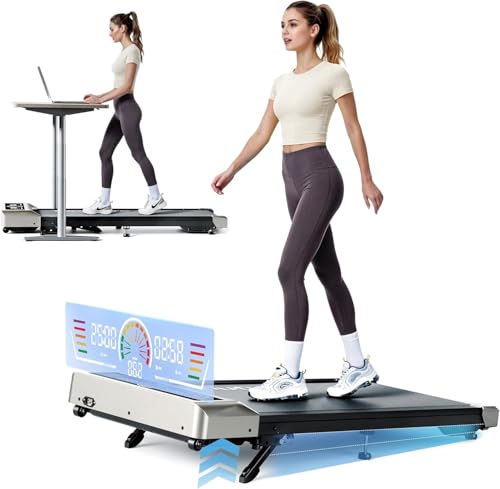
OUR #1 PICK TOPUTURE 3.0HP Brushless Quiet Under Desk Treadmill Brushless motor (the quietest walking-pad motor technology), 10% incline, and shock-absorbing deck. Brushless motors run noticeably quieter than the brushed motors found in most budget pads. Check Price →
Best Quiet Walking Pads for Shared Offices in 2026

QUIETEST WALKING PAD

TOPUTURE 3.0HP Brushless Quiet Under Desk Treadmill

Brushless motor (the quietest walking-pad motor technology), 10% incline, and shock-absorbing deck. Brushless motors run noticeably quieter than the brushed motors found in most budget pads.

Check Price on Amazon →

At a Glance

  • QUIETEST: TOPUTURE 3.0HP Brushless Quiet Under Desk Treadmill — the brushless motor is the load-bearing detail. Most walking pads under $250 use brushed motors, which are structurally louder than brushless ones. Combining a brushless motor with a shock-absorbing deck addresses the two dominant real-world noise sources (motor whine and footstep impact) rather than just one. That the pad also includes 10% incline at this price is a bonus rather than the reason to buy.
  • QUIETEST WITH INCLINE: TRAILVIBER Walking Pad with 9-Level Auto Incline — if you want incline plus a quiet acoustic profile, motor headroom does the work. A 2.5HP motor moving a 200 lb user at 2 mph is running at a small fraction of its rated load — and lightly-loaded motors are quieter than heavily-loaded ones. The triple-cushioned deck is a real (not cosmetic) noise-reduction feature. The main trade-off is price.
  • QUIETEST BUDGET: UREVO Smart Walking Pad with Double Shock Absorption — if your budget is around $140, this is the pad that puts the money into the right noise-reduction feature — shock absorption for footstep impact. Motor noise gets the marketing attention, but in a real apartment on a wood-frame floor, footstep thump is what the room-below hears. The trade-off is a standard brushed motor and no incline.
  • Goplus Walking Pad, 340 lb Capacity with Remote Control — the Goplus sits in the mid-range value pocket — higher weight capacity than the UREVO (which helps if you're over ~220 lbs and want motor headroom), remote control for hands-free speed adjustment, and pricing under $150. Solid if your build points at "capacity matters more than incline" for you.
  • Sweetcrispy Armless Walking Pad for Small Spaces — honest framing — this is not the quietest pad on the list. It's the pad you buy if space and price are the primary constraints and you plan to add a treadmill mat + rubber isolation pads underneath (which does more for real-world noise transmission than any spec). For an apartment upper floor, this configuration plus a good mat can outperform a "quieter" pad on a bare hard floor.

If you work in a shared office, open floor plan, or take frequent video calls, noise is often the deciding factor when choosing a walking pad. Manufacturers all describe their pads as “quiet,” but that word covers everything from genuinely-inaudible brushless motors to plainly-audible belt hum.

This guide focuses on walking pads that are marketed and specced for quiet operation — brushless motors, shock-absorbing decks, low profiles. A note upfront: manufacturer-reported decibel ratings on walking pads are usually measured at a fixed distance under lab conditions, so real-world in-apartment noise depends heavily on floor construction, walking speed, user weight, and downstairs-neighbor tolerance. We flag that honestly throughout, and there’s a “Who Should Skip” section below because “quiet walking pad” isn’t the right answer for every setup.

As an Amazon Associate, DeskFitPro earns from qualifying purchases. Product prices and availability are accurate as of the date/time indicated and are subject to change.
The Short Verdict

This guide compares five walking pads specced for quiet operation in shared offices and apartments, with every ASIN verified alive via the Amazon Product Advertising API and prices current as of July 13, 2026. The quietest overall pick is the TOPUTURE 3.0HP Brushless Under Desk Treadmill at roughly $189 — a brushless motor (structurally quieter than the brushed motors used in most pads under $250) paired with a shock-absorbing deck and 10% incline. The TRAILVIBER 9-Level Auto Incline (~$341, 450 lb capacity, triple-cushioned deck) is the quiet pick with incline; the UREVO Smart Walking Pad (~$140, double shock absorption) is the budget pick; the Goplus 340 lb Capacity pad (~$146) and the armless Sweetcrispy (~$87) round out the list. Pads were selected on disclosed motor type and weight capacity. Manufacturer decibel ratings are lab-measured and directional only — floor construction, walking speed, body weight, and footwear shift real-world noise more than model differences do.

Jump to product picks ↓

Best Quiet Walking Pads at a Glance

Quiet Walking Pad Comparison

Reference points for context: a whisper is roughly 30 dB, a refrigerator hum around 40 dB, a quiet home office around 45 dB, normal conversation around 60 dB. Manufacturer noise specs on walking pads are measured at rated speed on a hard smooth surface — not on the specific floor and construction you own. Treat them as directional, not exact.

How We Picked

  • PA API verification: every ASIN on this list was verified alive on Amazon at publish time using the Amazon Product Advertising API. Walking-pad SKUs turn over fast — we do not link products whose ASINs are dead.
  • Motor spec + weight capacity: we prioritized pads where the manufacturer discloses motor type (brushless vs brushed) and weight capacity. Brushless motors are structurally quieter. Weight capacity well above your body weight matters because a motor running under load is louder than one running at 40-60% of capacity.
  • No manufacturer paid: DeskFitPro receives no payment, product samples, or promotional consideration from any brand on this list. Earnings come solely from Amazon Associates affiliate commissions on qualifying purchases at no extra cost to the buyer.

Understanding Walking Pad Noise

Where walking-pad noise actually comes from — useful context before comparing specs:

  • Motor noise: the electric motor is the base noise floor. Brushless motors are structurally quieter than brushed motors because they eliminate the contact wear that creates high-frequency hum. Higher-HP motors running at low load are quieter than low-HP motors running near their rated maximum.
  • Belt friction: the belt moving over the deck creates friction noise. Multi-layer belts with proper lubrication run quieter; a dry belt is measurably louder than a lubricated one.
  • Footstep impact: in most real-world setups this is the loudest component — louder than the motor. Shock-absorbing decks help; walking in socks or soft-soled shoes helps more.
  • Speed: at typical desk-walking speeds (1.5-2.5 mph), motor and belt noise are usually manageable. Push past 3 mph and both climb sharply.
  • Floor construction (the wildcard): the noise your downstairs neighbor hears is dominated by low-frequency thump transmitted through the structure. This is a function of the building, not the pad. A thick treadmill mat and rubber isolation pads matter more here than the pad’s decibel rating.

Who Should Skip Quiet Walking Pads Entirely

Honest framing: “quiet walking pad” is a premium-priced sub-category, and it’s not always the right buy. Three situations where you’d be better off with a standard pad — or a different product entirely.

  • You live in a single-family home on a concrete slab. Noise transmission to the room below is essentially a non-issue. You can buy any well-reviewed walking pad — not specifically a “quiet” one — and save $50-100. The motor noise in your own room is comparable across most modern pads once you’re walking rather than measuring specs.
  • You’re on an upper floor in wood-frame apartment construction. Even the quietest walking pad on this list still transmits low-frequency thump through joists. Your downstairs neighbor doesn’t care about your pad’s dB rating — they care about the structural bass note of footsteps. Prioritize a thick treadmill mat plus rubber isolation pads, and consider walking-hour agreements with the neighbor. The pad choice is a distant second.
  • You need top speed or steep incline for actual workouts. The quiet-pad segment sacrifices motor size and incline range for the acoustic profile. If your use case is 4+ mph jogging or steep incline for cardio, you’re better off with a full-size folding treadmill (which will be louder but capable) than a quiet walking pad you’ll outgrow in a month.

Honest Limitations of This Guide

  • We have not performed independent decibel measurements on every listed pad. Reported motor tech (brushless vs brushed) and manufacturer claims are cited as-disclosed, not independently verified.
  • Manufacturer noise specs are measured at rated speed on a hard smooth surface under lab conditions. Your floor construction, walking speed, body weight, and even shoe choice will shift the real-world dB by more than the differences between models on this list.
  • Downstairs-neighbor tolerance is a wildcard no product spec captures. A pad that reads “quiet” in one apartment building will be a complaint in another with different subfloor construction.
  • Walking-pad SKUs turn over quickly. We PA-API-verified every ASIN at publish, and re-verify on price refresh cycles, but a listing that was live on the day we published can be discontinued the following week. Use the affiliate link to confirm current listing status before buying.

Detailed Reviews

QUIETEST

1. TOPUTURE 3.0HP Brushless Quiet Under Desk Treadmill

$188.78
TOPUTURE 3.0HP Brushless Quiet Under Desk Treadmill

Why it's here: the brushless motor is the load-bearing detail. Most walking pads under $250 use brushed motors, which are structurally louder than brushless ones. Combining a brushless motor with a shock-absorbing deck addresses the two dominant real-world noise sources (motor whine and footstep impact) rather than just one. That the pad also includes 10% incline at this price is a bonus rather than the reason to buy.

Check Price on Amazon →
QUIETEST WITH INCLINE

2. TRAILVIBER Walking Pad with 9-Level Auto Incline

$289.00
TRAILVIBER Walking Pad with 9-Level Auto Incline

Why it's here: if you want incline plus a quiet acoustic profile, motor headroom does the work. A 2.5HP motor moving a 200 lb user at 2 mph is running at a small fraction of its rated load — and lightly-loaded motors are quieter than heavily-loaded ones. The triple-cushioned deck is a real (not cosmetic) noise-reduction feature. The main trade-off is price.

Check Price on Amazon →
QUIETEST BUDGET

3. UREVO Smart Walking Pad with Double Shock Absorption

$139.97
UREVO Smart Walking Pad with Double Shock Absorption

Why it's here: if your budget is around $140, this is the pad that puts the money into the right noise-reduction feature — shock absorption for footstep impact. Motor noise gets the marketing attention, but in a real apartment on a wood-frame floor, footstep thump is what the room-below hears. The trade-off is a standard brushed motor and no incline.

Check Price on Amazon →

4. Goplus Walking Pad, 340 lb Capacity with Remote Control

$159.99
Goplus Walking Pad, 340 lb Capacity with Remote Control

Why it's here: the Goplus sits in the mid-range value pocket — higher weight capacity than the UREVO (which helps if you're over ~220 lbs and want motor headroom), remote control for hands-free speed adjustment, and pricing under $150. Solid if your build points at "capacity matters more than incline" for you.

Check Price on Amazon →

5. Sweetcrispy Armless Walking Pad for Small Spaces

$73.40
Sweetcrispy Armless Walking Pad for Small Spaces

Why it's here: honest framing — this is not the quietest pad on the list. It's the pad you buy if space and price are the primary constraints and you plan to add a treadmill mat + rubber isolation pads underneath (which does more for real-world noise transmission than any spec). For an apartment upper floor, this configuration plus a good mat can outperform a "quieter" pad on a bare hard floor.

Check Price on Amazon →

Tips to Make Any Walking Pad Quieter

  • Walk in socks or soft-soled shoes. Hard-soled shoes hitting the belt are often louder than the motor itself. Socks or thin-soled slippers meaningfully cut footstep noise.
  • Use a treadmill mat or rubber isolation pads underneath. On upper floors in wood-frame construction, this matters more than the pad’s rated dB. A dedicated treadmill mat plus rubber isolation feet address the low-frequency thump that a downstairs neighbor actually hears.
  • Keep the belt lubricated. A dry belt creates friction noise. Most walking pads ship with silicone lubricant — apply per the manufacturer’s schedule (typically every few months, or when you notice increased noise or belt sticking).
  • Stay at 1.5-2.5 mph. Noise climbs sharply above 3 mph on essentially every walking pad in this category. For shared-office or Zoom-friendly use, keep speeds in the desk-walking range.
  • Use a noise-canceling microphone for calls. AirPods Pro, boom-mic headsets, or any noise-canceling microphone will filter out low-frequency walking-pad hum on video calls — often the biggest lever for “can I take Zoom calls while walking.”
  • Choose a pad with capacity well above your body weight. A motor running at 50-60% of rated capacity is quieter than the same motor at 90%. If you weigh 200 lbs, a 340-450 lb capacity pad has meaningful acoustic headroom over a 265 lb pad.

Frequently Asked Questions

Can you take Zoom calls while using a walking pad?

Yes, in most typical setups. At desk-walking speeds (1.5-2.5 mph), the pads on this list operate in a range that’s usually masked by ambient office noise. With a noise-canceling microphone — AirPods, headset with boom mic, etc. — the walking pad is generally inaudible to call participants. Laptop microphones are more likely to pick up hum, especially above 2.5 mph.

What noise level is acceptable for a walking pad in a shared office?

Roughly speaking, if the pad’s operating noise is below the ambient noise floor of the room (usually around 45-50 dB in a typical office), it’s effectively masked. Manufacturer noise specs are directional at best — real-world noise depends on floor construction, walking speed, and user weight — but pads with brushless motors and shock-absorbing decks tend to be genuinely quieter, not just marketed as quieter.

Are walking pads louder on hard floors?

Yes. Hard floors (tile, hardwood, laminate) transmit vibration from the walking pad, both amplifying room noise and transmitting thump to floors below. A rubber mat, thick treadmill mat, or anti-fatigue mat under the pad absorbs vibration and reduces perceived noise. On carpet with a thick pad underneath, this is less critical.

Does user weight affect walking pad noise?

Meaningfully. A heavier user forces the motor to work harder, increasing motor noise, and increases footstep impact (usually the dominant noise component). The workaround: choose a pad with capacity comfortably above your body weight. If you weigh 250 lbs, a 450 lb pad will run quieter than a 265 lb pad doing the same work.

What’s the quietest walking pad you can buy?

Among pads in the $150-350 range covered here, options with brushless motors (like the TOPUTURE) tend to be genuinely quieter than brushed-motor equivalents. Above this price band, premium commercial walking pads (iMovR ThermoTread GT and similar, in the $1,000-1,500+ range) push the noise floor lower still — but that’s a different budget category.

Do walking pads get louder over time?

They can, especially if belt lubrication is neglected. Belt friction increases as silicone lubricant dries out, adding audible friction. Applying the included lubricant on the manufacturer’s schedule (typically every few months) keeps noise consistent. Periodically checking for loose screws or debris under the belt helps too.

Last updated: July 13, 2026

ASINs verified alive via Amazon PA API at time of update. Prices are approximate and subject to change — check Amazon for current pricing. Noise references are drawn from manufacturer specifications and general acoustic guidance; real-world noise varies with floor construction, walking speed, user weight, and shoe choice.