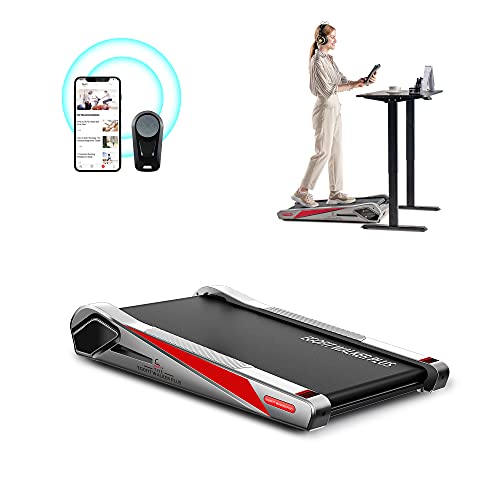
TRAILVIBER Walking Pad Treadmill with 9-Level Auto Incline
12% powered auto-incline across 9 levels, 450 lb capacity, 2.5 HP brushless motor, triple-cushioned deck, hiking mode, and a Bluetooth speaker — the most usable incline pad under $300 we evaluated.
Check Price on Amazon →At a Glance
- TOP PICK: TRAILVIBER Walking Pad Treadmill with 12% 9-Level Auto Incline — The TRAILVIBER is the rare walking pad where the incline is actually the headline feature, not an afterthought. Nine levels with auto-adjust means you can run a real 12-3-30 session, drop to 6% for a recovery block, and ramp back up without breaking stride. The 450 lb capacity matters more than people realize — heavier users put more load on the deck at grade, and most sub-$300 pads simply can't handle it for long. This one was built around the load, not in spite of it. It's the pad I'd buy if I were starting over today.
- HIGHEST INCLINE: TOPUTURE Walking Pad with 15% 15-Level Auto Incline — If your goal is to push the metabolic equivalent ceiling — to do a 15-3-30 instead of 12-3-30, or to use the pad as a structured cardio device rather than a desk accessory — this is the pad. The extra grade is real, the motor can sustain it, and the level resolution lets you tune intervals tighter than the TRAILVIBER. The trade-off is that you wouldn't actually type while walking at 15%. Pick this if your walking pad doubles as your cardio machine.
- QUIETEST: MERACH W50 Walking Pad with 12% Auto Incline — The MERACH W50 is the pad I'd buy if I were going to put it in a home office where someone else has to hear it. The 3.5 HP brushless motor is overkill for steady walking — and that's exactly why it stays quiet under inclined load. Most walking pad motors get loud when you tilt the deck because they're operating near their max rated output; this one barely notices. Pair it with the 12% incline and you've got a pad that can drive a real cardio session in a room where someone's on a call.
- BUDGET PICK: Viamotion Walking Pad with Incline and Handle Bar — Manual incline catches a lot of flak, and most of it is unfair. Yes, you can't run intervals — but if you walk one inclined session per day, a fixed grade is enough. The Viamotion nails the budget question: it gives you a real, measurable 4-degree manual grade for materially less money than any powered-incline option here, plus a foldable handle bar, an LED display, and a remote. With 1,500+ reviews at 4.3 stars and an Amazon's Choice badge, the value story is well validated. Mind the 265 lb weight capacity. Buy this if you want the cardio benefit of incline without paying for the auto-adjust convenience.
- Egofit Walker Pro/Plus — Fixed 5% Incline — The Egofit is the only pad on this list designed with the assumption that you'll be typing the entire time you walk. The fixed 5% grade is too mild to drive a real workout — but it's exactly steep enough that 8 hours of casual desk walking burns meaningfully more calories than a flat pad would. If your goal is incremental, all-day movement at low intensity (the actual reason most people buy walking pads), the Egofit's fixed grade is more useful than any powered system. If your goal is structured cardio, this is the wrong pad.
| Product | Price | Rating |
|---|---|---|
| TRAILVIBER Walking Pad Treadmill with 12% 9-Level Auto Incline | $289.00 | 4.5★ |
| TOPUTURE Walking Pad with 15% 15-Level Auto Incline | $374.99 | 4.4★ |
| MERACH W50 Walking Pad with 12% Auto Incline | $299.98 | 4.4★ |
| Viamotion Walking Pad with Incline and Handle Bar | $114.99 | 4.3★ |
| Egofit Walker Pro/Plus — Fixed 5% Incline | $555.99 | 4.3★ |
The best walking pad with incline in 2026 is the TRAILVIBER 9-Level Auto Incline Walking Pad ($299) — 12% powered auto-incline, 450 lb capacity, a 2.5 HP brushless motor, and a hiking mode that adjusts grade for you mid-walk. Every pad on this list has been picked specifically for incline performance: power vs manual, max grade, how it handles weight at a slope, and whether it can actually run the now-infamous “12-3-30” workout without stalling.
Incline is the spec most walking pad buyers skip, and it’s the one I’d argue matters most. Walking at 3 mph on a 10–12% grade puts you into roughly the same metabolic zone as jogging 6 mph on flat ground — but with a fraction of the joint impact. That’s the entire reason every flat-only walking pad eventually disappoints: to get a real cardio response, you end up pushing the belt faster than the deck was designed for, the bushings wear, and the motor cooks. An inclined pad lets you walk slower, breathe harder, and finish with knees intact.
The Short Verdict
This guide compares five walking pads with incline sold on Amazon. The top pick is the TRAILVIBER (4.5 stars, about $299), with 12% powered auto-incline across nine levels, 450 lb capacity, a 2.5 HP brushless motor, a triple-cushioned deck, and a hiking mode that adjusts grade mid-walk. The TOPUTURE (4.4 stars) offers the highest grade at 15% across 15 powered levels on a 3.0 HP brushless motor; the MERACH W50 (4.4 stars) is the quietest, with a 3.5 HP brushless motor and 400 lb capacity at 12%; the Viamotion (4.3 stars, $114.99) is the budget pick with a fixed 4-degree manual incline; and the Egofit Walker Pro/Plus (4.3 stars) has a fixed 5% grade for all-day desk walking. Selection required verifiable incline, a motor of at least 2.0 HP, review ratings of 4.0 stars or better, and adequate weight capacity at grade. Last verified August 8, 2026.
Why Incline Matters More Than Speed for Heart Rate
Walking pads get marketed on top speed. That’s the wrong number to chase. For an under-desk treadmill, you’ll never actually use the top speed — typing at 4 mph is impossible, and most belts in this category aren’t built to sustain a run regardless. What you’ll use, every single workout, is the grade.
The metabolic math is straightforward. MET research consistently puts steady walking at 3.0 mph on flat ground at roughly 3.3 METs — a brisk-but-easy effort. Add a 10% incline at the same 3.0 mph and you’re looking at something close to 8 METs, which is the same neighborhood as running an 8-minute mile on flat ground. You haven’t changed pace. You haven’t added pounding. You’ve just tilted the deck.
That’s the reason a 5’2”, 130 lb desk worker can do a 30-minute inclined walk and finish noticeably winded, while the same person on a flat pad has to push to 3.5–4.0 mph and a near-jog just to get the heart rate up. Incline buys you intensity without speed, and intensity without speed is the whole game on a walking pad.
There’s a second reason it matters: deck life. Belts, rollers, and bushings on a sub-$300 walking pad are sized for steady walking — 1.5 to 2.5 mph for hours, not bursts at 4. Every minute you spend pushing the belt faster than its designed operating range, you’re eating into bearing life. Incline lets you stay at a deck-friendly speed and still get a workout. Cheaper to maintain. Quieter. And much, much easier on the knees.
Best Walking Pads with Incline at a Glance
- Best Overall: TRAILVIBER 9-Level Auto Incline — 12% powered auto-incline, 450 lb capacity, hiking mode
- Highest Max Incline: TOPUTURE 15% 15-Level Auto Incline — 15% across 15 powered levels, 3.0 HP brushless, RGB display
- Quietest Inclined Pad: MERACH W50 with 12% Auto Incline — 3.5 HP super-quiet brushless, 400 lb capacity, app control
- Best Budget Manual Incline: Viamotion Manual Incline — fixed 4-degree manual incline, 4.3★, foldable handle bar
- Best Office-Only Fixed Incline: Egofit Walker Pro/Plus — fixed 5% incline, ultra-compact, app + remote
The Incline Spec Sheet: Power vs Manual, Max Grade, Auto-Adjust
Not all “incline” is the same. The word gets stamped on listings that include everything from a powered motor that drives the deck up to a programmable grade, all the way down to a pair of plastic feet that prop one end of the pad two inches higher. Here’s how to read the spec sheet before you spend money.
Powered auto-incline is the gold standard. A small motor under the deck raises and lowers the running surface in fixed levels — usually 3, 9, 12, or 15 — and you change grade with the remote or app while walking. This is the only kind of incline that lets you do interval training. Expect to pay $250 and up for genuine powered incline; the TRAILVIBER, TOPUTURE, and MERACH on this list all qualify.
Manual fold-up incline means feet or struts at one end that you set before the walk. One to three fixed grades, no mid-walk adjustment. The Viamotion is the cleanest example — set its 4-degree grade and go. It’s still a real grade, and it still drives heart rate up, but you can’t run intervals and you have to step off to change it.
Fixed-frame incline is what you’ll find on ultra-compact office pads like the Egofit. The deck is permanently angled at a low grade (usually 5%) — you can’t change it. The trade-off is that the whole machine is much smaller and simpler, which is exactly what you want under a real desk.
Max grade is the headline number. Most walking pads cap at 12%; a handful (TOPUTURE, some 15-level models) push to 15%. Above 12%, your heel-to-toe stride starts to break down at walking speeds — the deck is steep enough that you’re effectively hiking — so 15% is genuinely useful but not strictly necessary for most users. The 12-3-30 protocol that drove this whole category was built around 12%, and that remains the sweet spot.
Motor HP under grade. Watch this one. A 2.25 HP motor that handles a 200 lb walker fine on flat will labor at 12% with the same load. For inclined work, especially if you’re over 200 lbs, look for 2.5 HP minimum and ideally 3.0+ HP brushless. Brushless motors run cooler at sustained load — which is exactly the load profile incline puts on them.
Detailed Reviews
1. TRAILVIBER Walking Pad Treadmill with 12% 9-Level Auto Incline
Why it's here: The TRAILVIBER is the rare walking pad where the incline is actually the headline feature, not an afterthought. Nine levels with auto-adjust means you can run a real 12-3-30 session, drop to 6% for a recovery block, and ramp back up without breaking stride. The 450 lb capacity matters more than people realize — heavier users put more load on the deck at grade, and most sub-$300 pads simply can't handle it for long. This one was built around the load, not in spite of it. It's the pad I'd buy if I were starting over today.
Check Price on Amazon →2. TOPUTURE Walking Pad with 15% 15-Level Auto Incline
Why it's here: If your goal is to push the metabolic equivalent ceiling — to do a 15-3-30 instead of 12-3-30, or to use the pad as a structured cardio device rather than a desk accessory — this is the pad. The extra grade is real, the motor can sustain it, and the level resolution lets you tune intervals tighter than the TRAILVIBER. The trade-off is that you wouldn't actually type while walking at 15%. Pick this if your walking pad doubles as your cardio machine.
Check Price on Amazon →3. MERACH W50 Walking Pad with 12% Auto Incline
Why it's here: The MERACH W50 is the pad I'd buy if I were going to put it in a home office where someone else has to hear it. The 3.5 HP brushless motor is overkill for steady walking — and that's exactly why it stays quiet under inclined load. Most walking pad motors get loud when you tilt the deck because they're operating near their max rated output; this one barely notices. Pair it with the 12% incline and you've got a pad that can drive a real cardio session in a room where someone's on a call.
Check Price on Amazon →4. Viamotion Walking Pad with Incline and Handle Bar
Why it's here: Manual incline catches a lot of flak, and most of it is unfair. Yes, you can't run intervals — but if you walk one inclined session per day, a fixed grade is enough. The Viamotion nails the budget question: it gives you a real, measurable 4-degree manual grade for materially less money than any powered-incline option here, plus a foldable handle bar, an LED display, and a remote. With 1,500+ reviews at 4.3 stars and an Amazon's Choice badge, the value story is well validated. Mind the 265 lb weight capacity. Buy this if you want the cardio benefit of incline without paying for the auto-adjust convenience.
Check Price on Amazon →5. Egofit Walker Pro/Plus — Fixed 5% Incline
Why it's here: The Egofit is the only pad on this list designed with the assumption that you'll be typing the entire time you walk. The fixed 5% grade is too mild to drive a real workout — but it's exactly steep enough that 8 hours of casual desk walking burns meaningfully more calories than a flat pad would. If your goal is incremental, all-day movement at low intensity (the actual reason most people buy walking pads), the Egofit's fixed grade is more useful than any powered system. If your goal is structured cardio, this is the wrong pad.
Check Price on Amazon →The “12-3-30” Math: Why It Works
The “12-3-30” workout — 12% incline, 3 mph, 30 minutes — went viral on TikTok in 2020 and has refused to go away. Most fitness trends die in a year. This one didn’t, because the underlying physiology is genuinely sound. Here’s the math.
At 3 mph on flat ground, an average adult burns somewhere in the neighborhood of 240–300 calories per hour, depending on body weight. That’s a brisk walk, but it’s not a workout — most people can carry on a phone call without breathing hard. Add a 12% grade at the same 3 mph, and the same person burns closer to 500–600 calories per hour. You haven’t moved any faster. You haven’t impacted your knees any harder. You’ve just asked your legs to do more vertical work per step.
MET research lines up with the calorie numbers. Walking 3 mph on flat sits at about 3.3 METs (light-moderate). Push that to a 10–12% grade and you cross 7–8 METs — which is officially “vigorous” exercise territory and roughly equivalent to running a 9-minute mile on flat ground. The exercise prescription literature has used this swap (incline walking for jogging) as a low-impact substitute for decades.
The joint-impact comparison is the part worth dwelling on. Running at 6 mph creates ground reaction forces in the range of 2.5–3x bodyweight at each foot strike. Walking — even uphill walking — caps around 1.2–1.5x bodyweight. Over 30 minutes, that’s the difference between a few thousand high-impact loadings and a few thousand low-impact ones. For anyone over 35, anyone with prior knee surgery, or anyone with a 9-to-5 desk job that already loads their joints in awkward positions, that’s not a small difference. That’s the whole reason inclined walking exists as a category.
The catch is that 12% is steep. If you’ve never done a 12-3-30 before, start at 6% and 2.5 mph for the first week and build up. Your calves will tell you when you’ve added too much grade too fast.
Building Your Walking Pad Workout: Incline Intervals
Most people who buy an inclined walking pad use it the same way they used a flat one — stick it at one setting, walk for half an hour, get off. That works, but you’re leaving most of the value on the table. Here are three protocols that actually use the auto-incline feature.
The straight 12-3-30 (30 minutes). 5-minute warmup at 0% grade, 2.5 mph. Then 30 minutes at 12% grade, 3 mph. 5-minute cool-down at 0%, 2.0 mph. Total 40 minutes. This is the protocol the workout is named for. Expect to be breathing hard by minute 10 if you haven’t done it before. Three sessions a week is plenty.
The pyramid (25 minutes). 5 minutes at 4% grade, then 5 minutes each at 8%, 12%, 8%, and 4%, all at 3.0 mph. Easier to start, peaks in the middle, finishes recovered. Better for new users or anyone who finds 12-3-30 too monotonous.
The micro-interval (20 minutes). Alternate 1 minute at 12% with 1 minute at 4%, keeping speed constant at 3.2 mph. Ten cycles. This is the protocol where powered auto-incline pays for itself — manually adjusting every 60 seconds is hopeless.
All three work better with a heart rate monitor. The whole point of incline walking is hitting cardio zones without the impact, and the only way to know whether you actually got there is to look at the watch.
Walking Pads with Incline vs Real Treadmills: When Each Wins
A treadmill with a 12% incline and a walking pad with a 12% incline are not the same machine, and it’s worth being honest about that. A full-sized home treadmill has a longer deck, a heavier frame, a larger motor (typically 3.0–3.5+ HP continuous duty), and is designed to handle running. A walking pad with the same maximum grade is built for walking — period.
Where walking pads win: footprint, storage, price, and noise. A folded walking pad slides under a couch. A treadmill doesn’t. For someone who wants to do inclined walking in a small apartment, alongside a desk, the walking pad is the only realistic option. The 12-3-30 itself is a walking protocol, not a running one — so the inclined walking pad covers the use case that matters.
Where treadmills win: anyone who wants to actually run, sprint, or do incline work above 15%. Walking pads top out at 4–5 mph and 12–15% grade. If your workouts ever cross into either threshold, a real treadmill is the right tool.
If you’re not sure which side of the line you’re on, start with the walking pad. Most people who think they need a treadmill don’t — they just bought one because that’s what the gym had. An inclined walking pad does 80% of the work for a quarter of the cost and a fifth of the floor space. If you outgrow it later, you’ve still got a useful office tool.
Who Should NOT Use a Walking Pad with Incline
Incline is wonderful for healthy knees. It’s not for everyone. Specifically:
Achilles tendon issues. Walking uphill loads the Achilles harder than walking flat. If you’ve had Achilles tendinopathy, plantar fasciitis, or chronic calf tightness, don’t jump straight to 12%. Build from 3% gradually, and stop if you feel pulling at the back of the heel.
Anterior knee pain. Counterintuitively, walking uphill is usually easier on the knees than walking downhill, because the patella tracks better under flexion. But if you have anterior knee pain that worsens with stairs, it’ll worsen with incline too. Try 2–3% before 12%.
Hip impingement or labral issues. Higher grades increase hip flexion at the top of each step. If you have a diagnosed labral tear or impingement, talk to your PT before doing 12-3-30. A flat walking pad or fixed-low-grade pad like the Egofit may be a better fit.
Recent ankle sprain. Walking on a tilted surface changes ankle biomechanics, and an unstable ankle won’t appreciate it. Stick to flat until the sprain is fully resolved.
None of these are absolute disqualifiers — they’re “build up slowly” warnings. The point is just that inclined walking is harder than flat walking, on more than just the cardiovascular system, and if you’ve got a structural issue, respect it.
How We Picked These
The walking pads on this list were narrowed down from roughly 40 inclined models currently selling on Amazon. The filter:
First, the incline had to be real and verifiable in product specs — not marketing fluff. A “fold-up handle that doubles as incline” doesn’t count. We required either powered auto-incline at 5% grade or more, a real manual fold-up grade, or fixed-frame grade above 3%.
Second, motor specs had to make sense for inclined load. Anything under 2.0 HP was disqualified — those motors can’t sustain a heavier user at 12% for long. Brushless motors got preference because they run cooler under sustained load, which is the load profile incline creates.
Third, real review data. We weighted pads with hundreds or thousands of reviews at 4.0★+ over newer listings with thinner data. Where the spec sheet looked promising but the review base was small, we noted it.
Fourth, weight capacity. Inclined walking shifts more load to the deck per step. Pads with 265 lb capacity were acceptable for lighter users but couldn’t be the top pick; 400+ lb capacity earned bonus points because it means the deck and frame are over-built relative to the load — which is exactly what you want at grade.
For broader walking pad picks (not specifically inclined), see our best walking pads guide. For taller users who need a longer belt at incline, see best walking pads for tall users. For shared offices and Zoom-heavy days, the quietest walking pads guide focuses on dB levels.
Honest Limitations of This Guide
The case for incline walking is strong, but a few honest caveats belong on the record:
- The calorie and MET numbers are population estimates, not your numbers. “3 mph at 12% is roughly 7–8 METs” comes from general MET tables; your actual burn depends on body weight, fitness, stride, and how much you hold the rails. The metabolic case for incline is directionally solid, but treat any specific calorie figure as a rough guide, not a promise.
- Motor-life estimates come from review patterns, not a multi-year test rig. We didn’t run each pad daily for three to five years. The “2–3 years for 2.25–2.5 HP, 4–5+ for 3.0 HP brushless” ranges are drawn from aggregated owner reports, and the single biggest variable — how close your body weight sits to the pad’s capacity at grade — is one only you can control.
- Listed incline percentages are manufacturer specs we didn’t verify with an inclinometer. A pad advertised at “12%” or “15%” is quoting its own spec sheet. On budget auto-incline units the real deck angle and the level-to-level consistency can drift from the label, and we’re relying on the listing plus owner feedback rather than our own measured grade.
Frequently Asked Questions
Can I run on an inclined walking pad?
Generally no, and you shouldn’t try. The walking pads in this guide top out at 4.0–5.0 MPH, and the decks aren’t built to absorb running impact — especially at grade, which loads the bearings harder. If you want to run, get a real treadmill. The whole point of an inclined walking pad is that you don’t have to run to get a cardio response.
What incline burns more calories — 5% or 12%?
12% burns substantially more — roughly double the calories per minute compared to 5% at the same walking speed. But more isn’t always better. If you’re walking 6+ hours a day at a desk, a fixed 5% grade adds up to more total calories burned than three 30-minute 12% sessions per week. The right answer depends on whether you’re doing all-day low-intensity walking or focused cardio sessions.
Manual vs powered incline — which should I buy?
Powered if you can afford it. The reason: interval training. Switching grade every few minutes is what unlocks the cardio benefit, and you can’t do that with manual incline without stepping off and resetting between intervals. Manual incline still works for steady-state walking, and it’s significantly cheaper. If your workouts will all be one-grade, one-pace sessions, manual is fine.
Walking pad with incline vs StairMaster — which is better cardio?
For pure calorie burn, a StairMaster at moderate intensity beats a 12% walking pad at 3 mph — the stair stepping motion involves more hip and quad activation per minute. But the StairMaster is also high-impact at the knees during the descent phase of each step, takes more floor space, and can’t fit under a desk. An inclined walking pad gets you 80% of the cardio benefit at a fraction of the impact and footprint. For most people, that trade is worth it.
Will incline walking hurt my knees?
For healthy knees, walking uphill is usually easier on the joint than walking flat — the patella tracks better under slight flexion. Downhill walking is where knee pain typically appears, and walking pads don’t do downhill. The main risk at 12% is the Achilles tendon and calves, not the knees. If you have existing knee issues, start at 3–5% and build up.
Do I need a special desk height for an inclined walking pad?
Yes. When the deck tilts up, your hand position relative to the desk changes. At 12% grade you’re roughly 4–5 inches higher at the front of the pad than at the back. Most height-adjustable desks handle this fine — just raise the desk 2–3 inches above your normal walking-pad height. If you only have a fixed-height desk, the fixed-grade Egofit is a better fit since the elevation change is built in.
How long do inclined walking pad motors actually last?
Real-world data is thin, but the pattern across reviews suggests 2–3 years of daily use for 2.25–2.5 HP motors at incline, and 4–5+ years for 3.0+ HP brushless motors. The single biggest factor is whether you’re inclining near the pad’s weight capacity. A 200 lb user on a 450 lb-capacity pad gets noticeably longer motor life than a 200 lb user on a 265 lb-capacity pad — even though both are within spec. Buy more capacity than you need.
Final Thoughts
If you’re going to spend $200+ on a walking pad in 2026, get one with incline. The cost difference between a flat pad and a comparable inclined pad is smaller than people think — usually $50–$100 — and the cardio benefit is dramatically larger. A flat walking pad is a step-counter. An inclined walking pad is a cardio machine that also happens to count steps. Those are different products, and only one of them is worth carving out floor space for long-term.
Of the five on this list, the TRAILVIBER 9-Level Auto Incline is the pad I’d buy first. The combination of 12% powered grade, 450 lb capacity, and the hiking mode auto-program means you can ignore the controls and still get a real workout. If you want to push intensity further, the TOPUTURE 15-level gives you steeper grade and finer resolution. If you want the quietest inclined pad for a shared space, the MERACH W50’s 3.5 HP brushless motor barely registers under load. And if you just want a real grade on a budget, the Viamotion is the best value for manual incline on Amazon.
Whatever you pick, do the 12-3-30 once. Even if you never do it again. You’ll understand why the grade matters more than the speed.
Last updated: June 16, 2026. Prices and availability shown are accurate as of this time and are subject to change. As an Amazon Associate, DeskFitPro earns from qualifying purchases.