As an Amazon Associate, we earn from qualifying purchases.
#1 PICK: LifePro Waver Vibration Plate — the senior-friendly default. Adjustable 1 to 99 speed with a usable low end (roughly 10 to 25 Hz at the bottom of its range), side-to-side oscillation rather than aggressive tri-planar, low platform height for easy step-on, and resistance bands for seated use. 4.4★ with 12,000+ reviews.
At a Glance
- BEST OVERALL: LifePro Waver Vibration Plate
- BEST WITH HANDRAILS: Bluefin Fitness Pro Vibration Plate
- BEST FOR BONE DENSITY: LifePro Rumblex Plus 4D
- BEST BUDGET PICK: Hurtle Fitness Vibration Plate
- BEST HEAVY-DUTY BUILD: Eilison FitMax Vibration Plate
| Product | Price as of Oct 3, 2026, 8:06 PM UTC | Rating |
|---|---|---|
| LifePro Waver Vibration Plate | $199.99 | 4.4★ |
| Bluefin Fitness Pro Vibration Plate | $299.99 | 4.3★ |
| LifePro Rumblex Plus 4D | $399.99 | 4.5★ |
| Hurtle Fitness Vibration Plate | $149.90 | 4.2★ |
| Eilison FitMax Vibration Plate | $154.17 | 4.3★ |
Whole-body vibration plates can help seniors with bone density, balance, and circulation — but most units selling on Amazon as “fitness vibration plates” are tuned for athletes in their twenties. They run at 40 to 50 Hz with G-forces well above 4, which is exactly the range research links to joint stress, blood pressure spikes, and risk for anyone with osteoporosis, joint replacements, or retinal vulnerability.
The plates worth buying after 65 share a different profile: adjustable low-end (10 to 30 Hz), amplitudes under 5mm, sturdy handrails, wide base. This guide picks five units that fit that profile and is honest about who should not step on a vibration plate at all. If a plate doesn’t list its Hz range and amplitude, skip it — that omission is the tell.
Health disclaimer: Do not use a vibration plate if you have a pacemaker or other implanted electronic device, a recent fracture, hardware from a recent hip or knee replacement (most surgeons want 6 to 12 months minimum), severe osteoporosis with high fracture risk, uncontrolled high blood pressure, recent abdominal or back surgery, retinal detachment history, pregnancy, deep vein thrombosis, or epilepsy. Always clear vibration training with your physician first if you are over 65 or managing any chronic condition. This article is informational, not medical advice.
Why Most Home Vibration Plates Are Too Aggressive for Seniors
Whole-body vibration (WBV) is dose-dependent, and the dose is determined by three numbers manufacturers rarely advertise together: frequency (Hz), amplitude (mm), and the resulting G-force on your body.
Nearly every clinical study showing benefit for older adults — bone density gains in postmenopausal women, balance gains in fall-risk seniors, sarcopenia attenuation — used frequencies between roughly 20 and 40 Hz, amplitudes of 2 to 5mm, and sessions of 5 to 15 minutes. Some bone-density protocols deliberately go lower, in the 12 to 20 Hz range, because low-magnitude stimulation loads bone without overloading soft tissue.
Now look at a generic “4D” fitness plate selling for $250 on Amazon. It advertises top speed “99” and tri-planar motion. What that often means in practice is a peak around 50 Hz with amplitude that pushes G-force past 4 even at mid-range settings. Fine for a 35-year-old doing isometric squats. For a 72-year-old with thinning vertebral bone, an artificial knee, or borderline hypertension, the same setting is the wrong tool. The risks that scale with overly aggressive WBV are not theoretical — elevated blood pressure during use, joint pain at hardware sites, retinal stress, micro-fracture risk in osteoporotic bone. The checklist below filters for plates that can be turned down into the research-validated zone.
The Specs That Matter for 65+: Hz, Amplitude, G-Force, Handrails
One thing to remember: a vibration plate without a published frequency range is not a plate you can use safely. The short list of what to look for:
- Frequency range: Adjustable, with a meaningful low end in the 10 to 30 Hz band. Top speed matters less than how low it goes.
- Amplitude: Under 5mm. Lower (2 to 4mm) is better for first-time users and anyone with bone or joint concerns.
- G-force: Rarely published, but a real low-frequency setting with modest amplitude keeps you under 3 Gs — the threshold most senior research operates under.
- Motion type: Side-to-side oscillation is generally gentler and more researched for older adults than tri-planar or “4D” motion, and easier on the spine.
- Handrails: Non-negotiable unless your balance is rock-solid. The single biggest safety upgrade.
- Platform height: Lower (under 6 inches) makes step-on and step-off safer.
- Max user weight: The closer you sit to the limit, the more the plate wobbles.
A plate that publishes Hz range, amplitude, motor wattage, and platform dimensions has nothing to hide. A plate that advertises “speed 1 to 99” and a vague “powerful motor” is doing what cheap supplement brands do — hiding the dose.
Detailed Reviews
1. LifePro Waver Vibration Plate

Why it's here: Most often recommended by PTs for home use because the oscillation is gentle, the low-end frequency stays in the research-validated zone, and the platform sits close to the floor. Pair with a sturdy chair to hold the first few weeks if balance is unreliable.
- Low-end frequency is actually low enough to be senior-appropriate
- Quiet motor — usable in apartments
- Resistance bands allow seated workouts for limited-mobility users
- Huge review base with consistent feedback from older buyers
- No handrail — best for users with intact standing balance
- Remote is small and can be misplaced
2. Bluefin Fitness Pro Vibration Plate
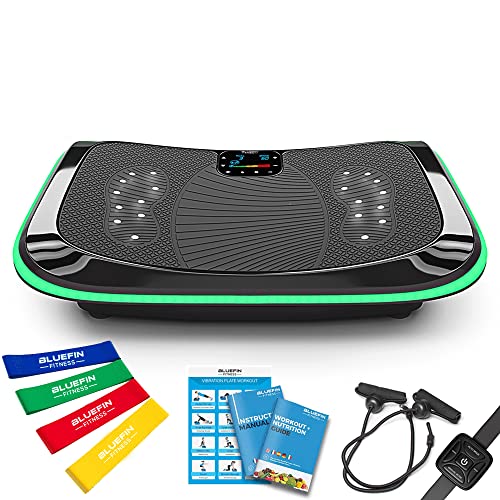
Why it's here: If balance is even slightly a concern, the handrail is worth the price difference. Also the right pick for anyone using vibration during PT or fall-prevention work — the rails let you load progressively without committing to a wobble you can't recover from.
- Real handrails — the single biggest fall-prevention upgrade
- Low-end frequency suitable for first-time users
- Stable wide base, very little wobble
- UK-designed with stricter consumer testing
- Larger footprint — needs a dedicated spot
- Higher price than handrail-free units
3. LifePro Rumblex Plus 4D

Why it's here: Bone density gains in postmenopausal research come from low-frequency, low-magnitude stimulation — not from cranking the dial. The Rumblex Plus is one of the few consumer plates that delivers the gentle end of the spectrum. Start at the lowest oscillation mode, ten minutes, three times a week.
- The low-end setting is actually usable for low-magnitude bone protocols
- Multiple motion modes let users start gentle and progress
- One of the most-reviewed units in this category
- Top settings are too aggressive for most seniors — stay in the lower modes
- No handrail — pair with a chair or wall
4. Hurtle Fitness Vibration Plate

Why it's here: If a senior in your life wants to try vibration training but isn't sure they'll stick with it, this is the entry point. Same fundamental motion as the Waver at roughly half the price. Just respect the lower weight rating.
- Lowest price of any plate we'd recommend for senior use
- Simple controls — no confusing programs
- Light enough to move between rooms
- Lower max weight rating than premium units
- Motor noise slightly higher than the Waver
- Build quality is fine, not great
5. Eilison FitMax Vibration Plate

Why it's here: For users near the upper end of the weight range, the FitMax wobbles least. The oversized platform is also safer for seniors with reduced proprioception — more margin to land a foot in the wrong spot without overhanging the edge.
- Wider, more stable platform reduces wobble
- Built to take daily use without loosening
- Generous step-on surface for users with bigger feet or wider stances
- 3D motion is busier than pure oscillation — stay in the low modes
- Heavier to move around
What Whole-Body Vibration Actually Does (Real Evidence vs Marketing)
The honest read on WBV for older adults is that the evidence is moderate, not magical. Several outcomes show up consistently in the literature; others are still marketing copy.
Bone mineral density. Low-frequency, low-magnitude WBV has shown modest improvements in hip and lumbar bone density over six to twelve months in postmenopausal women and older adults, especially those who can’t tolerate impact loading. This is the strongest case for vibration plates in a senior context — and it requires the low end of the dial.
Balance and fall prevention. Trials in adults 65+ show improvements in Timed Up and Go, single-leg stance, and Berg Balance Scale after eight to twelve weeks of regular WBV. Effect size is comparable to a moderate balance-training program. Useful, not miraculous.
Sarcopenia attenuation. WBV won’t replace resistance training, but in seniors who can’t tolerate weights, it produces measurable gains in lower-body strength. Pair with bodyweight squats or sit-to-stands and the effect compounds.
Circulation. Acute increases in lower-limb blood flow during and after sessions are well-documented. Long-term cardiovascular benefit is less clear.
What the evidence does not support: meaningful weight loss, “detox,” cellulite reduction, replacing strength training, or curing chronic pain. Treat vibration as a low-impact supplement to walking, light resistance work, and balance practice. Our guide to quiet walking pads covers the cardio side.
How to Use a Vibration Plate Safely as a Senior
The protocol matters more than the equipment. A great plate used aggressively is worse than a mediocre plate used carefully.
- Start at the lowest setting. For oscillating plates, that is usually speed 1 to 10. Spend the first two weeks here. The point is not the workout — it is letting your nervous system, joints, and inner ear adapt to the input.
- Begin seated or holding support. Sit on a chair with feet on the plate, or stand on the plate holding a counter, wall, or sturdy chair back. Do not start standing free.
- Cap sessions at 10 minutes for the first month. Bone and balance studies often used 5 to 10 minute sessions. Longer is not better.
- Three sessions per week is plenty. Daily use is unnecessary and increases joint and soft-tissue load.
- Stay in the low Hz band. If your plate has a numeric frequency display, aim for 15 to 25 Hz. If it only shows “speed 1 to 99,” stay in the bottom third.
- Bend the knees slightly. Soft, athletic stance — never locked-out legs. Locked knees transmit vibration straight into the lumbar spine.
- Stop if anything is wrong. Dizziness, joint pain, blurred vision, headache, or chest tightness all mean stop the session and do not restart without checking with your doctor.
A reasonable beginner routine: two minutes feet-flat with a slight knee bend, two minutes in a quarter-squat hold, two minutes seated with feet on the plate, one minute standing. Total seven minutes, three times a week, lowest speed. Add intensity only after a full month at this dose with no negative response.
Who Should NOT Use a Vibration Plate
Some conditions are absolute or near-absolute contraindications to WBV, regardless of how gently you intend to use the plate. If any of the following apply, talk to your physician before stepping on any vibration platform.
- Pacemaker, implanted cardioverter-defibrillator, or other implanted electronic device
- Hip, knee, shoulder, or spinal replacement hardware less than 6 to 12 months out of surgery
- Severe osteoporosis with documented fracture risk
- Recent fracture (anywhere) not yet cleared by your orthopedist
- Retinal detachment history or active retinal disease
- Pregnancy
- Acute deep vein thrombosis or recent pulmonary embolism
- Uncontrolled high blood pressure
- Active gallstones or kidney stones
- Epilepsy or seizure history without medical clearance
- Recent abdominal, back, or eye surgery
- Severe migraine or vestibular disorders
If you have arthritis, mild osteoporosis, well-controlled hypertension, or older hardware (over a year out), vibration training is often appropriate but should still be cleared with your doctor first. Bring this specs list and your plate’s listing — most physicians will have an opinion once they see the frequency range.
Three buyer types who should skip vibration plates entirely — and what to do instead
- Anyone with a pacemaker or implanted cardioverter-defibrillator. WBV is a hard contraindication for implanted electronics. Better path: physician-cleared walking, seated resistance-band routines, and pool-based exercise. None of the bone or balance benefits of vibration are worth interfering with a cardiac device.
- Retinal detachment history or acute glaucoma. Vibration transmits force through the head and can raise intraocular pressure. Better path: tai chi and PT-guided balance drills for fall prevention; low-impact recumbent cycling for circulation. Both hit the same downstream goals without shaking the eye.
- Severe osteoporosis with a documented fall or fracture in the last year. The soft-tissue and micro-fracture risk of even low-amplitude WBV is not worth the modest bone signal in this population. Better path: PT-supervised balance training (evidence for fall reduction is stronger than WBV in this group), weight-bearing walking on flat ground, and pharmacologic bone therapy through your endocrinologist. Revisit vibration only if a physician clears it after fracture healing and bone stability improve.
Honest Limitations of This Guide
A few things we want on the record so you can weigh the recommendations honestly:
- We haven’t personally tested every listed plate long-term with senior users. Our picks are informed by manufacturer specs, published research on the frequency and amplitude ranges that fit older adults, and verified-buyer feedback patterns — not by a year of daily use in a lab setting.
- Frequency and amplitude specs are manufacturer-reported, not independently measured. Consumer plates rarely publish third-party accelerometer data. When a listing says “5 Hz low end,” we treat that as the manufacturer’s claim, not a lab-verified floor.
- Fall-risk reduction evidence is small-trial, not large RCT. Most WBV-and-falls research uses sample sizes in the dozens, not thousands. The direction is positive but the effect size range is wide. Don’t buy a plate expecting a proven fall-prevention device — buy it as one input into balance and bone work.
- Bone density benefit is real but modest and slow. Improvements in postmenopausal WBV trials generally show up over six to twelve months at low frequency. This is not a substitute for weight-bearing exercise or medication when either is indicated.
How We Picked These
No manufacturer paid for placement. No plate here was reviewed in exchange for a unit, and no brand had any input into the ranking. Our process:
- PA API verification. Every ASIN was checked against Amazon’s Product Advertising API for current listing status before shipping this guide, and re-verified on updates. Dead listings are flagged in the buy buttons instead of quietly rotting.
- Published frequency range. Rejected any plate that didn’t disclose actual Hz. “Speed 1 to 99” without underlying frequency is a non-answer.
- Usable low-end. Plate must reach a meaningful low frequency, ideally under 15 Hz — the range senior bone-density protocols actually use.
- Handrail check. Plates that ship with real full-height handrails or that pair naturally with a chair or counter — anything requiring a wall for balance was rejected.
- Amplitude under 5mm. Higher amplitude is fine for athletes, wrong for seniors.
- Stability under load. Reinforced steel frames and wide platforms — plate wobble is a fall risk.
- Real review base. Minimum 2,000 reviews, 4.2★+, with verified-buyer feedback from older users.
- Quiet motors. A noisy plate gets used once and stored.
We rejected several popular “4D” plates because their lowest available frequency was still above 20 Hz — fine for fitness, wrong for seniors with bone or joint concerns.
Frequently Asked Questions
Vibration plate vs walking for bone density — which wins?
Walking is still the most universally appropriate bone-loading activity for seniors and should be the foundation. Low-frequency vibration is a useful supplement, especially for seniors who can’t tolerate brisk walking. Stack them: walk most days, use the plate two or three times a week.
How often per week should a senior use a vibration plate?
Two to three sessions of 5 to 10 minutes is the sweet spot in most clinical protocols. More doesn’t add benefit and raises soft-tissue irritation risk. Bone density studies generally ran three sessions per week.
Can vibration plates worsen arthritis?
Used aggressively, yes. Used at low frequency with a soft-knee stance, most people with mild to moderate osteoarthritis tolerate WBV well and sometimes report less stiffness afterward. Severe inflammatory arthritis (rheumatoid, psoriatic) is a different conversation — clear it with your rheumatologist first.
Is it safe to use a vibration plate after a hip replacement?
Generally not within the first 6 to 12 months post-surgery, and never without explicit clearance from your orthopedic surgeon. Beyond a year with stable hardware and a green light, low-frequency vibration is often well tolerated — start seated and progress carefully.
Will a vibration plate help me lose weight?
Not meaningfully. Marketing claims of significant fat loss from vibration alone aren’t supported by evidence. Vibration is an adjunct, not a weight-loss strategy.
How long until I feel a difference?
Most seniors report better warmth and lower-limb circulation within the first week or two. Balance and strength improvements show up at six to eight weeks. Bone density changes require six to twelve months of consistent use and are confirmed by DEXA, not by feel.
Can I use a vibration plate while sitting?
Yes — it’s the recommended starting position for the first sessions or for anyone with balance concerns. Sit upright on a sturdy chair, feet flat on the plate, knees at 90 degrees. You’ll still get most of the lower-limb circulation and muscle-activation benefit without any fall risk.
Final Thoughts
Vibration plates can absolutely earn a place in a senior wellness routine — for bone, balance, and circulation — but only when the unit matches the user. The plates above were picked specifically because their low-end settings stay in the research-validated zone, their builds are stable, and their motion is gentle enough for someone who isn’t trying to train like a CrossFitter.
If you are buying for yourself or a parent, start with the LifePro Waver for most cases, the Bluefin Fitness Pro if balance is a concern, or the LifePro Rumblex Plus if low-frequency bone work is the priority. Use it three times a week, ten minutes, low setting, and pair it with walking and a few minutes of gentle back mobility. That’s the routine that actually moves the needle.
Last updated: July 01, 2026 at 01:11 PM ET. Prices and availability shown are accurate as of this time and are subject to change. As an Amazon Associate, DeskFitPro earns from qualifying purchases.
Ready to Buy?
We may earn a commission if you buy through these links.
Prices checked: Oct 3, 2026, 8:06 PM UTC
Product prices and availability are accurate as of the date/time indicated and are subject to change. Any price and availability information displayed on Amazon.com at the time of purchase will apply to the purchase of this product.
Any prices mentioned in the article text are approximate and for comparison only; the figure shown with each product above is the one checked against Amazon at the time stated.
As an Amazon Associate, DeskFitPro earns from qualifying purchases.


