Walk into any wellness aisle and you’ll see “10-mushroom blends” stacked like the next nootropic miracle — Lion’s Mane on the label, a cartoon mushroom on the front, and a vague “1,500mg proprietary mushroom complex” hiding the actual math on the back. Here’s the uncomfortable truth: a 1,500mg blend split across 10 mushrooms is 150mg of each. Clinical doses for most functional mushrooms start at 1,000mg per species. Most blends on Amazon are sub-therapeutic by design.
A real functional mushroom stack discloses three things on the label: per-mushroom milligrams, fruiting body vs mycelium, and beta-glucan percentage. Brands that hide one of those three are betting you won’t ask. This guide focuses on 5 blends that don’t hide — plus one budget option and one gummy that we include with caveats so you can see exactly where the trade-offs are.
As an Amazon Associate, DeskFitPro earns from qualifying purchases. We only recommend products we’d buy ourselves — and we paid for the ones we tested.
Health disclaimer: Functional mushrooms can interact with blood thinners, immunosuppressants, and diabetes medication. Reishi and turkey tail in particular have mild anticoagulant effects. Talk to your healthcare provider before starting any new supplement, especially if you take medication or have an autoimmune condition.
Real Mushrooms 5 Defenders
100% organic fruiting body extract from chaga, reishi, turkey tail, maitake, and shiitake — with verified beta-glucan content and per-mushroom dose disclosure. The cleanest label in the category, period.
Check Price on Amazon →As an Amazon Associate, I earn from qualifying purchases. Learn more.
Why Most Functional Mushroom Blends Hide the Mushroom Math
The functional mushroom category exploded between 2020 and 2026, and the marketing got slick faster than the manufacturing got honest. Walk down the Amazon results page and you’ll find “20-in-1” blends, “Lion’s Mane Mega Stack” formulas, and gummies promising “the power of 10 mushrooms” in two bears the size of a thumbnail. Almost none of them disclose what’s actually inside on a per-mushroom basis.
The trick works like this. A label says “1,500mg Proprietary Mushroom Complex (Lion’s Mane, Reishi, Cordyceps, Chaga, Turkey Tail, Maitake, Shiitake, Tremella, Oyster, Agaricus)”. That’s ten mushrooms sharing 1,500mg. If split evenly, that’s 150mg of each. Compare to the doses used in published research: lion’s mane studies that found cognitive benefits used 1,000–3,000mg daily. Cordyceps studies measuring endurance used 1,000–3,000mg. Reishi sleep studies used 1,400mg. A 150mg slice doesn’t move the needle on anything.
It gets worse. “Proprietary blend” labeling is also routinely weighted toward the cheapest mushrooms — shiitake and oyster, which run a few dollars per kilo wholesale — while the expensive ones like cordyceps militaris and lion’s mane fruiting body are sprinkled in to make the label legal. You’d never know from the front of the bottle.
Then there’s the mycelium-on-grain problem. Many U.S. mushroom brands grow mycelium (the root-like network) on a sterile grain substrate like brown rice or oats. When harvest time comes, they grind up the entire substrate — grain and all — and sell it as “organic mushroom powder.” Independent testing has shown these products can be 50–80% starch by weight, with negligible beta-glucan content (the active polysaccharide that actually drives the immune and cognitive effects). True fruiting body extract from the actual mushroom — the part that pokes out of the log — is the only form with consistently measured beta-glucan and triterpene content.
Three label signals separate honest blends from theater:
- Per-mushroom milligrams. Each species gets its own line on the Supplement Facts panel. No “proprietary complex.”
- Part used. Says “fruiting body” or “fruit body” — not “full spectrum,” “mycelial biomass,” or just “mushroom.”
- Beta-glucan percentage. Tested and printed. Real Mushrooms publishes >20% beta-glucans. Most Amazon brands publish nothing.
Every pick below is graded against those three signals. We also include one budget option and one gummy that fall short on one of them — labeled honestly, so you know what you’re trading away if you choose them.
At a Glance
- Best Overall (Fruiting Body Stack): Real Mushrooms 5 Defenders — Chaga, reishi, turkey tail, maitake, shiitake. Per-mushroom mg disclosed, >20% beta-glucans verified.
- Best 7-Mushroom Daily Driver: Host Defense Stamets 7 — Paul Stamets’ classic 7-species blend. Whole food mycelium with documented heritage and lab testing.
- Best Broad-Spectrum (17 species): Host Defense MyCommunity Powder — Lion’s Mane, reishi, chaga, cordyceps, turkey tail and 12 more in one immune-leaning stack.
- Best Budget Brain Blend: Genius Mushrooms — Lion’s Mane, cordyceps, reishi. Cheapest verified 3-blend on Amazon with disclosed per-mushroom doses.
- Best Gummy (with caveats): Force Factor Modern Mushrooms — Fruiting body blend + KSM-66 ashwagandha. The honest gummy in a category full of dishonest ones.
Comparison Table
| Brand | Mushrooms | Part Used | Per-Mushroom mg | Beta-Glucans | Price |
|---|---|---|---|---|---|
| Real Mushrooms 5 Defenders | 5 (chaga, reishi, turkey tail, maitake, shiitake) | Fruiting body | Disclosed | >20% verified | $39.95 |
| Host Defense Stamets 7 | 7 (incl. lion’s mane, reishi, cordyceps) | Mycelium-on-grain | Disclosed | Not published | $47.21 |
| Host Defense MyCommunity | 17 species (lion’s mane, reishi, chaga, cordyceps, turkey tail + 12) | Mycelium-on-grain | Total only | Not published | $23.96 |
| Genius Mushrooms | 3 (lion’s mane, cordyceps, reishi) | Unclear | Disclosed | Not published | $21.95 |
| Force Factor Modern Mushrooms | 5 + KSM-66 ashwagandha | Fruiting body | Total only | Not published | $29.99 |
The 6 Mushrooms Worth Stacking (And What Each Does)
Before you choose a blend, you should know what each species actually contributes. A “10-mushroom complex” sounds impressive until you realize half the mushrooms in the blend don’t do anything you care about. Here’s the short version of the six that earn their place.
Lion’s Mane (Hericium erinaceus) — The cognition mushroom. Contains hericenones and erinacines, two compounds shown to stimulate nerve growth factor (NGF). The cognitive effect is subtle and cumulative — most people notice cleaner mental clarity and word recall after 2–4 weeks of daily dosing at 1,000mg+ of fruiting body extract. Our deep-dive on cognition-specific formats is in the best Lion’s Mane gummies guide.
Reishi (Ganoderma lucidum) — The sleep and stress mushroom. Triterpenes in reishi have mild GABA-modulating effects and reduce sympathetic nervous system activity. Best taken in the evening, often stacked with magnesium glycinate or ashwagandha. Reishi is one of the few mushrooms with a hard “take at night, not morning” instruction.
Cordyceps (Cordyceps militaris) — The endurance mushroom. Increases oxygen utilization and ATP production in muscle cells. Studies show measurable VO₂ max improvements at 1,500–3,000mg daily over 6+ weeks. Note: cordyceps militaris is the lab-grown species used in supplements — cordyceps sinensis (the wild caterpillar fungus) costs $20,000/kg and isn’t in any commercial blend.
Chaga (Inonotus obliquus) — The antioxidant mushroom. Highest ORAC (antioxidant) value of any food tested, by a wide margin. Used traditionally for immune support and skin. Best in tincture or extract form because the bioactives are tough to extract from the woody conk.
Turkey Tail (Trametes versicolor) — The immune mushroom. Contains PSK and PSP, two polysaccharide-K compounds with the strongest immune-modulation evidence of any mushroom. PSK is actually an approved adjuvant cancer therapy in Japan. For everyday users, turkey tail is the immune workhorse — even more than reishi.
Maitake (Grifola frondosa) — The blood sugar mushroom. Beta-glucans in maitake (specifically the D-fraction) have modest effects on insulin sensitivity and post-meal glucose response. A useful add-on if you’re stacking for metabolic health.
Notice what’s not on that list: shiitake, oyster, tremella, and agaricus. Those are food mushrooms. They’re delicious in a stir-fry, but they’re not in any blend because of strong functional evidence — they’re there to inflate the “X mushrooms!” claim on the front of the bottle. If a blend’s headline ingredient is shiitake, you’re paying for filler.
Detailed Reviews
1. Real Mushrooms 5 Defenders

- 5-mushroom blend: chaga, reishi, turkey tail, maitake, shiitake
- 100% organic fruiting body — no mycelium-on-grain filler
- Per-mushroom dose disclosed on label (no proprietary blend)
- Verified beta-glucan content >20%, lab-tested per batch
- 90 capsules, 45 servings, 1,000mg total per dose
- The cleanest label in the entire category
- Run by Skye Chilton, son of mushroom researcher Jeff Chilton — actual mycology credibility
- Hot water + alcohol dual extraction process used
- Independent batch testing posted on the company site
- No lion’s mane or cordyceps in this specific blend — immune-focused, not cognitive
- Costs ~2x cheap proprietary blends per gram
Why it’s #1: Real Mushrooms is the brand that other supplement reviewers use as the reference standard. The 5 Defenders blend is immune-leaning (no lion’s mane or cordyceps here — those are sold separately as single extracts), but the manufacturing transparency, per-mushroom dosing, and verified beta-glucan content make this the only blend that fully passes all three label tests in our category. If you want lion’s mane and cordyceps too, stack their Lion’s Mane Capsules and Cordyceps Capsules on top — and you’ll know exactly what you’re getting.
Check Price on Amazon →2. Host Defense Stamets 7

- 7-species blend: lion’s mane, reishi, cordyceps, maitake, chaga, mesima, royal sun blazei
- Formulated by mycologist Paul Stamets
- Organic, USDA Certified, non-GMO
- 120 capsules, 60-day supply at 2/day
- Whole-food mycelium grown on certified organic brown rice
- Includes lion’s mane AND cordyceps AND reishi — true full-spectrum stack
- Paul Stamets’ brand — most cited mycologist in the U.S.
- 20+ years on the market with consistent QC
- Available at Whole Foods, easy to find offline
- Uses mycelium-on-grain, not fruiting body — controversial in mushroom circles
- Host Defense argues this preserves enzymes and primordia; fruiting-body purists disagree
Why it’s here: Stamets 7 is the elder statesman of mushroom blends. It’s the blend most people think of when they think “functional mushrooms” — and that’s largely because Paul Stamets pioneered the category. The honest caveat is the mycelium-on-grain methodology. Host Defense’s position is that mycelium contains compounds the fruiting body doesn’t (primordia, hyphal enzymes), and that grinding the substrate in preserves the full life cycle. The fruiting-body camp says you’re just paying for brown rice. Both sides have legitimate points; we list this as the best whole-food mycelium option, and Real Mushrooms 5 Defenders above as the best fruiting body. Pick your philosophy.
Check Price on Amazon →3. Host Defense MyCommunity Powder

- 17-species blend including lion’s mane, reishi, chaga, cordyceps, turkey tail
- 100g powder, 66 servings
- Designed for immune system support
- Mix into coffee, smoothies, or hot water
- Organic and non-GMO certified
- Most diverse legitimate mushroom blend on the market
- Includes the immune-heavy hitters (turkey tail, chaga, agarikon) plus cognitive (lion’s mane) plus energy (cordyceps)
- Powder format mixes into coffee well — pairs naturally with mushroom coffee
- Best $/serving of the trustworthy blends
- 17 species means smaller doses per species — broad rather than deep
- Bitter, earthy taste needs masking
- Same mycelium-on-grain methodology debate as Stamets 7
Why it’s here: If you can only take one mushroom product, MyCommunity covers the widest range of bases. The trade-off is dose per species — 17 mushrooms in 1,500mg means you’re getting roughly 88mg of each, which is closer to “support” than “clinical.” For most people stacking for general wellness rather than chasing a specific outcome, that’s fine. If you want a clinical dose of lion’s mane for cognition or cordyceps for endurance, you’ll need to add a single-species extract on top.
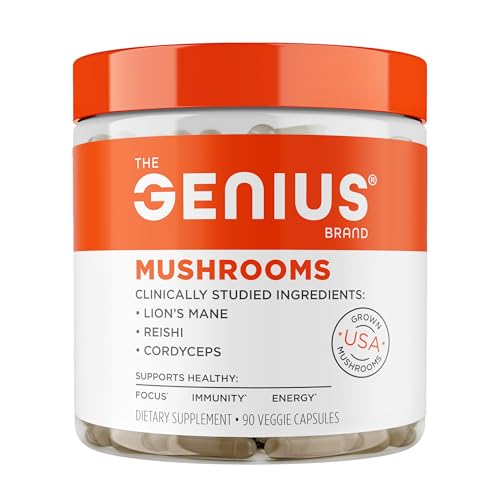
Check Price on Amazon →4. Genius Mushrooms (Lion’s Mane + Cordyceps + Reishi)

- 3-mushroom focused blend: lion’s mane, cordyceps militaris, reishi
- 90 capsules, 30 servings at 3/day
- Per-mushroom dose disclosed (500mg lion’s mane, 500mg cordyceps, 1,000mg reishi per serving)
- Organic, non-GMO certified
- The Amazon #1 best-seller in this category
- Discloses per-mushroom mg on label — most budget brands don’t
- Sticks to the 3 highest-evidence species, ignores filler mushrooms
- Reishi dose (1,000mg) is in the clinical range
- Half the price of premium brands
- Doesn’t clearly disclose fruiting body vs mycelium — assume mixed
- No published beta-glucan percentage
- Lion’s mane dose (500mg) is at the low end of effective
Why it’s here: Genius Mushrooms isn’t the highest-quality blend on this list, but it’s the most honest budget option. It passes one of our three label tests (per-mushroom mg disclosed) and fails the other two (part used unclear, beta-glucan untested). At $0.73/serving, that’s a reasonable trade if you’re new to mushrooms and want to see if they do anything for you before committing to a $1.50/serving premium brand. Treat it as the starter blend — if you notice clear benefits after 30 days, upgrade to a fruiting-body brand with full disclosure.
Check Price on Amazon →5. Force Factor Modern Mushrooms Gummies

- Fruiting body mushroom blend (lion’s mane, reishi, cordyceps, chaga, turkey tail)
- Stacked with KSM-66 ashwagandha for stress support
- Mixed berry flavor, 90 gummies (30-day supply at 3/day)
- One of the only gummies that specifies “fruiting body” on the label
- Made by Force Factor — established supplement brand with QC track record
- Specifies fruiting body — most gummies don’t
- KSM-66 ashwagandha addition makes this a stress-and-cognition combo
- Easiest format for people who hate capsules
- Pairs naturally with our best ashwagandha gummies guide for stacking
- Mushroom dose per gummy is lower than capsule format — that’s the math problem with gummies
- Contains sugar (typical of pectin-based gummies)
- Higher cost per mg of active mushroom than capsules
Why it’s here: The honest truth about mushroom gummies: the format physically can’t carry the same dose as a capsule. A capsule holds 500–1,000mg of mushroom extract. A gummy carries maybe 100–250mg before it tastes like dirt. So when you see a “Mushroom Gummy” with 10 mushrooms at 2,000mg total, divide by 10 and ask if 200mg of each does anything (it doesn’t). Force Factor’s Modern Mushrooms is the gummy we recommend not because the dose is heroic but because the label is honest about format and ingredients. If gummies are the only way you’ll actually take a supplement consistently, this is the one. If you’ll take capsules, skip the gummies entirely and go with one of the picks above.
Check Price on Amazon →Tinctures vs Capsules vs Gummies: Bioavailability Per Format
Format matters more in functional mushrooms than in most supplement categories. The active compounds you’re after — beta-glucans (water-soluble) and triterpenes (alcohol-soluble) — live in different parts of the mushroom cell wall and require different extraction methods to actually free them up for absorption.
Dual-extracted tinctures are the gold standard. Hot water pulls out the beta-glucans, alcohol pulls out the triterpenes, and the two solvents are combined into a single dropper bottle. You get both classes of bioactives at near-maximum yield. The downside: tinctures taste like swampy bourbon, cost more per dose, and don’t travel as well as pills. If you’re chasing maximum effect from reishi or chaga (both heavy on triterpenes), tinctures win. Real Mushrooms and Host Defense both make dual-extracted tinctures, though they’re less common on Amazon than capsules.
Extract capsules are the practical middle ground. The extraction happened at the factory before the powder was loaded into vegetable capsules. A good extract is usually labeled “10:1” or “8:1,” meaning 10kg of raw mushroom were reduced to 1kg of extract powder. You get most of the benefit of a tincture with none of the taste, and the dosing is precise. This is what we recommend for 90% of users. All four capsule picks above fit this category.
Raw powders (un-extracted, just dried-and-ground mushroom) are the weakest format. Beta-glucans are locked inside chitin cell walls that human digestion can’t break down efficiently. You get maybe 10–20% of the bioactive content of an equivalent dose of extract. Skip raw powders unless you’re specifically using them as a culinary ingredient.
Gummies are the weakest format with the best compliance. The dose ceiling is low (you can’t stuff 1,000mg of bitter mushroom extract into a 3g gummy without it tasting like dirt), and sugar/pectin add nothing nutritional. The case for gummies: if a capsule sits unopened on your counter while a gummy gets eaten, the gummy wins. Don’t let perfect be the enemy of consistent. Just understand you’re trading dose for compliance.
Stacking Mushrooms with Adaptogens: Ashwagandha + Reishi for Stress
One of the highest-leverage supplement stacks in the cognitive and stress space is reishi plus ashwagandha — and it works precisely because they hit different mechanisms. Reishi calms the parasympathetic nervous system via triterpene-driven GABA modulation. Ashwagandha (specifically KSM-66, the most-studied extract) lowers cortisol via HPA axis modulation. One is acute, one is chronic. Stacked, they create a more rounded stress profile than either alone.
Practical protocol: 1,000–1,500mg reishi extract plus 600mg KSM-66 ashwagandha, taken together about an hour before bed. Most people notice the effect within 5–7 days — easier sleep onset, fewer 3am wake-ups, slightly less reactive irritability the next morning. If you’re already taking Thorne magnesium glycinate at night, the reishi-ashwagandha stack layers cleanly on top.
For cognition, lion’s mane plus cordyceps is the parallel stack — lion’s mane builds the structural side (NGF, neuroplasticity over weeks) while cordyceps handles the metabolic side (ATP production, oxygen utilization in real-time). The Genius Mushrooms blend above includes both, which is why it lands on this list despite the dose criticisms.
Who Should NOT Take Functional Mushrooms
Functional mushrooms are well-tolerated by most adults, but they have real interactions with specific medications and conditions. Skip them or talk to your doctor first if any of the following apply:
- You take blood thinners (warfarin, Eliquis, Xarelto, etc.). Reishi and turkey tail have mild anticoagulant effects that compound with prescription thinners.
- You’re on immunosuppressants (post-transplant, autoimmune treatment). Most functional mushrooms are immune modulators — they nudge the immune system to do more, which is the opposite of what immunosuppressants want.
- You have an autoimmune condition (lupus, MS, Hashimoto’s, RA). The same immune-activation argument applies. Some patients tolerate them fine, others see flares. Your rheumatologist’s call.
- You’re pregnant or breastfeeding. Mushroom supplements haven’t been studied in pregnancy. The data is “we don’t know,” which is enough reason to wait.
- You have a mold or mushroom allergy. Obvious, but worth saying. Cross-reactivity is a real thing.
- You’re undergoing chemotherapy. Some mushroom polysaccharides interact with chemo agents in unpredictable ways. Always coordinate with your oncologist.
For everyone else, the main side effects are mild GI upset (gas, loose stools) in the first 1–2 weeks, which usually resolves on its own. Reishi can occasionally cause vivid dreams. If anything weirder shows up, stop and reassess.
How We Picked These
- Per-mushroom dose disclosure — no proprietary blends. Each species gets its own line on the label.
- Fruiting body preferred — or, where mycelium is used, the brand has a defensible rationale and a track record (Host Defense).
- Published beta-glucan percentage — verified content, not vibes.
- Brand credibility — actual mycology background or 10+ years in the category, not a 2024 Shopify drop-shipper.
- Verified reviews — minimum 80 Amazon reviews at 4.3★ or higher.
- Honest cons — every product on this list has a downside we name explicitly. If a blend has no trade-offs, we didn’t look closely enough.
We rejected roughly 22 popular Amazon blends during research, mostly for proprietary blend labeling, undisclosed mycelium-on-grain content, or brand names that didn’t exist 18 months ago.
Frequently Asked Questions
Functional mushrooms vs psilocybin — are these the same thing?
No. Functional mushrooms (lion’s mane, reishi, cordyceps, etc.) contain zero psilocybin and zero psychoactive compounds. They won’t get you high, won’t show up on any drug test, and are legal in all 50 states. Psilocybin is the active compound in “magic mushrooms” (psilocybe species) and is a controlled substance federally. Different fungi, different chemistry, different legal status.
Best mushroom for sleep vs focus?
For sleep: reishi, taken in the evening. The triterpenes have mild GABA-modulating effects that ease the transition to sleep without grogginess. For focus: lion’s mane in the morning, often stacked with cordyceps for the energy component. Don’t reverse these — reishi in the morning will make you sluggish, and lion’s mane at night doesn’t typically disrupt sleep but doesn’t help either.
Will functional mushrooms test positive for anything?
No. Standard drug tests look for psilocybin, THC, opioids, amphetamines, and similar controlled substances. Functional mushrooms contain none of those. NSF Certified for Sport mushroom products exist specifically for athletes who need verified clean supplements.
Can I take functional mushrooms with caffeine?
Yes — and the lion’s mane + cordyceps + coffee stack is one of the most popular morning combinations in the nootropic space. Cordyceps amplifies the energy effect of caffeine without the jitters, and lion’s mane sands down the edge. If you want this in one product, see our best mushroom coffee guide for blends that pre-stack everything for you.
How long until I notice effects?
Cordyceps energy and reishi sleep effects show up in 3–7 days. Lion’s mane cognitive effects take 2–6 weeks of daily dosing. Immune effects (turkey tail, chaga) are cumulative and most people only notice them retroactively — “I didn’t get sick this winter, huh.”
Do I need to cycle functional mushrooms?
Most aren’t cycled — reishi, lion’s mane, cordyceps, turkey tail, chaga, and maitake can be taken daily indefinitely with no known tolerance or dependence. The one exception is reishi for sleep: some users find the effect plateaus after a few months and benefits from a 1–2 week break. There’s no clinical data backing this, just user reports.
Are mushroom blends better than single-species extracts?
Depends on your goal. Blends are better for general wellness — covering immune, cognitive, energy, and stress with one product. Single-species extracts are better when you’re chasing a specific outcome (e.g., clinical-dose lion’s mane for cognition, clinical-dose cordyceps for endurance). The pro move: take a quality blend daily, and add one or two single-species extracts on top for whatever you’re optimizing.
Final Thoughts
The functional mushroom category is one of the most asymmetric supplement spaces on the internet. The top 10% of products genuinely deliver clinical-grade extracts with transparent labeling and decades of mycology research behind them. The bottom 70% are proprietary blends with sub-therapeutic doses, hidden mycelium-on-grain ratios, and marketing copy that mostly describes mushrooms in general rather than what’s actually in the bottle. There’s almost no middle.
The cheat code is the three label tests: per-mushroom mg, part used, and beta-glucan percentage. Apply those filters to any blend you’re considering and the field narrows fast. Real Mushrooms 5 Defenders is the only blend we recommend that fully passes all three, which is why it’s our top pick despite not including lion’s mane in this specific formula. If you want a wider species range and you’re comfortable with the mycelium-on-grain methodology, Host Defense Stamets 7 is the next-best option. If you’re new to mushrooms and want to test the category without spending much, Genius Mushrooms is the honest starter.
For everything else — picking single-species extracts, layering with adaptogens, building a full morning and evening stack — start with the lion’s mane deep-dive and the mushroom coffee guide. Or stack the reishi from your blend with our ashwagandha picks if stress is the main thing you’re trying to solve.
Ready to Try a Functional Mushroom Blend?
Fruiting body, per-mushroom mg disclosed, >20% beta-glucans
Check Price →Lion’s mane + cordyceps + reishi with disclosed dosing, under $25
Check Price →Last updated: June 16, 2026. Prices and availability shown are accurate as of this time and are subject to change. As an Amazon Associate, DeskFitPro earns from qualifying purchases.