As an Amazon Associate, we earn from qualifying purchases.
Sleepme Chilipad Cube — Bed Cooling System
$594, water-cooled mattress topper with adjustable temperature (55-115°F), single-zone or dual-zone configurations, no subscription required. The closest Amazon-available equivalent to the Eight Sleep mechanism — temperature-controlled water circulates through a mattress topper directly under you.
Check Price on Amazon →At a Glance
- TOP PICK: Sleepme Chilipad Cube — Single Zone
- Sleepme Chilipad Cube — Dual Zone (Couples)
- BedJet 3 — Climate-Controlled Air System
- BEST BUDGET WATER-COOLED: DREAMORA Luna — Compact Water-Cooled System
- Adamson B10 — Twin Bed Cooling System
The Eight Sleep Pod is the most-searched bed cooling system on the internet — and it’s also direct-to-consumer only, with a $2,000-3,000 entry price, a required subscription, and zero Amazon availability. For buyers who don’t want to pay the Eight Sleep premium or be locked into a subscription model, the Amazon-available alternatives have quietly become surprisingly good. The Sleepme Chilipad Cube delivers Eight Sleep-style water-cooled mattress-topper cooling at one-third the price. The BedJet 3 takes a completely different approach (warm/cool air pumped under your sheets) that some users prefer to direct cooling. DREAMORA and Adamson cover the budget end at $170-225. This roundup ranks the five real options on Amazon, explains the mechanism differences, and points you to the right pick for your sleep situation.
Why Bed Temperature Matters (the Real Sleep Science)
Body temperature is one of the most validated levers in sleep medicine. The mechanism is well-established: as you fall asleep, your core body temperature drops by roughly 1-2°F, peripheral blood flow increases to dump heat from extremities, and the drop in core temperature is part of the signal that allows you to transition into deeper sleep stages. Block this process — by sleeping in a too-warm bedroom or under too-warm bedding — and you measurably impair sleep onset and sleep architecture.
Published sleep research consistently puts the optimal bedroom temperature range at 60-67°F (15-19°C) for most adults. The National Sleep Foundation, AASM, and most institutional sleep medicine sources converge on this range. Below 60°F or above 67°F, sleep quality measurably degrades — fragmented sleep architecture, more frequent awakenings, reduced REM consolidation.
The problem: most people’s bedrooms aren’t actually 60-67°F. Either the HVAC system can’t reliably hold that range, energy costs make it impractical, or you share the bed with someone whose comfortable temperature is meaningfully different from yours. For these cases, bed-level temperature regulation — cooling or warming the bed surface rather than the whole room — is the cheaper, more efficient, and often more effective intervention.
Why Eight Sleep Isn’t on This List
Eight Sleep Pod is the most-marketed bed cooling system on social media and the brand most buyers first encounter when researching this category. It’s a genuinely well-engineered product. It’s also direct-to-consumer only — Eight Sleep does not sell on Amazon, and the company’s pricing model (hardware $2,000-3,000 + required subscription for full features) puts the total 3-year cost over $3,500.
For buyers who specifically want Eight Sleep’s product and don’t mind the DTC purchase and subscription, that’s a reasonable choice — go to eightsleep.com. This roundup is for the much larger group of buyers who want Eight Sleep-equivalent functionality (water-cooled mattress topper with temperature control) without the DTC purchase, without the ongoing subscription, and with the convenience and return policy of Amazon. The picks below cover that gap.
The Three Mechanisms
Bed cooling systems use one of three approaches, each with real engineering trade-offs:
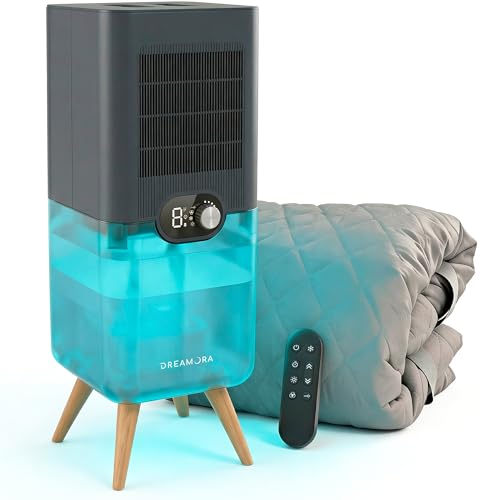
1. Water-cooled mattress topper (Sleepme Chilipad, DREAMORA Luna, Adamson B10). Temperature-controlled water circulates through tubes embedded in a mattress topper that sits between you and your sheet. The control unit sits next to the bed, chills (or heats) water, and pumps it through the topper. This is the same general mechanism Eight Sleep uses. Pros: direct skin-adjacent cooling, very effective, no airflow noise. Cons: requires a control unit next to the bed, the topper adds ~1/2” of thickness to your bed, water tank needs occasional refilling and maintenance.
2. Air-flow under sheet (BedJet 3). A small unit at the foot of the bed pumps temperature-controlled air through a small fabric tube that distributes it under your top sheet. You sleep with the cool (or warm) airflow gently moving across the surface of your body. Pros: no mattress topper required (works with your existing bed), heating capability is more responsive than water systems, no water maintenance. Cons: some users find the airflow itself disturbing, less direct cooling than water systems, slight fan noise.
3. Phase-change mattress pads (Elegear, generic brands). Materials with phase-change properties absorb heat as you sleep and release it later, providing passive cooling for the first few hours of sleep. Pros: no electricity, no maintenance, cheap ($40-60). Cons: passive cooling has a limited duration (typically 2-4 hours), no temperature control, no way to warm. Not a substitute for active cooling systems in the same product class as Eight Sleep.
This roundup focuses on active cooling systems (water-cooled and air-flow). Passive mattress pads are a different product category — adequate as supplements but not equivalent to active temperature control.
Best Bed Cooling Systems at a Glance
- Best Overall (Eight Sleep Alternative): Sleepme Chilipad Cube — water-cooled mattress topper, closest mechanism match
- Best for Couples: Sleepme Chilipad Cube Dual Zone — two independent temperature zones
- Best Air-Based Approach: BedJet 3 Cloud Sheet bundle — climate-controlled airflow under sheets
- Best Budget Water-Cooled: DREAMORA Luna — compact water-cooled system at one-third Chilipad price
- Best for Twin / Single Sleeper: Adamson B10 — entry-tier water-cooled at $224
Comparison Table
| System | Mechanism | Price | Zones | Subscription |
|---|---|---|---|---|
| Sleepme Chilipad Cube | Water-cooled topper | ~$594 | Single | None |
| Sleepme Chilipad Cube Dual Zone | Water-cooled topper | ~$1,316 | Two independent | None |
| BedJet 3 (Cloud Sheet bundle) | Climate-controlled airflow | ~$739 | Single (dual zone available) | None |
| DREAMORA Luna | Water-cooled topper | ~$170 | Single | None |
| Adamson B10 | Water-cooled topper | ~$225 | Single (twin only) | None |
Detailed Reviews


4. DREAMORA Luna — Compact Water-Cooled System
 Check Price on Amazon →
How to Actually Use a Bed Cooling System
The published sleep research on optimal nighttime body temperature suggests a specific protocol that most users don’t follow:
Pre-bed warming + early-night cooling. The natural sleep cycle involves rising peripheral skin temperature as you fall asleep (which helps you sleep) followed by declining core temperature through the night (which helps maintain deep sleep). The optimal bed temperature protocol mirrors this — start warm for 15-30 minutes before sleep onset to encourage peripheral vasodilation, then cool aggressively through the night.
Cooling targets:
- Most users find their sweet spot at 65-70°F bed surface temperature
- Hot sleepers / heavy night sweaters: 55-65°F
- Menopause / acute hot flash management: as cool as the system can go during episodes
- Cold sleepers / older adults: 70-80°F (often the warming mode is more useful than cooling)
Wake-up warming. Programming the system to gradually warm 30 minutes before your wake time helps the body’s natural rewarming process and can reduce morning grogginess. Most app-based systems support this; static cooling-only systems don’t.
When to Skip: a Bed Cooling System
Four cases where the right intervention is something else:
Your bedroom is genuinely just too hot. If the room itself is consistently above 75°F, fix the room first. HVAC repair, room AC unit, better insulation, blackout curtains for sun-heated rooms — these address the underlying problem more thoroughly than treating the bed surface only. A bed cooling system is the right tool when the room is bearable but you specifically run hotter than the room.
You have untreated sleep apnea. A bed cooling system doesn’t address breathing-disordered sleep. If you snore heavily, wake with a dry mouth, or experience daytime fatigue despite getting 7+ hours in bed, see a sleep specialist before optimizing temperature. CPAP or oral appliance therapy is the foundational treatment.
You’re a casual hot sleeper who hasn’t tried cheaper interventions. Bedroom AC, cooling sheets, a fan, sleeping with fewer blankets — these are $20-200 solutions vs $594+ for a Chilipad. Try the cheaper interventions first; upgrade to active cooling if those don’t resolve the issue.
You can’t commit to using it consistently. Like most wellness tools, the benefit comes from regular use. A bed cooling system used 3 nights per week produces minimal effect compared to nightly use. Be honest about whether you’ll actually run the unit every night before spending $594.
Honest Limitations of This Guide
The thermoregulation science behind bed cooling is solid, but the case for any specific unit on this list is weaker than the marketing suggests. A few things we can’t claim:
- No head-to-head trial exists for these exact machines. The published research on core-temperature drop and sleep architecture is general physiology — nobody has run a controlled study measuring REM consolidation on a Chilipad Cube versus a BedJet 3 versus an Eight Sleep Pod. The mechanism is well-established; the ranking between these particular units is our engineering judgment, not a trial result.
- The 4.1-4.3 star ratings are honest about reliability. Water-cooled units in this category have a real pattern of pump failures, hose leaks, and condensation issues appearing at the 18-36 month mark, and the budget picks (DREAMORA, Adamson) have the shortest track records. We didn’t run any unit through a multi-year durability teardown, so longevity here reflects owner-review patterns, not our own long-term use.
- ”One-third the price of Eight Sleep” understates what you give up. Eight Sleep’s premium buys auto-adjusting temperature tied to your biometrics and sleep-stage tracking that none of these Amazon alternatives replicate. The price gap is partly a feature gap, not pure markup — if the AI auto-adjustment is what you actually want, no pick here delivers it.
How We Picked These
We limited the field to active temperature-control systems actually purchasable on Amazon — which is why the DTC-only Eight Sleep Pod is discussed but not ranked, and why passive phase-change mattress pads are excluded as a different product class. From there we verified each ASIN was live and confirmed current pricing at publication, then deliberately spread the picks across mechanisms (water-cooled topper, air-flow, and budget water-cooled) and bed sizes so the roundup answers different sleep situations rather than five near-identical units.
We did not sleep on every unit for months. The rankings lean on published specifications (pressure ranges, temperature floors, zone counts), the documented mechanism differences, and the pattern of verified buyer reviews rather than an instrumented lab test of each machine. Where a spec or a reliability concern is manufacturer-reported rather than independently confirmed, we’ve flagged it in the review above.
Our Pick
For most buyers in 2026 who want Eight Sleep-equivalent functionality without the DTC purchase or subscription: Sleepme Chilipad Cube ($594). For couples with meaningfully different temperature preferences: Chilipad Dual Zone ($1,316). For users who prefer air-based to water-based: BedJet 3 ($739). For budget testers: DREAMORA Luna ($170) or Adamson B10 ($225) for twin beds.
Check Chilipad Cube on Amazon →Want broader sleep optimization picture? Read our Manta Sleep Mask review or RingConn smart ring review for tools that pair well with bed temperature control.
Prices checked: Oct 3, 2026, 8:06 PM UTC
Product prices and availability are accurate as of the date/time indicated and are subject to change. Any price and availability information displayed on Amazon.com at the time of purchase will apply to the purchase of this product.
Any prices mentioned in the article text are approximate and for comparison only; the figure shown with each product above is the one checked against Amazon at the time stated.
As an Amazon Associate, DeskFitPro earns from qualifying purchases.