Sciatica is not a back muscle problem. It’s a nerve problem — specifically, the sciatic nerve, the thickest peripheral nerve in the human body, running from the lumbar spine, through the piriformis, down the back of the thigh, branching at the knee into the tibial and peroneal nerves. That nerve sits two to four centimeters below the skin surface at most points along its path. And that single anatomical fact is why most TENS units people buy for sciatica do almost nothing.
A TENS unit can absolutely close the pain gate on sciatic nerve signals. The mechanism is well-established — pulsed current at the right frequency depolarizes large-diameter A-beta fibers, which inhibits transmission of pain signals through the dorsal horn. But the current has to reach the nerve first. Most cheap units physically can’t generate the pulse width needed to penetrate that deep. This guide picks the 5 TENS units on Amazon that actually have the pulse-width range, frequency programs, and electrode-placement guidance to reach the sciatic nerve — not just twitch the surface muscle and call it therapy.
Health disclaimer: Do NOT use a TENS unit if you have a pacemaker, implanted defibrillator, or any active implanted medical device. Do not use over the carotid artery, near the eyes or throat, across the chest in a way that crosses the heart, on broken or infected skin, on cancerous tissue, during pregnancy without OB clearance (especially over the abdomen or lower back), or while operating heavy machinery. Sudden or worsening sciatica with bowel/bladder changes, leg weakness, or saddle anesthesia is a medical emergency — see a doctor, not a TENS unit. This article is educational, not medical advice.
TENS 7000 Digital TENS Unit
Professional-grade unit with adjustable pulse width up to 300μs — the spec that actually matters for reaching the sciatic nerve. 106,000+ reviews, used in physical therapy clinics, dual-channel, manual frequency and pulse-width control instead of locked presets.
Check Price on Amazon →As an Amazon Associate, I earn from qualifying purchases. Learn more.
Why Most TENS Units Won’t Actually Reach Your Sciatic Nerve
Open Amazon, search “TENS unit,” and you get a wall of $20–$40 devices advertising “24 massage modes” and “40 intensity levels.” Almost all of them share a quiet, undisclosed specification: a fixed pulse width somewhere between 50 and 150 microseconds. That number is the single most important spec for sciatica — and it’s the one cheap units bury or omit entirely.
Here’s why it matters. Pulse width is the duration of each electrical pulse, measured in microseconds (μs). Short pulses (50–150μs) excite small-diameter cutaneous fibers near the skin surface. They produce that tingly, prickly sensation people associate with TENS, and they’re fine for muscle soreness in a thin area like the trapezius or forearm. But to depolarize the deeper, larger-diameter A-beta fibers that gate sciatic pain signals, you need a pulse width of 200–400 microseconds. That’s the range used in clinical TENS research and the range built into PT-office machines.
The sciatic nerve at the piriformis runs roughly 4–6 cm below the skin in a non-obese adult. At the gluteal fold, it’s 3–4 cm deep. A 100μs pulse simply can’t deliver enough charge to a target that deep without the surface sensation becoming intolerable first. You crank the intensity, your skin lights up, and the nerve underneath barely notices. That’s the experience most sciatica patients have with a $25 Amazon TENS unit — strong skin sensation, no meaningful change in leg pain.
Three specs separate a TENS unit that works for sciatica from one that doesn’t:
- Pulse width range: 200–400μs minimum. Cheap units max out at 100–150μs. The TENS 7000 hits 300μs. The iReliev and Compex units go to 400μs.
- Frequency control: You need both high-frequency conventional TENS (50–100 Hz, for acute flare-ups) and low-frequency acupuncture-like TENS (2–10 Hz, for chronic sciatica via endogenous opioid release). A “24 modes” unit with locked presets doesn’t tell you which is which.
- Electrode pad size: 2″×4″ pads concentrate current more effectively over the sacroiliac joint and lumbar region than the 2″×2″ pads most kits ship with.
The other half of the problem is placement. People put the electrodes where it hurts — usually the back of the thigh or the calf — because that’s where the pain feels loudest. But sciatic pain in the leg is referred pain. The actual irritation is at the nerve root in the lumbar spine (L4-L5, L5-S1) or where the nerve passes through the piriformis. Placing pads on the calf gates calf pain signals at the calf, which does almost nothing for the nerve root upstream. Correct placement is over the sacroiliac joint and along the lumbar paraspinals — closer to the source than the symptom. (Detailed placement instructions in the section below.)
Quality TENS units for sciatica — Compex, iReliev, the higher-spec TENS 7000 line — have wider pulse-width range, manual frequency control, and dedicated lower-back or sciatica program presets. They cost $50–$200 instead of $25 not because the brand is fancier, but because they can actually generate the pulse the deep nerve requires. Cheap units fail at sciatica not because they’re cheap; they fail because their hardware can’t produce the right current shape for a deep target.
At a Glance
- Best Overall: TENS 7000 Digital TENS Unit — adjustable pulse width to 300μs, manual frequency control, 106,000+ reviews
- Best Premium (TENS + EMS): iReliev TENS + EMS Combination Unit — 14 preset programs including sciatica, FDA-cleared, backlit display
- Best Mid-Range: AUVON 3-in-1 TENS + EMS + Massage — 24 modes, 40 intensity levels, dedicated sciatica preset, 12 pads
- Best Budget (Verified Specs): AUVON Dual Channel TENS — independent dual channels, 43,000+ reviews, lower-back program
- Best Pad Variety: AVCOO 3-in-1 TENS Unit — 30 modes, 40 intensities, mix of 2″×2″ and 2″×4″ pads for SI-joint placement
Comparison Table
| Unit | Pulse Width | Channels | Programs | Price | Rating |
|---|---|---|---|---|---|
| TENS 7000 | 50–300μs (adjustable) | Dual | 5 manual modes | $38.88 | 4.6★ |
| iReliev TENS+EMS | 50–300μs | Dual | 14 preset (incl. sciatica) | $59.95 | 4.4★ |
| AUVON 3-in-1 | 100–250μs | Dual | 24 modes | $25.98 | 4.6★ |
| AUVON Dual Channel | 100–250μs | Dual (independent) | 20 modes | $37.99 | 4.6★ |
| AVCOO 3-in-1 | 100–250μs | Dual | 30 modes | $36.99 | 4.6★ |
The Specs That Matter for Sciatica: Pulse Width, Frequency, Electrode Placement
Before reading the product reviews, understand the three specs that decide whether a TENS unit will actually help. Marketing copy on Amazon hides all three behind softer language like “intensity levels” and “massage modes.” Ignore those. Look for:
Pulse width (μs): The duration of each electrical pulse. For sciatica, the target range is 200–400μs. Below 150μs and the pulse can’t reach a deep nerve. Above 400μs and you start recruiting motor fibers and triggering muscle contraction instead of sensory gating. Manufacturers who don’t list pulse width in their spec sheet are almost always shipping 100μs or less — they’re hiding the number on purpose.
Frequency (Hz): How many pulses per second. Two regimes matter for sciatica. High-frequency conventional TENS (50–100 Hz) produces fast, gate-control analgesia — good for acute flare-ups, takes effect in minutes, fades within 30 minutes of stopping. Low-frequency, acupuncture-like TENS (2–10 Hz) produces slower, longer-lasting relief via endogenous opioid release — better for chronic sciatica, takes 20+ minutes to kick in, lasts hours after the session ends. The best units let you switch between both or run mixed-frequency programs.
Independent dual channels: Sciatica is typically unilateral, but the irritation often spans from the SI joint down to the gluteal fold — a longer area than a single pair of pads can cover. Independent dual-channel control lets you run one channel over the lumbar paraspinals at 80 Hz and a second channel over the SI joint at 2 Hz simultaneously, with separate intensity dials for each. Cheap “dual channel” units share intensity across both pairs — not the same thing.
Detailed Reviews
1. TENS 7000 Digital TENS Unit
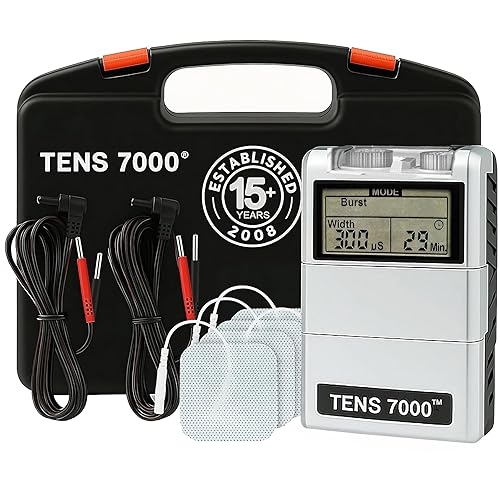
- Adjustable pulse width from 50–300μs — actually reaches the sciatic nerve
- Adjustable frequency from 2–150 Hz with manual control
- 5 modes including burst, modulation, and constant — not locked presets
- Dual independent channels, 4 electrode pads included
- FDA-cleared as a medical device (not a wellness consumer product)
- Manual pulse width and frequency control — the spec that actually matters
- Used in physical therapy clinics; PT-recommended unit
- Massive review base (106,000+) with sciatica-specific feedback
- 9V battery (replaceable) — no charging dependency
- Interface is utilitarian — no big touchscreen, no app
- Requires understanding of TENS settings to dial in (instructions help)
- Only 4 pads included; budget more for replacements
Why it’s #1: The TENS 7000 is the only sub-$50 unit on Amazon with both an adjustable 300μs pulse width and manual frequency control across the full 2–150 Hz range. Every other “best TENS” list defaults to it for a reason: it’s the closest consumer device to what a physical therapist would actually put on a sciatica patient. The lack of fancy presets is a feature — you control the settings instead of trusting a “Mode 7 — Sciatica” preset that may or may not match your nerve depth.
Check Price on Amazon →2. iReliev TENS + EMS Combination Unit

- 14 preset programs including dedicated lower-back and sciatica modes
- Pulse width up to 300μs across most programs
- Combined TENS (pain) + EMS (muscle re-education) in one device
- Backlit LCD, dual independent channels, lockable intensity
- FDA-cleared, made by US medical-device manufacturer
- Pre-programmed sciatica mode dials in the right frequency/pulse-width combo automatically
- EMS mode useful for the muscle deconditioning sciatica often causes
- Better customer support than no-name Amazon brands
- Replacement pads and accessories widely available
- $60 vs $25 for cheap units — pays for medical-grade output
- Programs are preset; less manual flexibility than TENS 7000
- Heavier than pocket units, less portable
Why it’s here: If you want sciatica relief without learning to dial in settings, iReliev is the answer. The preset sciatica program runs at conventional TENS (80 Hz, 250μs) for the first 10 minutes, then drops to low-frequency (4 Hz) for the back half — the mixed-protocol clinicians use. Combine that with a working EMS mode for the gluteal medius (commonly weak in chronic sciatica patients) and you have a single device that handles both pain relief and the strengthening that prevents recurrence.
Check Price on Amazon →3. AUVON 3-in-1 TENS + EMS + Massage

- 24 modes including dedicated “lower back” and “sciatica” presets
- 40 intensity levels with 0.5mA increments — fine control for nerve-depth tuning
- Pulse width up to 250μs on TENS modes
- 12 electrode pads included (mix of 2″×2″ and 2″×4″)
- Rechargeable lithium battery, 10+ hours per charge
- Amazon’s Choice for sciatica searches; 10,000+ sold per month
- Includes larger 2″×4″ pads better suited to lumbar/SI placement
- Best value at under $30 with both pulse-width range and preset modes
- Memory function remembers your last settings
- Pulse width caps at 250μs (vs 300μs on TENS 7000)
- Shared intensity dial between channels in some modes
- Sciatica preset is fixed — you can’t modify the mixed-frequency profile
Why it’s here: The AUVON 3-in-1 hits the sweet spot for someone who doesn’t want to learn manual settings but won’t pay iReliev premium. The dedicated sciatica preset uses a defensible frequency/pulse-width combo, the larger 2″×4″ pads work properly for SI-joint placement, and the 40-step intensity dial lets you tune without overshooting. The pulse width ceiling is the real compromise versus pricier units — 250μs reaches the nerve at typical depths but leaves less headroom for higher-BMI users.
Check Price on Amazon →4. AUVON Dual Channel TENS Unit

- Independent dual channels — run two different programs simultaneously
- 20 modes with manual pulse-width-adjustable lower-back program
- Pulse width 100–250μs; frequency 2–100 Hz
- 43,400+ reviews — most-tested mid-priced TENS unit on Amazon
- 2″×2″ and 2″×4″ pads included
- Independent channels let you target SI joint + lumbar paraspinals separately
- Massive review base with sciatica-specific user feedback
- Backlit screen visible in low light
- Lockable intensity prevents accidental cranking
- No dedicated “sciatica” preset — relies on lower-back program
- Pulse width ceiling at 250μs
- Pads degrade after ~25 uses (replace regularly)
Why it’s here: The dual independent channels are the standout feature. Sciatica often requires hitting two areas — the lumbar nerve root and the piriformis/gluteal region — with different settings. This unit lets you run channel A at 80 Hz over the spine and channel B at 4 Hz over the SI joint with separate intensity control on each. That’s a clinical-style protocol most $40 units physically can’t do.
Check Price on Amazon →5. AVCOO 3-in-1 TENS Unit

- 30 modes with dedicated lumbar and sciatica programs
- 40 intensity levels in 0.5mA steps
- Pulse width 100–250μs; frequency 1–100 Hz
- 12 pads including four 2″×4″ pads — best for SI joint placement
- Rechargeable, ~12 hour battery, memory function
- Best pad mix for sciatica placement (four large 2″×4″)
- More mode variety than AUVON 3-in-1 (30 vs 24)
- Comes with EVA case — better for travel
- Rapid intensity step at low levels for tuning around nerve threshold
- Fewer reviews than the AUVON line (2,700 vs 43,400)
- Programs are fixed — no manual frequency editing
- Pulse width capped at 250μs
Why it’s here: Electrode size matters more than most buyers realize. The 2″×4″ pads concentrate current evenly across the SI joint and lumbar paraspinals, where the smaller 2″×2″ pads create hot spots. AVCOO is the only sub-$40 unit shipping four large pads in the box — most kits include one or two and expect you to buy more. For sciatica specifically, that pad mix matters more than another preset mode.
Check Price on Amazon →Where to Place TENS Electrodes for Sciatica
Pad placement is the single most common mistake in self-administered TENS therapy. Most people place electrodes where the pain feels strongest — usually the back of the thigh or calf — because that’s where the symptom is loudest. That’s wrong. Sciatic pain in the leg is referred from the nerve root or impingement point upstream. Gating the signal at the calf does almost nothing for the lumbar root.
The correct sciatica placement targets the nerve closer to its source. Three placements, in order of priority:
1. The sacroiliac (SI) joint and lumbar paraspinals (primary placement). Find the two dimples at the top of your buttocks — those mark the SI joints. Place one pad about an inch above each dimple, roughly over the L4-L5 region, with pads angled so the current flows across the lumbar spine, not parallel to it. This targets the nerve root irritation that causes most sciatica. Use the larger 2″×4″ pads if your kit includes them.
2. The gluteal medius and piriformis (secondary placement). If your sciatica radiates deep into the buttock — a sharp point of pain when you sit on a wallet — the piriformis is likely involved. Place one pad on the upper outer buttock, about three inches below the iliac crest, and the second pad on the lower outer buttock, roughly above the gluteal fold. The current flows through the piriformis where it crosses the sciatic nerve. Run this as a second channel after lumbar placement.
3. NOT the calf or back of the thigh. Pain radiating to the calf is a downstream symptom, not the source. Placing pads there gates calf sensation without addressing the nerve root. Some people get partial relief from calf placement via local distraction, but it’s chasing symptoms. Treat the source first; if calf pain persists after 20 minutes of correct lumbar/SI placement, then add a third pair distally — don’t lead with it.
General rules for all placements: Keep pads at least one inch apart (closer and the current shortcuts between them without penetrating). Never place pads on broken skin, over the spine itself, across the heart, or near the throat. Replace pads when they stop sticking firmly — degraded pads cause hot spots and reduce penetration.
TENS Programs: When to Use 80 Hz vs 2 Hz for Sciatica
Two frequency regimes do different things. Knowing which to use when is most of the skill in self-administered TENS.
Conventional TENS (high-frequency, 50–100 Hz, narrow pulse width 50–200μs): Use during acute flare-ups, after a bad day of sitting, or anytime you need pain to drop in the next 10 minutes. Mechanism is pure gate control — fast A-beta fiber stimulation overrides the slower C-fiber pain signal in the dorsal horn. Effect onset: 2–5 minutes. Effect duration: 30 minutes or so after the session ends. Comfortable, tingly sensation; should not cause visible muscle contraction.
Acupuncture-like TENS (low-frequency, 2–10 Hz, wider pulse width 200–400μs): Use for chronic, persistent sciatica that hasn’t responded to conventional TENS. Mechanism is endogenous opioid release — slow, larger pulses trigger the release of beta-endorphin and met-enkephalin, producing longer-lasting analgesia. Effect onset: 20–30 minutes. Effect duration: several hours after the session, sometimes more. Sensation is slower, thumping; you’ll see mild muscle twitching at therapeutic intensity. Less comfortable but more durable relief.
Mixed-frequency or burst-mode programs: The best presets alternate between the two regimes — 10 minutes of 80 Hz to get fast relief, then 10–15 minutes of 4 Hz to build longer-lasting endorphin-driven analgesia. The iReliev’s sciatica preset and TENS 7000’s burst mode do this automatically. If you’re using a unit with manual control, switch programs mid-session yourself.
Most clinicians recommend 20–30 minute sessions, 2–3 times daily during a flare, tapering as pain reduces. Do not exceed 60 minutes per session — beyond that, skin irritation outweighs additional analgesic benefit, and adaptation reduces TENS effectiveness over time. If you’re using TENS more than three weeks consecutively for the same pain, see a clinician — sciatica that needs continuous electrical pain gating is sciatica that needs a different diagnosis.
Who Should NOT Use a TENS Unit
TENS is generally safe, but the contraindications are absolute. Do not use a TENS unit if any of the following apply:
- You have a pacemaker, implanted defibrillator, or any active implanted medical device. The TENS current can interfere with device function. This is non-negotiable.
- You are pregnant, especially over the abdomen, lower back, or pelvis. TENS for labor analgesia is a different context and requires OB supervision.
- You have epilepsy — TENS over the head, neck, or upper shoulders can trigger seizures in susceptible individuals.
- You have undiagnosed pain, especially sudden severe back pain with bowel/bladder dysfunction, leg weakness, numbness in the groin/inner thighs (saddle anesthesia), or fever. These can signal cauda equina syndrome, infection, or tumor — emergencies that require imaging, not pain gating.
- You have deep vein thrombosis (DVT) in the area being treated — electrical stimulation could dislodge a clot.
- You have broken, infected, or inflamed skin where the pads would go. Wait until skin heals.
- You’re near the eyes, throat (carotid artery), or directly across the heart. Never place pads in those locations.
- You have a metal implant near the placement site — surgical hardware can concentrate current and cause local burns. Spinal fusion hardware in the lumbar region is a common issue for sciatica patients; check with your surgeon first.
Less absolute but worth a clinician conversation: anticoagulants, diabetes with reduced skin sensation, history of skin allergies to electrode gel.
How We Picked These
- Pulse width range — minimum 200μs ceiling, with bonus for adjustable manual control across the 50–300μs range
- Frequency control — units that support both 50–100 Hz conventional and 2–10 Hz acupuncture-like modes, ideally with mixed-frequency presets
- Independent dual channels — separate intensity and program per channel for combined SI/lumbar placement
- Electrode pad mix — at least two 2″×4″ pads included for proper SI-joint and lumbar paraspinal placement
- Review depth — minimum 1,000 reviews with at least 4.4★ average, weighted toward units with sciatica-specific user feedback
- FDA clearance preferred — devices cleared as medical (not just consumer wellness) products use better-validated current shaping
We rejected roughly a dozen popular Amazon units during research — most because they refused to publish pulse width specs in their listings (a near-certain sign the number is under 150μs), several because their “dual channel” was a shared-intensity gimmick, and a few because customer reviews specifically reported they “tingled the skin but did nothing for sciatica” — the exact failure mode the pulse-width spec predicts.
Frequently Asked Questions
TENS vs EMS for sciatica — which one do I want?
TENS for pain, EMS for muscle. They’re different therapies that look similar. TENS uses lower current and shorter pulses to gate pain signals at the nerve — that’s what you want during a sciatica flare. EMS uses higher current and longer pulses to force muscle contraction, used for strengthening or re-education of muscles that have shut down. Chronic sciatica often coexists with weak gluteal medius and deep core, so an EMS mode is useful for prevention — but during a flare, you want TENS settings. Combination units like the iReliev or AUVON 3-in-1 give you both.
How long should one TENS session last?
20–30 minutes is the standard, 2–3 times per day during an acute sciatica flare. Don’t exceed 60 minutes in a single session — beyond that you get diminishing analgesic returns and increased risk of skin irritation. Skin under the pads should be checked between sessions; if it’s red or itchy, give it an hour before reapplying. The body also adapts to TENS over weeks — if effectiveness fades, switch from conventional to acupuncture-like settings (or vice versa) to break adaptation.
Can a TENS unit make sciatica worse?
Direct nerve damage from TENS at consumer-device intensities is extremely rare. What can get worse: skin irritation from prolonged pad contact, muscle soreness from running EMS-level current under “TENS” settings (cheap units sometimes mislabel intensity ranges), and a false sense of improvement that causes you to keep aggravating the underlying mechanical problem because the pain is masked. TENS treats the pain signal, not the disc herniation or piriformis spasm causing it. If you’re using TENS to push through activities that flare your sciatica, you’re trading short-term relief for long-term worsening of the root cause.
TENS vs heat pad vs chiropractor — what’s the order of operations?
For an acute sciatica flare, the typical order is: ice for the first 24–48 hours (reduce inflammation), then heat after that (relax surrounding muscle spasm), with TENS layered on for pain gating during either phase. A back stretcher or floor-based decompression tool addresses the mechanical component once the acute inflammation has settled. Chiropractic and PT are appropriate when symptoms persist beyond 2–3 weeks or include neurological signs. TENS is symptomatic relief — it buys you tolerable time to do the mechanical and movement work that actually resolves sciatica. It is not, by itself, a cure.
Do I need a prescription for a TENS unit?
No. All five units in this guide are over-the-counter, FDA-cleared (or FDA-registered as wellness devices) and ship to consumers freely. Insurance coverage for TENS units typically requires a prescription and a documented condition, but cash purchase doesn’t.
How often do I need to replace the electrode pads?
Self-adhesive gel pads last 20–30 uses with proper care — peel them off slowly, return them to the plastic backing after each session, and store away from heat. When they stop sticking firmly, replace them. Worn pads cause hot spots, uneven current distribution, and skin irritation. Budget $10–$15 every couple months if you’re using the unit daily.
Will TENS interfere with my Apple Watch, Whoop, or fitness tracker?
Generally no — consumer wearables aren’t active medical devices in the sense that pacemakers are. TENS may cause a brief HRV reading anomaly during sessions because the electrical signal can bleed into optical or ECG sensors, but it doesn’t damage the device or invalidate longer-term data. The contraindication is for active implanted devices, not wrist-worn wearables.
Final Thoughts
Sciatica is a nerve problem masquerading as a back-muscle problem, and most TENS units are built for surface muscles. The five units on this list have the pulse width, frequency range, and pad configuration to actually reach the sciatic nerve at depth — and the protocols above will get more out of them than a “Mode 7” button ever will.
If you want a single recommendation: the TENS 7000 remains the most defensible pick — manual control over pulse width and frequency, 300μs ceiling, and the same form factor PTs use in clinic. If you’d rather press a button than dial in settings, the iReliev TENS + EMS has the best preset library specifically for sciatica, and adds working EMS for the gluteal strengthening that prevents recurrence.
For tools that address the mechanical side of sciatica alongside the pain-gating side, see our guide to the best back stretchers and decompression tools and the broader roundup of best TENS and EMS units for general use.
Ready to Try TENS for Sciatica?
Adjustable 300μs pulse width, manual frequency, PT-grade
Check Price →Dedicated sciatica preset + EMS for gluteal strengthening
Check Price →Last updated: June 16, 2026 at 10:30 AM ET. Prices and availability shown are accurate as of this time and are subject to change. As an Amazon Associate, DeskFitPro earns from qualifying purchases.