The clinical studies everyone cites for collagen — the skin elasticity improvements, the joint pain reduction, the nail growth, the bone-density preservation in post-menopausal women — used 2.5 to 15 grams of hydrolyzed collagen peptides per day, taken for 8 to 24 weeks. Most collagen gummies on Amazon deliver 50 to 500mg per serving. That’s five to one hundred times below the studied dose. A few don’t disclose milligrams at all — they just list “collagen” as an ingredient and call it a beauty supplement.
We pulled every popular collagen gummy on Amazon, separated the ones that actually disclose hydrolyzed collagen peptides in milligrams from the ones leaning on “contains collagen” marketing, and ranked them by dose, peptide type disclosure, sugar load, and review credibility. Four made the cut — and we’re going to be straight with you up front: even the highest-dosed gummy on this list sits at the bottom of the clinical range. If you want the full studied dose, you need a powder. We get into that math below, then rank the gummies that come closest.
Affiliate disclosure: As an Amazon Associate, DeskFitPro earns from qualifying purchases. We only recommend products we’d actually take.
Health disclaimer: Collagen is generally well-tolerated but can interact with certain medications and conditions. People with fish, shellfish, or egg allergies should check the source (marine vs bovine vs eggshell). Anyone with a history of kidney stones should talk to a doctor first — collagen is high in hydroxyproline, which the body can convert to oxalate. This article is informational, not medical advice.
#1 PICK: Sugar-Free Multi Collagen Peptides Gummies (Type I, II, III, V, X) — the closest mainstream gummy we found to a clinical-floor dose, with 1,500mg hydrolyzed collagen peptides per 2-gummy serving, plus biotin, B12, and vitamin C in disclosed amounts. Sugar-free, 4.5★ (1,400+ reviews). $29.39 for 60 gummies.
As an Amazon Associate, I earn from qualifying purchases. Learn more.
Why Collagen Gummies Don’t Have Enough Collagen to Matter
Almost everything you’ve read about collagen — Korean and German trials showing improved skin elasticity and hydration, the joint-pain trials in athletes and osteoarthritis patients, the nail-growth studies, the post-menopausal bone density work — comes from supplementing with hydrolyzed collagen peptides at doses between 2.5g and 15g per day. The most-cited skin studies sit at 2.5g to 5g. The joint and bone studies push higher, often 5g to 10g. Twelve weeks is the typical minimum trial length before measurable changes show up.
Now look at the supplement facts panel on a collagen gummy.
The typical gummy serving (usually two gummies) contains somewhere between 50mg and 500mg of collagen. The best ones we found on Amazon push 1,500mg in a 2-gummy serving, and that’s the high end of the entire gummy category. A handful claim 3,000mg, but the small print reveals the number includes other ingredients (biotin, hyaluronic acid, keratin, vitamins) padding out the headline. You have to read the supplement panel to see the actual collagen number, and it’s almost always smaller than the front-of-bottle claim suggests.
To hit a 2,500mg clinical floor dose using a typical 250mg gummy, you’d need 10 gummies a day. At 30 to 50 calories and 2 to 3g of sugar per gummy, that’s an extra 300-500 calories and 20-30g of sugar daily — the metabolic equivalent of drinking a can of soda for your skincare routine.
Four things go wrong on a typical collagen gummy label:
- Collagen listed without a milligram amount. “Hair, Skin & Nails Gummies with Collagen” on the front, then you flip the bottle and “hydrolyzed collagen” appears in the ingredient list with no mg disclosure. Assume it’s a sprinkling — under 100mg.
- Total formula weight passed off as collagen. “3,000mg formula” can mean 500mg collagen plus 2,500mg of biotin, keratin, hyaluronic acid, and bulking agents. The collagen line specifically is what matters.
- Collagen source and type undisclosed. Marine collagen (from fish skin) is mostly Type I. Bovine collagen (from cow hide) is Type I and III. Chicken sternum collagen is Type II. The studies are type-specific — Type II for joints, Type I for skin and nails. A label that just says “collagen” without a type or source is selling you noise.
- “Hydrolyzed” left off. Intact collagen is a huge protein that the gut can’t absorb. Hydrolyzed collagen (collagen peptides) is enzymatically broken down to low-molecular-weight fragments — roughly 3-5 kDa — that survive digestion and reach the bloodstream. The clinical trials all use hydrolyzed. If a label just says “collagen” or “marine collagen powder” without “hydrolyzed” or “peptides,” the bioavailability is much lower.
The math is unforgiving. A 100mg collagen gummy isn’t a smaller version of a 5,000mg powder dose — it’s a fundamentally different intervention. Below 1,000mg per day, there’s almost no clinical evidence for visible effects on skin or joints. Skip any gummy that doesn’t disclose hydrolyzed collagen peptides in milligrams. That’s the first filter. The second is dose: aim for at least 1,000mg per daily serving, ideally 2,500mg+.
At a Glance
- Best Overall (Closest to Clinical Floor): Sugar-Free Multi Collagen Peptides Gummies — 1,500mg hydrolyzed multi-collagen, sugar-free, disclosed peptide types
- Best Value (Trusted Brand, Honest Label): Nature Made Collagen Gummies with Vitamin C, Zinc, Biotin — established maker, disclosed hydrolyzed peptides, under $11
- Best Multi-Type Formula: Multi Collagen 3000mg Gummies + Keratin + Biotin — 5-type collagen blend, sugar-free, broader formula for hair-skin-nails stack
- Honest Alternative (Powder, Not a Gummy): Vital Proteins Collagen Peptides Powder — 10g (10,000mg) per scoop, full clinical dose, unflavored. The recommendation if you actually want results.
- Most Popular Hair-Skin-Nails Gummy (Underdosed — Buy With Eyes Open): Nature’s Bounty Hair, Skin & Nails with Biotin and Collagen — 45,000+ reviews, but the collagen dose is a token amount; you’re buying biotin
The Dose Math: Clinical Studies vs Typical Gummy
Here’s the gap, laid out plainly. All collagen doses below refer to hydrolyzed collagen peptides per daily serving, as listed on the manufacturer’s supplement facts panel.
| Product / Reference | Form | Hydrolyzed Collagen / Daily Serving | Collagen Types | Sugar / Serving | Price |
|---|---|---|---|---|---|
| Clinical skin elasticity studies | Powder | 2,500-5,000mg | I, III | — | — |
| Clinical joint pain studies | Powder | 5,000-10,000mg | I, II, III | — | — |
| Vital Proteins Powder | Powder | 10,000mg (1 scoop) | I, III | 0g | $18.65 |
| Sugar-Free Multi Collagen | Gummy | 1,500mg | I, II, III, V, X | 0g | $29.39 |
| Multi Collagen 3000mg Gummies | Gummy | ~1,000mg (collagen line) | I, II, III, V, X | 0g | $22.99 |
| Nature Made Collagen Gummies | Gummy | ~500mg | I, III (bovine) | 4g | $10.99 |
| Nature’s Bounty Hair/Skin/Nails | Gummy | ~50-100mg (token) | Not disclosed | 3g | $7.00 |
One thing this table makes obvious: every gummy on Amazon sits well below the clinical dose ranges. The best gummy we found (1,500mg) is 40% of the lowest-end skin study dose, and roughly 15% of the joint-study range. The Nature’s Bounty product — the most popular hair-skin-nails gummy in America by review count — is essentially a biotin gummy with a sprinkle of collagen for marketing copy. The powder gets you there in one scoop. That’s the unvarnished tradeoff: gummies are easy to take and taste good; powder actually delivers the dose studied.
Detailed Reviews
1. Sugar-Free Multi Collagen Peptides Gummies (Type I, II, III, V, X)
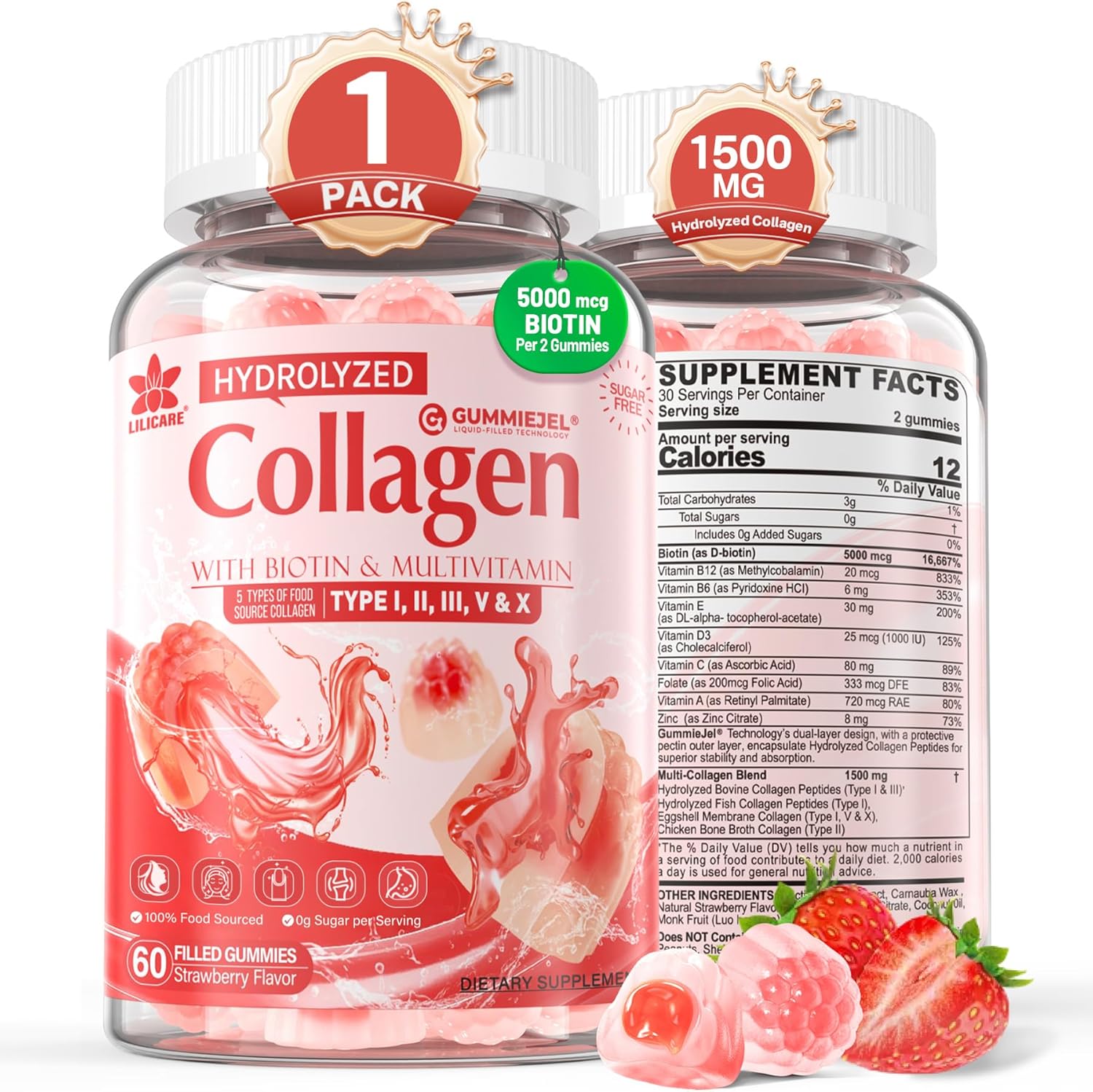
- Hydrolyzed collagen peptides: 1,500mg per 2-gummy serving
- Collagen types disclosed: I, II, III, V, X (multi-collagen blend)
- Sugar per serving: 0g (sugar-free formulation)
- Co-ingredients: 5,000mcg biotin, methylated B12, vitamins C, A, E, D3, B6
- 60 gummies = 30 servings (one month)
- Fruit-flavored, gluten-free
- Highest disclosed hydrolyzed collagen peptide dose we found in a mainstream gummy
- Zero sugar — actually viable as a daily supplement without sneaking in 90g of sugar per month
- Methylated B12 (the active form) is unusual at this price point — most gummies use cyanocobalamin
- Multi-type blend covers Type II (joints) alongside I and III (skin/hair/nails)
- Still only ~60% of the lowest skin-study clinical dose — closer than the rest, but not full clinical
- Newer SKU — review volume is solid (1,400+) but not Nature Made’s 11,500
- Source of collagen (bovine vs marine vs blend) is less clear than we’d like
Why I recommend it: If your goal is to get the most actual collagen possible into a gummy format — without buying powder, without taking 10 gummies a day, without choking down sugar — this is the pick. 1,500mg is genuinely meaningful at this delivery format. The sugar-free formulation matters more than people realize: a gummy you take daily for 12 weeks adds up to a measurable sugar load that contradicts the metabolic goals of most people taking collagen for skin or weight. Pair this with a vitamin-C-rich diet and you’ve replicated the lower bound of what skin studies have used.
Check Price on Amazon →2. Nature Made Collagen Gummies with Vitamin C, Zinc, Biotin
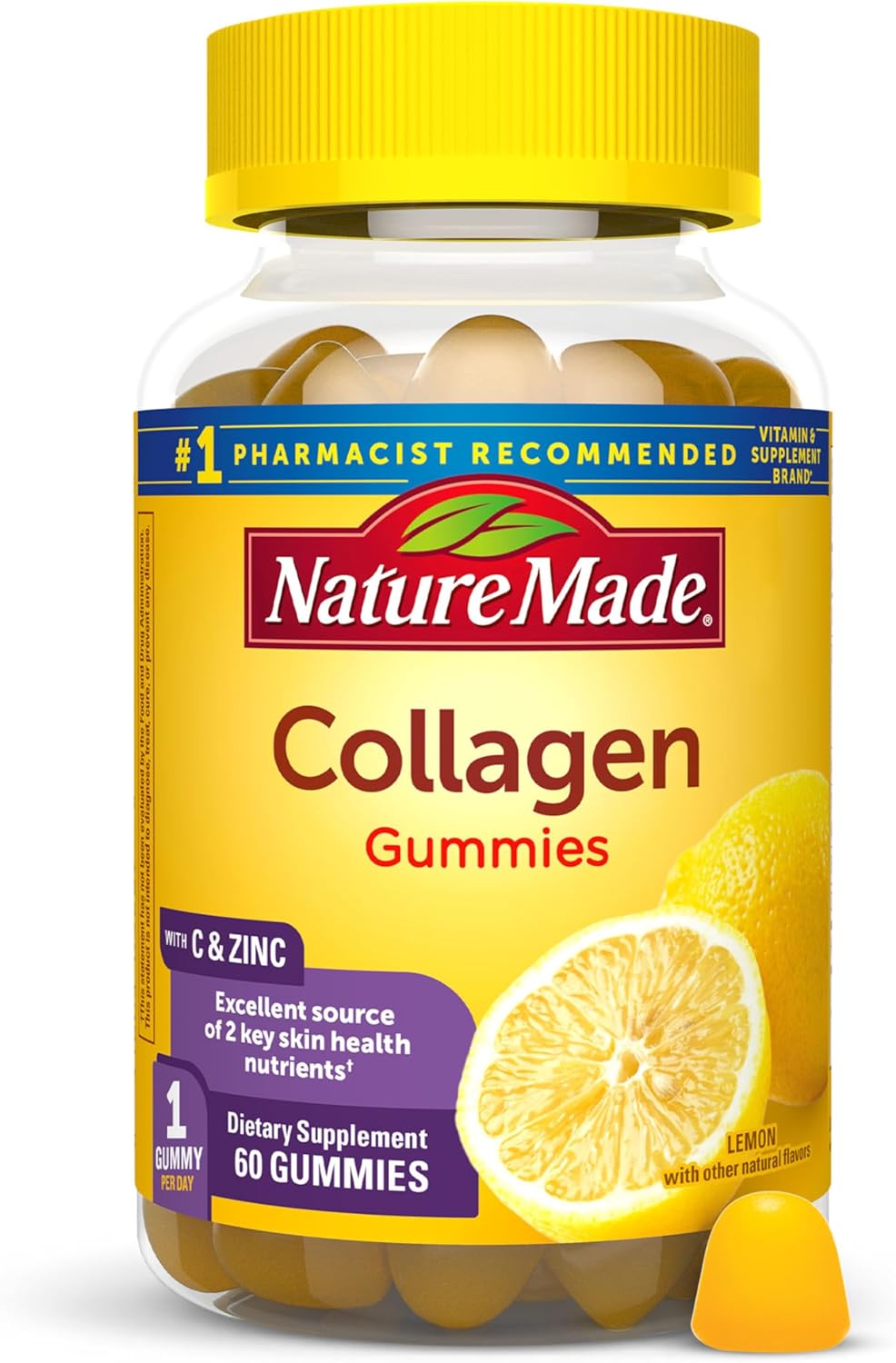
- Hydrolyzed collagen peptides: ~500mg per 2-gummy serving (bovine)
- Collagen types: I and III
- Sugar per serving: 4g
- Co-ingredients: vitamin C, zinc, biotin (skin-support cofactors)
- 60 gummies = 60-day supply (single gummy dosing option)
- Made by Nature Made — USP-verified parent brand, established U.S. manufacturer
- Cheapest legitimate disclosed-dose collagen gummy on this list — under $11
- Nature Made is one of the most-tested supplement brands in retail; QC is real
- 11,500+ reviews at 4.6★ — strongest social proof in the category at this dose
- Includes vitamin C, which collagen synthesis genuinely depends on
- Dose is well below clinical range — ~500mg is starter-tier
- Contains 4g sugar — more than our top pick, less than mass-market gummies
- Only Type I and III, no Type II for joint support
Why I recommend it: Nature Made is the closest thing to a default safe pick in this category — recognizable brand, USP-style QC, real hydrolyzed peptides on the label, and at $11 you’re not paying a premium for a sub-clinical dose. If you’re new to collagen and just want to see whether you tolerate it before committing to powder, this is the on-ramp. The 500mg dose won’t replicate the trials, but it will tell you whether your stomach handles bovine collagen and whether you actually remember to take a daily supplement — both real questions before you spend $40 on a tub of powder.
Check Price on Amazon →3. Multi Collagen 3000mg Gummies + Keratin + Biotin (5-Type Blend)

- Total formula: 3,000mg per serving (collagen line is ~1,000mg; rest is keratin, biotin, hyaluronic acid)
- Collagen types: I, II, III, V, X — full multi-type stack
- Sugar per serving: 0g
- Co-ingredients: 2,500mg keratin, 5,000mcg biotin, hyaluronic acid, vitamin C, zinc
- 60 gummies = 30 servings
- Sugar-free, gluten-free
- Type II included — relevant if you want joint support alongside skin
- Hyaluronic acid stacked in the formula (modest evidence for skin hydration)
- Sugar-free — fine for daily use without sugar-load tradeoffs
- Keratin and biotin together for hair-nail focus
- The “3,000mg” headline includes co-ingredients — actual collagen is closer to 1,000mg
- Lower review count than Nature Made (350 vs 11,500) — newer brand
- Multi-collagen blends rarely disclose the ratio of each type
Why I recommend it: If your interest in collagen is broader than “skin only” — joints, nails, the full hair-skin-nails stack — this is the formula. Five collagen types covers the bases the single-source Nature Made doesn’t. The keratin and hyaluronic acid additions are useful (HA has its own modest evidence for skin hydration at oral doses around 120mg). Just be honest about the headline: 3,000mg is the total formula weight, not the collagen line. The collagen itself is around 1,000mg — which is still ahead of most of this category.
Check Price on Amazon →4. Vital Proteins Collagen Peptides Powder — Unflavored

- Hydrolyzed collagen peptides: 10,000mg (10g) per scoop — full clinical dose
- Collagen types: I and III (grass-fed, pasture-raised bovine)
- Sugar per serving: 0g
- Unflavored — dissolves in coffee, smoothies, oatmeal
- 9.33oz tub = ~26 servings
- Vital Proteins is the category benchmark — NSF-tested supply chain
- One scoop replicates the skin-study clinical dose. No gummy on this list can say that.
- Unflavored dissolves cleanly in hot or cold liquid — almost no taste change
- 67,000+ reviews at 4.6★ — most-validated collagen product on Amazon
- Grass-fed bovine, third-party-tested
- Cheaper per gram of collagen than any gummy by a wide margin
- Not a gummy — requires a scoop, a liquid, and 30 seconds of stirring
- Travel is less convenient than a gummy bottle
- Some users report mild bloating when starting at the full 10g dose (start with half-scoop)
Why I recommend it: If you’ve read this far you already know the recommendation. Gummies are convenient and pleasant; powder is what actually delivers the dose used in the studies. One scoop of Vital Proteins gets you to 10g — more than the entire month’s supply of collagen in a 60-count gummy bottle. We’d be intellectually dishonest if we wrote a “best collagen gummies” article and didn’t say, plainly, that the powder is the option that produces results. Take it in coffee. You won’t notice it. Your skin will, eventually.
Check Price on Amazon →5. Nature’s Bounty Hair, Skin & Nails with Biotin and Collagen

- Biotin: 2,500mcg per serving (the headline ingredient)
- Collagen: included, but mg not disclosed prominently — estimated 50-100mg per serving
- Sugar per serving: 3g
- Co-ingredients: vitamin C, vitamin E, zinc
- 80 gummies = 40 servings
- Citrus-flavored, gluten-free
- 45,600+ reviews at 4.6★ — most-bought hair-skin-nails gummy in America
- Nature’s Bounty has decades of consumer trust and reasonable QC
- Biotin is the actual workhorse ingredient here, and 2,500mcg is a credible dose for nail and hair effects
- Cheapest on this list — under $0.20 per serving
- The collagen content is a token amount — well under any meaningful threshold
- Marketing leans on “with collagen” but the supplement panel tells a different story
- If you’re buying this for collagen specifically, you’re paying for biotin and citrus flavor
Why I recommend it (with a caveat): Nature’s Bounty is on this list because excluding the most-bought hair-skin-nails gummy in the category would be dishonest. It works — for some people — because the biotin dose is real, and biotin does help nail thickness in people who are deficient. But the collagen is a sprinkle. If you bought this thinking the collagen was the active ingredient, you’ve been mis-sold. Buy it knowing it’s a biotin-and-vitamin-C gummy with collagen on the label, not a collagen supplement. For an honest biotin-focused recommendation, see our biotin gummies guide when it publishes.
Check Price on Amazon →Hydrolyzed vs Marine vs Bovine: Which Collagen Type for What?
“Collagen” is shorthand for at least 28 different proteins your body builds. Only a handful matter for supplementation. Here’s what you actually need to know.
Type I: The most abundant collagen in the body — roughly 90% of total collagen, found in skin, tendons, bones, organs, and the white of your eyes. This is the type that matters for skin elasticity, hair, and nail studies. Both bovine (cow) and marine (fish) collagen are predominantly Type I.
Type II: Found in cartilage. Relevant only for joint support. Sourced almost exclusively from chicken sternum cartilage. Studies on osteoarthritis pain and athletic joint discomfort use undenatured Type II at small doses (~40mg) or hydrolyzed Type II at higher doses. If you don’t have joint issues, you don’t specifically need Type II.
Type III: Almost always present alongside Type I in skin, blood vessels, and organs. Usually included automatically when you buy bovine collagen (the two are co-located in cow hide). Marine collagen is much lower in Type III.
Type V and X: Trace types that appear in multi-collagen blends. The evidence base for V and X specifically is thin — they’re included for marketing breadth more than measurable benefit. Not a reason to choose or avoid a product.
Marine collagen: Derived from fish skin and scales. Predominantly Type I, with smaller peptide size on average, which has been argued (with limited but real evidence) to absorb slightly faster. The case for marine is real if you don’t eat beef for religious, dietary, or environmental reasons. It’s typically more expensive per gram.
Bovine collagen: Derived from cow hide. Provides Type I and III together, grass-fed sourcing is widely available, and it’s cheaper per gram than marine. The default for most clinical studies. If price-per-gram and Type I+III coverage matter, bovine wins.
Eggshell membrane collagen: A niche source, primarily Type I, V, and X with hyaluronic acid co-occurring naturally. Doses studied are much smaller (~500mg) for joint endpoints. Allergen risk if you have egg allergies.
For most people, the practical answer is: hydrolyzed bovine collagen peptides delivering Type I and III, at 2,500-10,000mg per day. If you specifically want joint support, look for a multi-collagen blend that includes Type II.
Should You Just Buy Collagen Powder Instead?
We’re going to give you the honest answer first: yes, probably. If your goal is to replicate the results from the trials — measurable improvements in skin elasticity, joint discomfort, nail growth, bone density — powder is the format that delivers the dose those studies used. The math isn’t subtle: one scoop of Vital Proteins is 10g of hydrolyzed collagen. That’s more than an entire 60-count bottle of even the highest-dosed gummy on Amazon, which contains about 45g total spread across 30 servings.
But there are real cases where gummies make sense:
- You have texture issues with powder. Some people genuinely cannot drink a beverage that has been mixed with collagen — the slight viscosity bothers them. A gummy sidesteps this entirely.
- You travel constantly. A gummy bottle goes in a carry-on. A powder tub doesn’t. If your alternative is “I won’t take it at all because the tub is at home,” a sub-clinical gummy dose is still better than zero.
- You want a hair-skin-nails stack, not a collagen-only supplement. Gummies often bundle biotin, vitamin C, zinc, and hyaluronic acid in disclosed doses. If you’d be taking those anyway, a gummy that includes them all is a reasonable consolidation.
- You’re just starting out. Buying a $40 tub of powder to find out you don’t tolerate collagen or won’t remember to take it is wasteful. A $10 bottle of Nature Made gummies is a low-stakes test.
- Adherence beats dose, sometimes. A 500mg gummy you actually take daily for six months may produce more effect than a 10g powder you abandon after week three. This is the most-underrated variable in supplementation.
Where gummies don’t make sense: if you’ve already proven you’ll stick with a supplement, if you’re treating something specific (joint pain, post-menopausal bone loss), or if you’re cost-conscious per gram of active ingredient. In all three cases, powder wins by a wide margin.
Stacking: Collagen + Vitamin C + Hyaluronic Acid
The reason collagen co-ingredients exist isn’t pure marketing. Two of them have real mechanistic and clinical support — the third is mostly a bonus.
Vitamin C: Collagen synthesis in the body requires vitamin C as a cofactor — specifically for the hydroxylation of proline and lysine residues that stabilize collagen’s triple-helix structure. Without vitamin C, you literally cannot make functional collagen (this is what scurvy is). The studies that show collagen-supplement effects on skin almost always have participants with adequate vitamin C intake. Aim for at least 75-90mg daily from food or supplements alongside collagen. Most gummies include 60-90mg, which is sufficient.
Hyaluronic acid (HA): Found in skin, eyes, and joints, where it holds water and lubricates. Oral hyaluronic acid at 120-240mg daily has modest but real evidence for improvements in skin hydration and elasticity (small Japanese and Italian trials, 8-12 weeks). It’s not a replacement for collagen, but the two stack cleanly because they target different layers of the dermis. Multi-collagen gummies often include 50-100mg of HA, which is below the studied dose but still potentially additive.
Biotin: Real evidence for nail brittleness and hair quality only in people who are biotin-deficient (rare in adults eating a varied diet). Most healthy people taking 2,500-10,000mcg biotin gummies are getting no measurable effect because their baseline is already adequate. The high-dose biotin in “hair, skin & nails” gummies is mostly there because it’s cheap to include and consumers expect it. If you’re not deficient, the biotin isn’t doing much.
Zinc: Plays a role in collagen synthesis and wound healing. Most diets cover it. Supplementing isn’t harmful at gummy doses (8-15mg), and there’s a thin but real case for inclusion.
The reasonable evening or morning stack: 2,500-10,000mg hydrolyzed collagen + 75-90mg vitamin C (from gummy, food, or a separate supplement) + optionally 120mg+ hyaluronic acid. Pair with magnesium glycinate at night if you’re already supplementing — see our best magnesium glycinate gummies guide for stack-friendly picks.
Who Should NOT Take Collagen
Collagen has one of the cleaner safety profiles in the supplement world, but there are real contraindications worth flagging.
- People with a history of kidney stones. Collagen is high in hydroxyproline, which the body can metabolize to oxalate — a major component of the most common kidney stones. If you’re a chronic stone-former, talk to a urologist before starting daily collagen, especially at higher powder doses.
- Anyone with severe fish or shellfish allergies. Avoid marine collagen entirely. Bovine and eggshell are alternatives, but verify the source.
- People with egg allergies. Avoid eggshell-membrane collagen. Bovine and marine are fine.
- Strict vegetarians or vegans. All collagen comes from animal sources (bovine, marine, chicken, eggshell). “Vegan collagen boosters” are not collagen — they’re plant-based blends of amino acids and vitamin C that purport to support your body’s own collagen production. The evidence for those is much thinner than for actual collagen peptides.
- Pregnant or breastfeeding women. Collagen itself isn’t contraindicated, but the high-biotin co-ingredients in some gummies can interfere with thyroid lab tests. Tell your OB you’re taking it before any thyroid bloodwork.
- People on warfarin or other anticoagulants. Some marine collagens are sourced from species with naturally high vitamin K content. Unlikely to be a major issue at supplement doses, but worth flagging to your prescriber.
- Anyone with gut conditions sensitive to amino-acid loads. Some users with IBS or histamine intolerance report mild bloating, headache, or histamine-like flushing on collagen, especially at higher doses. Start low.
For most healthy adults, side effects are limited to mild bloating in the first week and an occasional aftertaste from marine collagen. Liver and kidney function are unaffected at supplement doses in healthy people.
How We Picked These
Hundreds of collagen gummies and powders exist on Amazon. We filtered to five using strict criteria:
- Must disclose hydrolyzed collagen peptides in milligrams — not as part of a vague “proprietary beauty blend.” If we couldn’t find the mg on the supplement facts panel, the product was excluded. This eliminated most of the category.
- Must specify collagen type or source (bovine, marine, eggshell, or multi-type by Roman numeral). “Just collagen” wasn’t acceptable.
- Must have meaningful review volume. Minimum 300 reviews for newer SKUs (our top pick), preferably 5,000+. Brands with fake-review patterns were dropped.
- Must come from a manufacturer with credible compliance. Available at major retailers or has a verifiable U.S. address and DBA. Generic Amazon-only brands were excluded.
- Sugar load and ingredient quality were tiebreakers. Between two products tied on collagen dose, the one with cleaner sweeteners (allulose, stevia, monk fruit) or stricter testing won.
We also included one powder (Vital Proteins) and one mass-market product that we explicitly de-rank (Nature’s Bounty) because pretending those products don’t exist would be dishonest. You’re going to encounter both on Amazon. We’d rather tell you what they actually are.
We did not get paid by any of the brands on this list. We earn affiliate commission if you buy through our links — that’s how the site stays free — but the ranking is based on disclosed dose, label honesty, and review credibility, not who’s writing checks.
Frequently Asked Questions
Do collagen gummies actually work?
At the doses most gummies deliver (50-500mg), the evidence for visible effects on skin, hair, or joints is thin — the clinical trials all used 2,500mg or more. At the doses our top picks deliver (1,000-1,500mg), you’re at the bottom of the clinical range and may see modest effects over 12+ weeks if you’re consistent. For results in line with what the studies show, powder at 5-10g daily is the format that actually delivers.
How long does it take to see results from collagen?
Skin elasticity and hydration changes in trials typically take 8 to 12 weeks at clinical doses. Nail growth effects show up around 4 to 8 weeks. Joint discomfort improvements in athletes and OA patients take 8 to 16 weeks. Don’t expect anything in the first month, and don’t expect anything ever at sub-clinical doses.
What’s the difference between marine and bovine collagen?
Bovine (cow) collagen provides Type I and III together, costs less per gram, and is the source used in most clinical trials. Marine (fish) collagen is almost entirely Type I, has slightly smaller peptide size which may absorb faster (limited evidence), and is more expensive. For most people, bovine is the practical default. Choose marine if you don’t eat beef, have religious or ethical reasons to avoid bovine, or specifically want the smaller peptide size.
Can I take collagen and creatine together?
Yes — they don’t interact and target different things. Collagen supports connective tissue (skin, joints, tendons), creatine supports muscle and brain ATP. They stack cleanly and are both safe at standard daily doses. See our creatine gummies guide for women for stack-friendly picks.
Does collagen actually reach my skin or do I just digest it?
Hydrolyzed collagen peptides are broken down by digestion into smaller peptides and free amino acids, which enter the bloodstream. Some of those peptides (particularly proline-hydroxyproline and others) reach the skin intact and have been shown in animal and small human studies to signal fibroblasts to produce more collagen. So the answer is: you digest it, but the digestion products are bioactive in a way intact collagen wouldn’t be. That’s why “hydrolyzed” matters.
Is the sugar in collagen gummies a problem?
At 3-4g of sugar per serving, over 12 weeks of daily use, you’re adding roughly 1 to 1.5 pounds of sugar to your diet. That’s not catastrophic, but it contradicts the goals of most people taking collagen for skin (chronic sugar intake is one of the more meaningful drivers of skin glycation and visible aging). If sugar matters to you, choose the sugar-free options — our top pick and the multi-type formula are both 0g.
Can I get enough collagen from bone broth instead?
Bone broth contains collagen, but in low and variable concentrations — typically 6-12g per quart, with most of it intact rather than hydrolyzed. To hit a 5g hydrolyzed-equivalent dose, you’d need to drink several quarts daily, which is impractical and expensive. Bone broth is a reasonable dietary addition; it’s not an efficient supplement.
Final Thoughts
The category-wide problem with collagen gummies is that the clinical evidence is built on doses gummies physically can’t deliver in a reasonable serving size. Once you filter for “discloses hydrolyzed collagen peptides in milligrams” and “actually states the collagen type” and “hits at least 1,000mg per daily serving,” the field collapses to a small handful of products. We listed the best three, plus the powder you should probably be buying instead, plus the most-popular product we don’t want you to be confused about.
If you take exactly one thing from this article: read the supplement facts panel, not the marketing copy. “Collagen Gummies 3,000mg” on the front of the bottle is almost always the total formula weight. The collagen line specifically — the one labeled “hydrolyzed collagen peptides” or “multi-collagen blend” — is the number that matters. If that number is under 1,000mg, you’re below the clinical range. If it’s not on the panel at all, you’re buying biotin with collagen branding.
For most people who actually want skin or joint effects, our honest recommendation is the powder — one scoop of Vital Proteins is more collagen than an entire 60-count gummy bottle, costs less per gram, and matches the dose used in the trials. If gummies are non-negotiable for adherence or texture reasons, the Sugar-Free Multi Collagen Peptides at 1,500mg is the closest you’ll get to a real dose in gummy form. Nature Made is the cheap on-ramp if you’re just testing the waters.
For broader supplement decisions, our magnesium glycinate gummies guide applies the same label-skeptical lens. If you came here from the hair-skin-nails category, our forthcoming biotin gummies guide will dig into the same dose-disclosure question for biotin specifically.
Best Gummy (Highest Disclosed Dose): Sugar-Free Multi Collagen Peptides Gummies — 1,500mg hydrolyzed multi-collagen, sugar-free, Types I/II/III/V/X. The closest gummy to a clinical floor dose.
Best Honest Pick (Powder, Full Clinical Dose): Vital Proteins Collagen Peptides Powder — 10g hydrolyzed Type I and III per scoop. The format the studies used.
Last updated: June 16, 2026. Prices on Amazon change frequently — current price at checkout is what counts. Affiliate links earn DeskFitPro a commission at no cost to you.